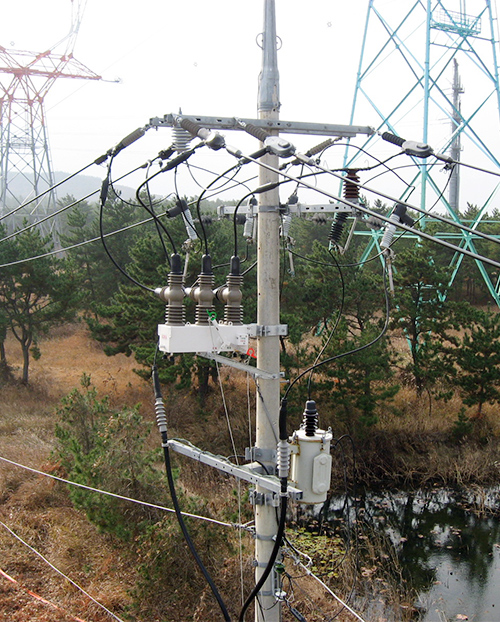
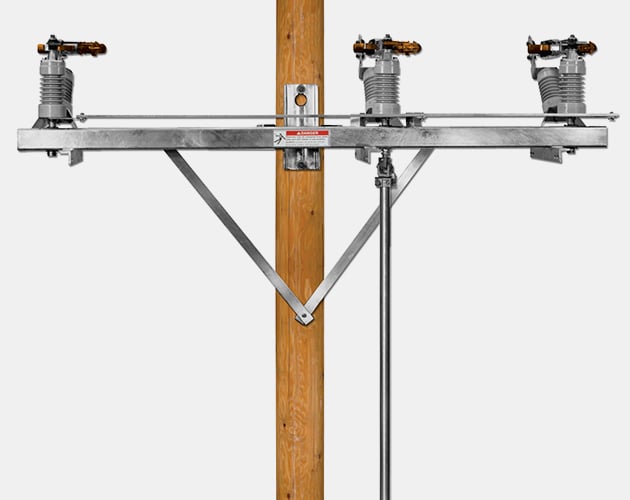
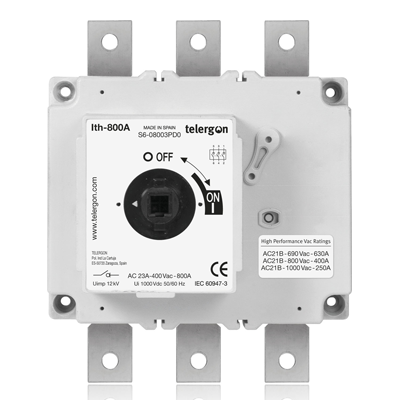
A load break switch is a mechanical switching device built to make, carry, and break the full rated current of a live electrical circuit under normal operating conditions, including specified overloads. It occupies the middle ground between a disconnector, which only isolates a dead circuit, and a circuit breaker, which also interrupts short-circuit faults. The load break switch breaks load current and isolates, but does not clear faults, which is why it is so often paired with fuses.
At low voltage the device is governed by IEC 60947-3 and is usually called a switch-disconnector; above 1 kV it falls under IEC 62271-103 and is central to ring main units in distribution networks. This guide decodes both worlds: utilization categories, interrupting media, the ratings that actually drive selection, and the manufacturer series engineers specify.
Photo: Chschlue, CC BY-SA 4.0, via Wikimedia Commons
This guide is written for industrial procurement and design engineers. Across 6 chapters it covers what a load break switch is, how it differs from disconnectors and circuit breakers, the low-voltage and medium-voltage device types, the arc-interrupting technologies, the spec-sheet parameters that decide selection, and a practical selection sequence, followed by 7 selection FAQs. All parameters reference the public standards IEC 60947-3 (low-voltage switches and disconnectors), IEC 62271-103 (high-voltage AC switches 1 to 52 kV), IEC 60947-1, IEC 60947-2, UL 98, and IEEE C37.71.
Chapter 1 / 06
What is a Load Break Switch
A load break switch is a mechanical switching device capable of making, carrying, and breaking currents under normal circuit conditions, which may include specified operating overload conditions, and of carrying for a specified time currents under abnormal conditions such as a short circuit. The defining capability is that it can interrupt load current safely: when an operator throws the handle on a live, fully loaded feeder, the switch parts its contacts and extinguishes the resulting arc without damage. This is the line that separates it from a pure disconnector.
The distinction matters because three families of devices look similar but do fundamentally different jobs. A disconnector, also called an isolator, exists only to create a safe, verifiable isolating gap for maintenance; under IEC 60947-3 it is permitted to make or break only negligible current, so the circuit must be switched off elsewhere before it is operated. A load break switch can switch the live load off by itself. A circuit breaker, governed by the separate standard IEC 60947-2, goes one step further and automatically interrupts short-circuit fault currents of many thousands of amps. The load break switch deliberately stops short of that last capability: it has no short-circuit breaking capacity.
The most common physical form is the switch-disconnector, a single device that combines both functions. It breaks load current like a switch, and when open it satisfies the isolation requirements of a disconnector: defined creepage and clearance distances across the open contacts, and a reliable positive contact indication so the position of the main contacts is mechanically linked to the handle. This dual qualification is why low-voltage main switches and motor isolators are almost always switch-disconnectors rather than plain switches.
Historically the function descends from the open knife switch, a hinged copper blade pulled into stationary jaws, still found in legacy panels and operated with an insulated hook stick. As fault levels and operator-safety expectations rose, the open blade gave way to enclosed quick-make quick-break mechanisms with spring-loaded snap action that drives the contacts apart fast enough to confine and extinguish the arc inside an arc chute, independent of how slowly the operator moves the handle. In medium-voltage networks, the device became the workhorse of the ring main unit, the compact sealed switchgear that feeds distribution transformers in tens of millions of street-side substations worldwide.
Four engineering facts frame every load break switch selection: the rated operational voltage and current it must switch, the utilization category that describes the load it switches (resistive, mixed, or motor), the short-circuit withstand it must survive while a fuse or breaker clears a fault, and the means of isolation it provides. Get these four right and the catalog number follows. Treat the switch as if it were a circuit breaker, and the result is a device that welds shut or fails violently the first time a real fault passes through it.
Chapter 2 / 06
Device Types and Classification
Load break switches are classified first by voltage class, which selects the governing standard, and then by construction and function. The first and most consequential split is low voltage versus medium voltage. Below 1,000 V AC the device sits under IEC 60947-3 and is built around air-break contacts. Above 1 kV and up to 52 kV it sits under IEC 62271-103 and requires a more capable arc-quenching medium because air alone cannot reliably interrupt the arc at those voltages. The table below maps the main device families across both worlds.
Type
Voltage Class
Governing Standard
Typical Use
Open knife switch
LV, <1 kV
IEC 60947-3 / legacy
Legacy panels, hook-stick operation
Switch-disconnector (rotary/cam)
LV, <1 kV
IEC 60947-3
Main switches, motor isolation
Fuse switch-disconnector
LV, <1 kV
IEC 60947-3 + fuse
Feeders with short-circuit protection
Enclosed safety switch (UL 98)
LV, ≤600 V
UL 98 / NEC
North American service and motor disconnect
MV switch / ring main unit
MV, 3 to 36 kV
IEC 62271-103
Distribution rings, transformer feed
MV fuse-switch combination
MV, 3 to 24 kV
IEC 62271-105
Transformer protection in RMUs
Open knife switches are the original form: a hinged conductive blade swung into a fixed jaw contact. Without an arc chute they tolerate only modest load breaking and are frequently restricted to no-load or light-load duty, often as single-pole units operated by an insulated hook stick at a safe distance. They survive in older installations but are rarely specified new, having been displaced by enclosed mechanisms that confine the arc and protect the operator.
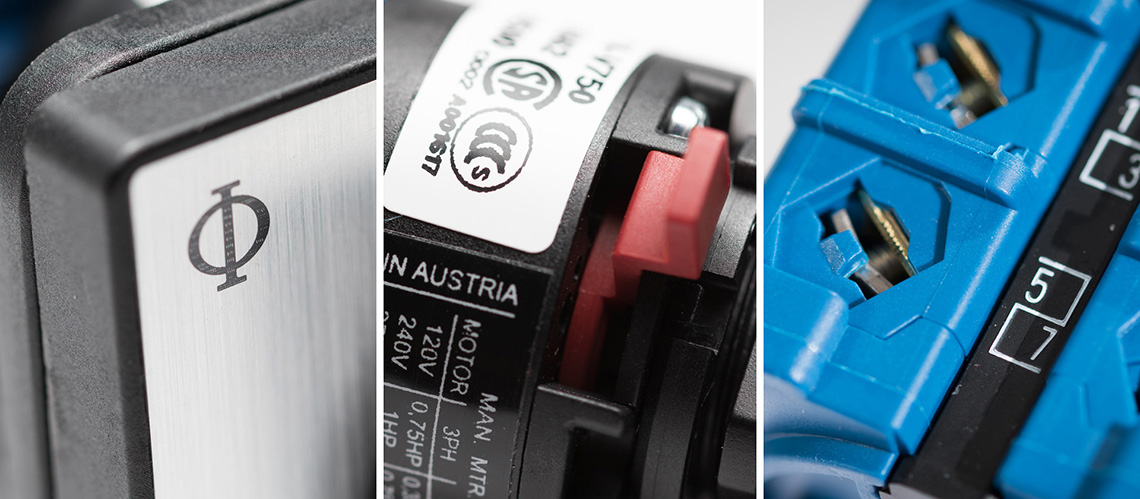
Rotary and cam switch-disconnectors are the dominant low-voltage form. A shaft carries cam-driven moving contacts that wipe across fixed contacts; a stored-energy spring snaps them apart with quick-make quick-break action so arc duration does not depend on operator speed. These are sold as bare bodies for panel building or as fully enclosed units, in three-, four-, six-, and eight-pole arrangements, with current ratings spanning roughly 16 A to 5,000 A across a manufacturer range. They serve as panel main switches, sub-distribution isolators, and local safety switches at motors.
Fuse switch-disconnectors, or fuse-combination units, integrate HRC fuse-links into the switch body so the same device breaks load current, isolates, and provides short-circuit protection. Opening the switch isolates the fuse carriers for safe replacement. They are the natural choice for feeders and motor circuits where a dedicated circuit breaker is unnecessary expense. In North America the directly comparable product is the UL 98 enclosed safety switch, fusible or non-fusible, rated to 600 V and up to 600 A or more, used as service-entrance, feeder, and motor disconnects under the National Electrical Code.
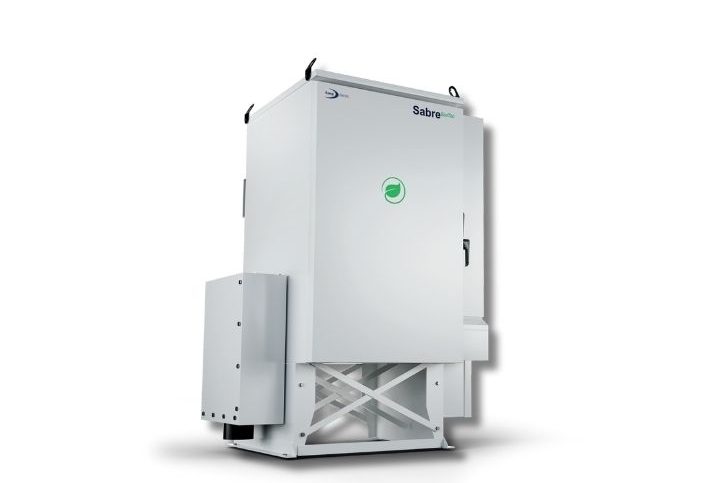
Medium-voltage switches and ring main units form the second world. Here the load break switch is sealed inside compact metal-enclosed switchgear, commonly at 12 kV, 24 kV, and 36 kV with continuous ratings of 630 A or 1,250 A, and it is the primary switching element that connects and disconnects the distribution ring. Combined with HRC fuses in a fuse-switch combination under IEC 62271-105, it protects the distribution transformer it feeds, breaking load and isolating while the fuses handle faults. The interrupting media that make MV switching possible are the subject of the next chapter.
Chapter 3 / 06
Arc-Interrupting Technologies
When contacts part under load, the current does not stop instantly: it sustains an arc, a column of conductive plasma that must be cooled and de-ionized before the current zero, the instant each AC half cycle passes through zero, so that it does not re-strike. How a switch achieves this defines its technology, its maintenance profile, and increasingly its environmental footprint. At low voltage, ambient air in an arc chute is sufficient. At medium voltage, a more aggressive medium is required. The table below compares the four mainstream approaches.
Medium
Voltage Class
Maintenance
Key Trade-off
Air (arc chute)
LV, <1 kV
Low
Limited to LV; contact erosion at high cycling
SF6 gas (puffer)
MV, 12 to 40.5 kV
Sealed, minimal
Excellent interruption; high-GWP greenhouse gas
Vacuum interrupter
MV, 7.2 to 40.5 kV
Very low, long life
Fast, clean; sealed bottle not field-serviceable
Sealed dry-air / hard-gas
MV, 12 to 24 kV
Sealed, minimal
SF6-free; larger volume per kV
Air interruption is the low-voltage standard. As the contacts separate, the arc is drawn upward by magnetic and thermal forces into an arc chute, a stack of metal splitter plates or an insulating channel that lengthens, cools, and divides the arc until it cannot sustain itself past the next current zero. Quick-make quick-break snap mechanisms ensure the arc is short-lived regardless of operator action. Air-break switch-disconnectors are simple, inexpensive, and maintenance-light, but the technology does not scale to medium voltage, and high operating-cycle counts gradually erode the contacts.
SF6 puffer interrupters dominated medium-voltage load break switches for decades. Sulphur hexafluoride is an excellent arc-quenching and insulating gas, allowing very compact sealed switchgear. In a puffer design, the relative motion of the moving contact compresses gas in a piston volume and blasts it through the arc to cool it at current zero. SF6 designs are sealed-for-life, low maintenance, and reliable. Their drawback is environmental: SF6 is among the most potent greenhouse gases known, with a global warming potential thousands of times that of carbon dioxide, which is driving regulatory phase-down and the search for alternatives.
Vacuum interrupters enclose the contacts in a sealed ceramic-metal bottle evacuated to a very high vacuum. With no gas to ionize, the arc is supported only by metal vapor from the contacts and self-extinguishes rapidly at the first current zero. Vacuum offers fast operation, very long electrical life, and no gas to monitor or leak, which makes it the preferred technology for many modern medium-voltage ring main units and reclosers. The sealed bottle cannot be field-serviced, and the technology historically suited switching duty better than the very high continuous currents of large breakers.
Sealed dry-air and hard-gas designs are the principal SF6-free response at medium voltage. Some pole units immerse the contacts in pressurized dry air or environmentally benign gas mixtures of oxygen, nitrogen, and carbon dioxide; others use solid materials that release a quenching gas under arc heat, a hard-gas or auto-expansion principle. These eliminate the high-GWP gas at the cost of somewhat larger enclosure volume per kilovolt, and they are now offered across mainstream ring main unit ranges as utilities respond to SF6 restrictions.
Chapter 4 / 06
Standards and Utilization Categories
A load break switch rating is meaningless without the utilization category that defines the load it was tested to switch. The category fixes the making current, breaking current, and power factor used in the type test, and choosing a switch by current rating alone, while ignoring the category, is the single most common specification error. The two standards that matter are IEC 60947-3 at low voltage and IEC 62271-103 at medium voltage.
Under IEC 60947-3, alternating-current switches and disconnectors are classified into four AC utilization categories, with parallel DC categories for direct-current systems. The number rises with the severity of the load. The table below gives the making and breaking duty each category is type-tested to, expressed as a multiple of the rated operational current Ie, with the test power factor.
Category
Make (× Ie)
Break (× Ie)
cos φ
Typical Load
AC-20
0
0
—
No-load make/break (isolation only)
AC-21
1.5
1.5
0.95
Resistive loads, modest overload
AC-22
3
3
0.65
Mixed resistive-inductive, distribution panel
AC-23
10
8
0.35 / 0.45
Motor loads, high inrush
AC-20 is no-load operation: the device connects and disconnects only when essentially no current flows, the pure disconnector duty. AC-21 covers resistive loads with modest overload, tested to make and break 1.5 times Ie at a high power factor near 0.95. AC-22 covers mixed resistive and inductive loads at a medium power factor of about 0.65, tested to make and break 3 times Ie, the realistic duty of a main distribution panel. AC-23 is the most demanding: a 100 A AC-23 switch must make 10 times rated current (1,000 A) at 0.35 power factor lagging to handle motor inrush, and break 8 times rated current (800 A) at 0.45 lagging. A switch fit for AC-21 is not automatically fit for AC-23.
Each category carries an A or B suffix denoting operating frequency. A means frequent operation, verified for a high number of operating cycles, while B means infrequent operation with fewer cycles. The required cycle counts fall as current rating rises: a small AC-class switch rated 100 A or below may be tested for on the order of 10,000 operating cycles, while larger frames above 100 A and up to 630 A are verified for fewer, on the order of a few thousand. For a frequently switched motor circuit, specify AC-23A, not AC-23B.
At medium voltage, IEC 62271-103 applies to AC switches from above 1 kV up to and including 52 kV. Instead of AC-2x categories it uses endurance and duty classes. Mechanical endurance is graded M1 (normal, on the order of 1,000 operations) or M2 (extended, on the order of 10,000). Electrical endurance of general-purpose switches is graded E1, E2, or E3 in rising order of the number of load-current and fault-make operations the device can perform without maintenance. Capacitive switching, for breaking cable-charging and line-charging currents, is graded C1 or C2 by restrike probability. A switch might be specified, for example, as class E3, M1. The standard also defines specific making and breaking duties: mainly active load current, distribution-line closed-loop transfer current, cable-charging current, line-charging current, and the short-circuit making current it can close onto.
Other standards complete the picture. IEC 60947-1 gives the common rules, including derating in extreme ambient conditions. IEC 60947-2 governs the circuit breakers that handle the faults a load break switch cannot. UL 98 covers enclosed and dead-front switches for North American industrial use, with the National Electrical Code dictating where disconnects are required, while in the United States IEEE C37.71 covers three-phase manually operated subsurface and vault load-interrupting switches and IEEE C37.20.3 covers medium-voltage metal-enclosed interrupter switchgear. Cross-region projects frequently require both an IEC and a UL/IEEE rating on the same device.
Chapter 5 / 06
Key Specification Parameters
Reading a load break switch datasheet means knowing which of the dozen or more listed figures actually constrain the application. Eight parameters drive nearly every selection decision: rated operational voltage, rated operational current, utilization category, rated short-time withstand current, rated short-circuit making capacity, rated insulation and impulse withstand voltage, endurance, and degree of protection. Each is explained below.
Rated operational voltage (Ue) is the voltage at which the make and break ratings are defined, for example 415 V or 690 V AC at low voltage, or 12 kV at medium voltage. A switch may carry several Ue figures, each paired with its own current rating, because breaking capability falls as voltage rises. Rated operational current (Ie) is the continuous current the switch carries and switches at a given Ue within a given utilization category; the same frame may be rated, say, 630 A in AC-22 but a lower current in the harsher AC-23 duty.
Rated short-time withstand current (Icw) is the RMS fault current the closed switch can carry, without contact welding or mechanical damage, for a specified short time, conventionally 1 second. It is the figure that lets the switch survive a downstream fault long enough for a fuse or breaker to clear it. A 630 A Schneider Interpact INS630 switch-disconnector, for instance, withstands 20 kA RMS for 1 second on its own at 690 V AC. Rated short-circuit making capacity (Icm) is the peak current, in kA peak, that the switch can safely close onto when a fault already exists; the same INS630 is rated 50 kA Icm at 690 V. Icm exceeds the peak of Icw because it includes the worst-case asymmetric first-half-cycle offset. Neither rating gives the switch any ability to break a fault.
Conditional short-circuit current applies to fuse-combination and breaker-backed arrangements: it is the prospective fault current the switch can endure when protected by a specified upstream device. The same Interpact frame that withstands 20 kA on its own is rated to a system 330 kA when backed by an appropriate upstream circuit breaker, because the breaker limits the energy reaching the switch.
Rated insulation voltage (Ui) and rated impulse withstand voltage (Uimp) fix the dielectric design: Ui sets the creepage and clearance basis (commonly 690 V or 1,000 V at low voltage), and Uimp, typically 6 kV or 8 kV at low voltage, is the peak transient the insulation survives, simulating lightning and switching surges. At medium voltage the equivalents are the rated power-frequency and lightning-impulse withstand voltages stated in the IEC 62271 series.
Endurance is stated as mechanical and electrical operating cycles, the no-load and on-load operations the switch performs before maintenance, tied directly to the A/B suffix at low voltage and the M and E classes at medium voltage. Degree of protection (IP) rates the enclosure against solid objects and water, from IP2X for finger-safe open bodies to IP65 or higher for outdoor and washdown enclosures.
Two further figures round out a rigorous specification:
Pole configuration: 3-pole, 4-pole (switching neutral), and at low voltage also 6- and 8-pole variants for multi-circuit or changeover duty.
Isolation and indication: certified isolating distance when open, with positive contact indication mechanically linking the handle to the true main-contact position, and provision for padlocking in the open position for safe lockout/tagout.
Chapter 6 / 06
Selection Decision Factors
Applying the previous five chapters to a catalog number follows a fixed sequence. Most selection mistakes come not from a single wrong value but from deciding a lower-level detail before settling a higher-level one, for instance choosing a current rating before confirming the utilization category. These eight steps double as an RFQ template.
Voltage class and system voltage: First decide low voltage (<1 kV, IEC 60947-3) or medium voltage (1 to 52 kV, IEC 62271-103). This selects the standard, the device family, and the interrupting medium. Confirm both the rated operational voltage and the system fault level at the point of installation.
Utilization category: Identify the load. Resistive feeder is AC-21, mixed distribution is AC-22, motor or highly inductive circuit is AC-23. For frequent switching pick the A suffix. At medium voltage select the E and M endurance classes and any C capacitive class for cable or line switching.
Rated operational current: Size Ie to the continuous load with headroom, then verify the chosen frame still holds that current in the specific category, since AC-23 ratings are lower than AC-22 on the same frame.
Short-circuit coordination: Confirm the switch Icw (1 s) exceeds the prospective fault current for the clearing time of the upstream protection, and that Icm covers any fault the switch could be closed onto. Where a fuse provides protection, verify the conditional short-circuit current of the combination.
Protection strategy: Decide whether short-circuit protection comes from a series circuit breaker or from integral fuses. If fuses, specify a fuse switch-disconnector and coordinate the fuse rating with the switch and the load.
Isolation, poles, and indication: Confirm switch-disconnector qualification if isolation is required, the pole count (3-pole, or 4-pole to switch the neutral), positive contact indication, and padlocking provision for lockout/tagout.
Environment and enclosure: Set the IP degree for the location (indoor panel, outdoor, washdown), the ambient temperature and any derating per IEC 60947-1, and operation method: direct handle, extended rotary, or motor operator for remote and automated switching.
Certification and total cost of ownership: Match the required standards (IEC, UL 98, IEEE C37.71, plus any regional approvals), and weigh purchase price against maintenance, especially the long-term cost and regulatory exposure of SF6 versus vacuum or SF6-free media at medium voltage.
One dimension engineers routinely underweight is serviceability and lifecycle support: spare-contact and fuse-carrier availability, field operability of the mechanism after years in service, retrofit compatibility within a switchgear range, and, at medium voltage, the long-term maintainability and end-of-life handling of the interrupting medium. ABB (OT, OETL, and SafeRing/SafePlus), Schneider Electric (Interpact, RM6, Ringmaster), Siemens (3KL/3KA and 8DJH), Socomec (Sirco and Sirco M), and Eaton (Bussmann UL 98 and Xiria) all maintain established product ranges, documentation, and regional support, which is what determines repair response a decade into a switch's service life.
FAQ
What is the difference between a load break switch and a disconnector?
A disconnector (isolator) is built to provide a verified, visible isolating gap for safety, and under IEC 60947-3 it only makes or breaks negligible current, meaning the circuit must already be dead or carry near-zero voltage across its poles. A load break switch is built to make, carry, and break the full rated load current of a live circuit under normal and specified overload conditions. The practical rule: a disconnector isolates a circuit you have already switched off elsewhere, while a load break switch can switch that circuit off itself. A switch-disconnector combines both functions: it breaks load current and, when open, satisfies the isolation requirements (creepage, clearance, positive contact indication) of a disconnector.
Can a load break switch interrupt a short circuit?
No. Under IEC 60947-3 a load break switch may have a rated short-circuit making capacity (Icm), meaning it can safely close onto an existing fault, but it has no short-circuit breaking capacity. It cannot clear the thousands of amps of a fault. That job belongs to a circuit breaker (IEC 60947-2) or to a series fuse. The switch is instead rated for a short-time withstand current (Icw), the fault current it can carry for a stated time, typically 1 second, while a downstream protective device clears the fault. This is why fuse-combination units (fuse switch-disconnectors) pair a load break switch with HRC fuses: the switch provides isolation and load switching, the fuses provide short-circuit protection.
What do utilization categories AC-22 and AC-23 mean?
They define the duty a load break switch is tested for under IEC 60947-3. AC-22 covers mixed resistive and inductive loads at a medium power factor of about 0.65, typical of a main distribution panel; the switch must make and break 3 times its rated current. AC-23 is the most severe, covering motor loads and highly inductive circuits with high inrush; the switch must make 10 times rated current at a power factor of 0.35 lagging and break 8 times rated current at 0.45 lagging. AC-21 covers resistive loads at 1.5 times rated current. The suffix A means the device is verified for frequent operation (more operating cycles), and B means infrequent operation. Always confirm the rating you need is AC-23A, not AC-21A, before applying a switch to a motor circuit.
What is the difference between Icw and Icm?
Icw, the rated short-time withstand current, is the RMS fault current the switch can carry while closed for a specified time, usually 1 second, without contact welding or mechanical failure. Icm, the rated short-circuit making capacity, is the peak current the switch can safely close onto when a fault already exists on the line, expressed in kA peak. Icm is always larger than the peak of Icw because it includes the asymmetric DC offset of the first half cycle; for a given prospective fault the IEC 60947 peak factor n that converts RMS to peak rises as power factor falls, reaching about 2.1 at a 0.2 power factor. A 630 A Schneider Interpact INS630 switch-disconnector, for example, withstands 20 kA RMS for 1 second alone at 690 V AC and is rated 50 kA Icm, with an upstream breaker raising the system conditional rating to 330 kA. Neither figure means the switch can break a fault.
When do I need a medium-voltage load break switch instead of a low-voltage one?
Voltage class decides the standard and the technology. Below 1,000 V AC you use a low-voltage switch-disconnector under IEC 60947-3, with air as the interrupting medium and ratings such as 415 V, 100 to 5,000 A. Above 1 kV and up to 52 kV you use a high-voltage switch under IEC 62271-103, common ratings being 12 kV, 24 kV, and 36 kV at 630 A or 1,250 A. At medium voltage, air alone cannot reliably quench the arc, so the switch uses SF6 gas, a vacuum interrupter, or sealed dry-air/hard-gas designs. Ring main units in urban distribution networks are the most common MV load break switch application, often combined with fuses for transformer protection.
What is a fuse switch-disconnector and when is it used?
A fuse switch-disconnector, also called a fuse-combination unit, integrates a load break switch with HRC (high rupturing capacity) fuse-links in one body. The switch provides load-current making and breaking plus visible isolation; the fuses provide short-circuit and high-overload protection that the switch alone cannot deliver. Opening the switch de-energizes and isolates the fuse carriers so they can be replaced safely. These units are standard for feeder and motor circuits where a separate circuit breaker would be overkill, and at medium voltage the fuse-switch combination protects distribution transformers in ring main units. Coordinate the fuse rating with the switch rated current and confirm the conditional short-circuit current of the combination, since the fuse limits let-through energy to within the switch withstand.
Which manufacturers and series are commonly specified for load break switches?
At low voltage, ABB OT and OETL switch-disconnectors (16 to 2,500 A), Schneider Electric Interpact INS and INV (visible-break) ranges (40 to 2,500 A), Socomec Sirco and Sirco M (100 to 5,000 A, AC-23 up to 1,000 V), Siemens 3KL/3KA fused switch-disconnectors, and Eaton Bussmann UL 98 enclosed disconnects are widely specified. At medium voltage, ABB (SafeRing/SafePlus and SF6-free puffer designs), Schneider RM6 and Ringmaster, Siemens 8DJH, and Eaton Xiria vacuum ring main units cover 12 to 24 kV distribution. Confirm the exact utilization category, Icw, and certification on the manufacturer datasheet for the specific catalog number, since ratings vary across the frame sizes within one series.
Load Break Switch Manufacturers
Source-backed product routes. Open a company dossier for procurement scope and cited evidence.