
Procurement teams buying circular saws in 2026 are sizing across four independent gates — blade diameter and bore, drive power tier, workpiece material, and whether the saw must integrate with a rip-cut or plunge track. Cordless 18V brushless rear-handle 7-1/4" saws (e.g. the Makita XSR01Z at AU $350.76) and corded 165 mm plunge-cut units (Makita SP6000J at AU $599.00, 1300 W) bracket the prosumer and trim-panel segment, per 2026 retail listings [S9].
Industrial CNC metal-saw frames sit in a separate bracket: a fully automatic high-speed metal circular saw was listed on Made-in-China at US $30,000-116,200 per set, 1-set MOQ, alongside a sliding-table woodworking unit at US $1,200-1,500 per set [S5]. DirectIndustry indexes 205 manufacturers and 909 products in its circular-saw category, with brand lists spanning Achilli, SCM, Scotchman, Wood-Mizer, YILMAZ and many regional fabricators [S1].
Blade Diameter, Bore and Tooth Count
Blade diameter and arbour bore define what a given saw head can physically hold. Prosumer handheld units cluster at 110 mm (4-3/8", Makita 4200N), 165 mm (6-1/2", SP6000J) and 184-185 mm (7-1/4", XSR01Z) [S9]. The diameter dictates maximum depth of cut and dictates which accessory ecosystem — rail, dust port, blade family — applies. Industrial catalogued blades such as the KAINDL REILING 13275 fit angle-grinder-to-saw conversions and are specced as carbide, 40 teeth, for chipboard, non-ferrous metal and plastic [S2]. Tooth count trades speed for finish: 24T framing blades prioritise chip evacuation in green lumber, 40T+ blades are the finish-and-trim baseline, and 60T+ fine-finish blades are specified for laminate and aluminium-skinned panels.
Drive Power Class: Corded, Cordless 18V, and Industrial 3-Phase
Three power tiers bracket the 2026 market. Tier 1 is cordless 18V brushless (rear-handle 7-1/4" platform), Tier 2 is corded 1100-1400 W (110-165 mm), Tier 3 is industrial 3-phase CNC cold saws and sliding panel saws. The Makita SP6000J at 1300 W on a 165 mm blade is the typical plunge-cut reference [S9]. On the industrial side, the made-in-China product feed lists automatic high-speed metal circular saws at US $30,000-116,200 per set with 1-set MOQ — these are floor-standing, coolant-fed cold saws intended for steel service centres, not handheld trim work [S5].
Selection by duty cycle is straightforward. For jobsite framing where power outlets are scarce, the 18V rear-handle brushless platform has effectively displaced corded 7-1/4" framing saws on union jobsites in many regions. For shop-fixed rip and crosscut on sheet goods, a corded 165 mm plunge-cut saw married to a 1.5 m extruded rail is the dominant pro pattern. For production metal cutting, only floor saws with automatic feed and flood coolant are acceptable; a handheld circular saw on steel is a wear-and-tear trap.
Cutting Material: Wood, Non-Ferrous, Ferrous, Composites

Match the blade family to the workpiece, not the other way round. Carbide-tipped blades with a triple-chip grind (TCG) and 40+ teeth are the baseline for chipboard, MDF, melamine and non-ferrous metals such as aluminium and copper alloys — the spec sheet for the KAINDL REILING 13275 lists exactly this cut-material set [S2]. Wood-Mizer, SCM and Achilli are the names most commonly appearing in the DirectIndustry circular-saw and bandsaw-adjacent categories for solid-wood and stone processing [S1]. Ferrous cutting at production scale belongs to cold-saw or bandsaw territory; retrofitting a wood blade onto mild steel is a rejected quote, not a workflow.
Stainless and high-alloy cutting further constrains the tool choice: bi-metal or carbide blades rated for ferrous work run at lower surface speeds and require flood coolant or wax-stick lubrication to meet tool life. Composite panels (aluminium-skinned composite, phenolic, solid surface) need a negative-hook or flat-ground TCG blade to control delamination and chipping. For a broader framework on the blade/power/material gates and how they interact, the Circular Saw Selection Criteria: Blade, Power and Material Gates piece walks the same decision tree in procurement form.
Guide Systems, Rails and Bevel Capacity
Cut accuracy on sheet goods lives or dies on the rail, not the saw. The 2026 retail options include: a 150 mm T-slide plastic base guide (Shinwa 73591, US $13.00 new) for axis-limited crosscuts on narrow stock [S3]; a 30 cm polycarbonate triangle guide ruler (Shinwa Sokutei) for angle-set guided cuts [S6]; and 24"-wide rip-cut track rail systems (Kreg KMA2685-style) for full sheet-good breakdown, listed at US $63.99 new with 31" rail length, no battery, silver/blue body [S7]. Most corded plunge saws ship with a rail-compatible shoe and a splinter strip; the rail is sold separately and is typically a 1.4 m or 1.5 m extruded aluminium section with anti-slip grip tape and a rubber dust seal.
Bevel capacity is a hidden differentiator. Most 7-1/4" rear-handle saws bevel to 56° with detents at 0, 22.5 and 45°. Plunge-cut track saws typically stop at 47° and rarely go past that — the rail interface geometry is the limiter. For 45°-and-steeper compound work, verify the saw is rated for rail-guided bevel cuts and that the dust port still seats at the chosen angle.
Industrial CNC Circular Saws vs Handheld: A Criteria Comparison
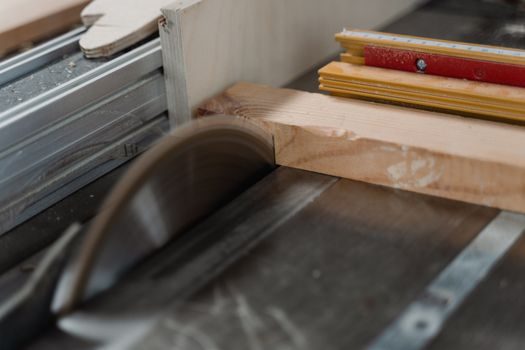
Four criteria separate the categories. (1) Blade size: handheld 110-185 mm, CNC cold saws 250-450 mm and up. (2) Drive: handheld 1100-1400 W universal motor, CNC 3-phase 3-15 kW with VFD or servo feed. (3) Duty cycle: handheld rated for intermittent cut-minutes, CNC rated for shift-long automated cycles with flood coolant. (4) Price band: prosumer Makita-class AU $109-599 [S9], industrial CNC US $30,000-116,200 per set [S5]. A handheld saw specced onto a steel-service-centre duty will burn through blades and motors; an industrial CNC specced onto trim carpentry is overkill and a 30x capex error. Match the four criteria to the actual job before comparing prices.
Sourcing Channels and Brand Concentration
DirectIndustry's manufacturer index lists 205 companies and 909 products in the circular-saw category, with concentrations in Italy (Achilli, SCM, ROTOX, zamacort), Germany (Schwamborn, ROTOX), China (Shanghai Ants Machine Equipment, Qingdao Yingzh via Made-in-China) and the US (Scotchman Industries) [S1][S5]. For handheld cordless and corded models, the dominant retail names remain Makita, DeWalt, Bosch, Festool and Milwaukee; eBay Australia 2026 listings show the Makita XSR01Z, 4200N and SP6000J all in active distribution with free or low-cost freight tiers [S9]. For prosumer buying guides, two updated-2026 references are worth a single read: onlinetoolreviews.com's "Circular Saw Buyer's Guide" page [S4] and protablesawreviews.com's "2026 Buyer's Guide" — both refresh annually and cover handheld tiers, not industrial CNC.
Limitations, Safety Notes and Failure Modes
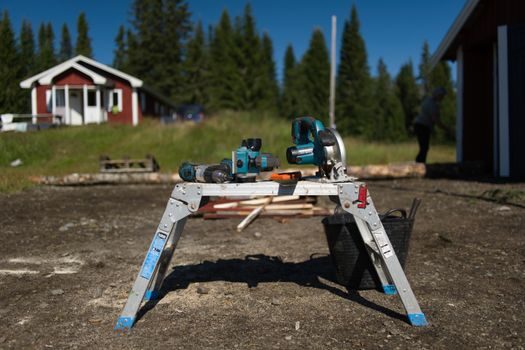
Handheld circular saws are responsible for a disproportionate share of jobsite laceration injuries. The two dominant failure modes are kickback on a pinched blade (overwhelmingly during freehand crosscutting without a rail) and contact with the lower guard during bevel cuts. Always specify a saw with a low-profile guard that retracts cleanly at bevel, a riving knife or splitter matched to the blade diameter, and a brake-equipped brushless motor where available. The "circular saw" noun itself covers hand-held electric saws with a circular blade per the common reference framing [S10], so do not treat the term as restricted to woodworking. PPE — safety glasses, hearing protection, dust mask (class FFP2 or better for MDF and treated timber) — is part of the tool spec, not an optional accessory.
For 2026 procurement, the next trackable signals are: (1) the spread of 18V rear-handle brushless saws into EMEA and APAC jobsite supply catalogues, currently anchored in AU retail at AU $350.76 for the bare-tool XSR01Z [S9]; and (2) the price trajectory of entry-level industrial CNC metal cold saws on Made-in-China, currently US $30,000-116,200 per set at 1-set MOQ [S5] — watch whether the floor of that band drops below US $25,000 as more domestic Chinese fabricators enter the segment.
For component-level specifications, see linear guide, and crossed roller guide.