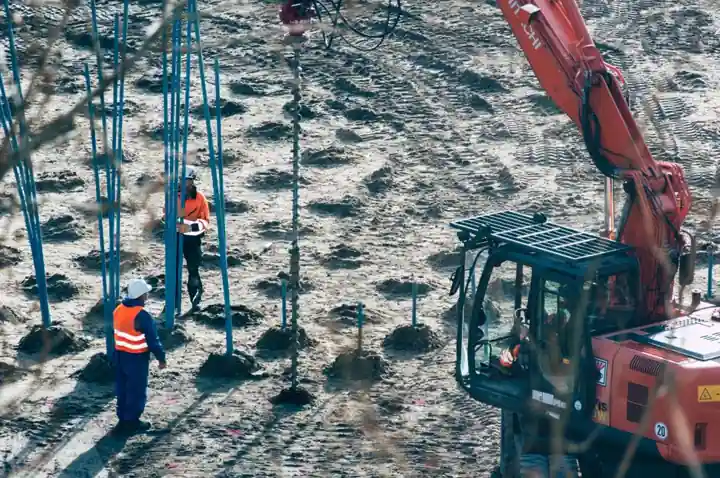
A cleaning bucket is a cylindrical steel tool hung from the Kelly bar of a rotary drilling rig, lowered to the borehole base, and rotated to mechanically agitate and collect the sediment that settles after the main drilling pass, leaving a clean substrate before tremie concrete placement [S1][S4].
Standard production diameters span 600-3000 mm, with shell weights scaling from 550 kg (⌀600) to 6150 kg (⌀3000) and fixed-bottom plate thickness held constant at 40 mm across the full range, while shell thickness steps up from 16 mm to 25 mm only above the 2000 mm diameter mark [S4].
Operating Principle and Why a Cleaning Pass Is Separate from Main Drilling
Main drilling augers and buckets evacuate the bulk of cuttings, but a residual sediment layer (commonly 50-300 mm, project-dependent) always settles back to the borehole base once rotation stops, and this layer must be removed to keep end-bearing capacity and shaft skin friction at design values [S1].
The cleaning bucket is a dedicated, second-pass tool: it is lowered to the base, rotated, and its bottom plate with cutting edges scrapes and scoops the loosened sediment into the shell, after which the bucket is hoisted clear and emptied at surface [S1][S4]. Compared with relying on the main auger or diaphragm wall grab duty cycles, a purpose-built cleaning bucket typically delivers a thinner residual sediment layer and shorter cycle time per pass, which is why it is standard kit on commercial bored-pile spreads worldwide [S1][S3].
Sizing Table: Diameter, Shell Height, Plate Thickness, Mass
Manufacturer-published dimensions for a representative cleaning-bucket range show a clear mass-vs-diameter scaling rule: shell height is held at 800 mm from 600 mm to 1200 mm diameter, drops to 600 mm from 1500 mm upward (because the larger buckets become mass- and clearance-limited on the rig), and shell thickness steps from 16 mm to 20 mm at 2000 mm diameter, then to 25 mm at 2500 mm diameter [S4].
The 40 mm fixed bottom plate is a deliberate design floor: cleaning buckets work the most abrasive interface on the whole rig (saturated sand, gravel, and slurry residue), and a thicker base plate than the side shell is the standard compromise between mass at the bucket's working face and total tool weight the Kelly bar can cycle [S4][S2].
Body Geometry, Bottom Type, and Cutting Edges
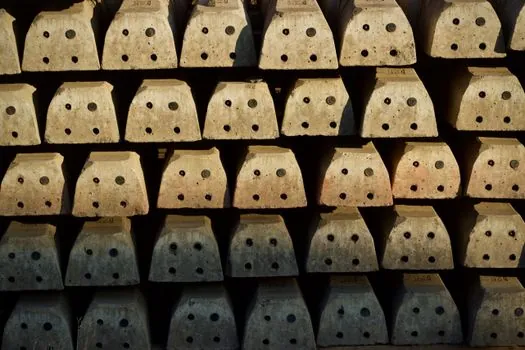
Cleaning buckets come in two main body geometries: conical (tapered) for sticky clays and cohesive soils where spoil release is the bottleneck, and straight-walled cylindrical for granular soils where filling speed and capacity dominate the cycle [S4].
Bottom options are fixed (rigid plate, simplest and heaviest, suited to soft-to-medium soil) or rotating (a free-spinning plate that re-orients under load, reducing stick-slip in dense or interbedded ground) [S4]. Cutting edges are offered in single-layer and double-layer weld configurations on the bottom plate, with double-layer edges typically giving 1.5-2x service life in abrasive sand and gravel but adding roughly 30-50 mm to the effective cutting height [S4]. Hard-facing strips are welded along the inside of the shell lip and around the cutting edge on most OEM builds, because this is the highest-wear zone in the cleaning cycle [S4].
Soil Matching: When the Standard Bucket Is Wrong
For soft-to-medium clays, silts, and loose sands (the most common cleaning-bucket duty), the standard flat-bottom straight-walled bucket with single-layer cutting edges is the economical default, and bucket mass per metre of diameter sits at roughly 0.7-1.0 kg/mm (e.g. 1500 kg at 1500 mm diameter) [S4].
For water-bearing sands, gravels, and bouldered ground, the rotating-bottom variant with double-layer edges is the field-proven choice, because the rotating plate prevents the bucket from "screw-driving" into dense layers and the thicker edge survives impact loading from cobbles [S4]. For fluid soil or caving conditions, the cleaning bucket alone is not enough: a tremie-pipe-supported fluid column and a heavier submersible pump-out rig are required, and the cleaning bucket's role shifts to final mechanical touch-up rather than primary spoil removal [S3].
Rig Compatibility, Drive Connection, and Customisation
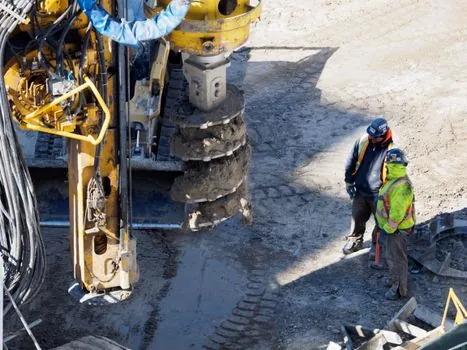
Cleaning buckets are connected to the host rig via a Kelly bar or direct-drive adapter and must be matched to the rig's torque class, hoist capacity, and clearance envelope; current OEM buckets are commonly cross-listed for Bauer, SANY, XCMG, Zoomlion, and Sunward carriers because the shaft and pin interfaces on these rigs follow a de facto industry standard, but high-flow hydraulic rotary drives and dedicated mini-rig mounts are separate families [S2][S5].
Cleaning-bucket diameters that match common rig classes are: 400-500 mm for mini-loaders and skid-steer auger drives, 600-1200 mm for 5-20 t excavator rotary rigs, and 1500-3000 mm for 20-50 t heavy piling rigs [S5]. Customisation is standard, with non-standard diameters, single- or double-layer cutting edges, manual or auto bottom-open mechanisms, and reinforced wear packages all quoted on request, and lead times for bespoke builds typically run 4-6 weeks versus 1-2 weeks for catalogue sizes [S2][S4].
Acceptance Criteria, Standards, and Field Verification
Acceptance is governed by the project's pile specification, not by a single international standard on the bucket itself, but the residual sediment thickness at the borehole base is the contractually measured value: typical limits are 50 mm for end-bearing piles, 100-150 mm for friction piles, and stricter on rock-socketed piles, verified by a weighted tape, a settlement plate, or a downhole camera before tremie concrete is placed [S1].
Key operational rules from manufacturer guidance: never rotate the cleaning bucket on the borehole wall (it welds cuttings back onto the cage), always run the cleaning pass in the same rotation direction as the main drilling, and lift the bucket slowly at the end of each pass to let slurry drain before hoisting clear [S1][S4]. Comparing this tool against the broader piling ecosystem, the cleaning bucket is the only dedicated base-finishing tool on a typical pile driver or shield machine job, and it is most often paired with a separate dynamic compactor or hammer for the cap or shaft work that follows.
Trackable signals going forward include growing adoption of auto bottom-open mechanisms, which are offered as an optional feature on cleaning buckets for bored piles alongside manual bottom opening [S4].