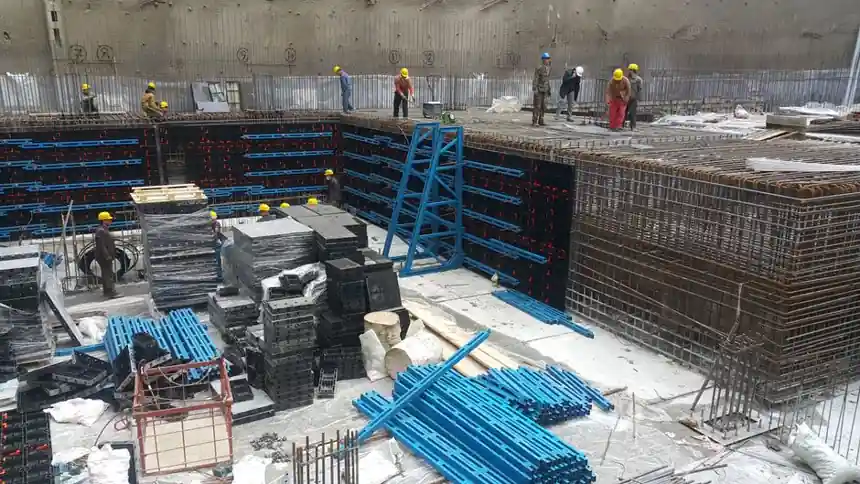
Climbing formwork platform loads range from 1.50 kN/m² for the MEVA KLK 230 wall-formwork platform to 400 kg/m² on a documented hydraulic climbing system top platform [S2][S4].
What Platform Load Capacity Means
Platform load capacity is the allowable distributed load assigned to a defined deck area, normally expressed in kN/m². The MEVA KLK 230 permits 1.50 kN/m² per level on the working platform of the wall formwork, and that value may be applied simultaneously with the other stated loads [S2].
A separate hydraulic climbing-formwork study records 400 kg/m² on the top platform for material storage, equivalent to approximately 3.92 kN/m² when multiplied by 9.81 m/s² [S4]. That figure describes a specific platform arrangement rather than a universal rating for every climbing formwork deck.
This distinction matters when reviewing climbing formwork specifications. A 150 kN bracket capacity is not interchangeable with a 1.50 kN/m² platform allowance because the former describes a concentrated structural load path and the latter describes load distributed over deck area.
Published Capacity Comparisons
Published climbing systems differ by three decision criteria: distributed platform load, concentrated bracket or lifting capacity, and the physical configuration to which each value applies [S1][S2][S3][S4].
The comparison shows why one number cannot be used for every decision. Deck loading is area-based, bracket loading is force-based, and hydraulic lifting capacity applies to the cylinder system rather than to personnel or stored materials on a deck [S1][S2][S3].
Where Each Load Value Applies
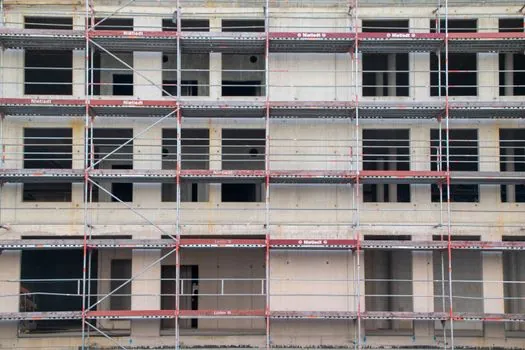
The 1.50 kN/m² value belongs to the KLK 230 working platform at each level [S2]. The 400 kg/m² value applies to the top platform in the super-high-rise hydraulic climbing arrangement studied by Li and coauthors, where the stated use was material storage [S4].
Hünnebeck SCF can take up and discharge forces up to a maximum vertical load of 150 kN per bracket. Its published influence width reaches 8.50 m per bracket, and the system permits formed surfaces up to 5.50 m high or 17 m wide [S1].
The Hünnebeck arrangement also uses platform widths of 3.20 m for the working platform, 2.30 m for the trailing platform, and 1.50 m for the pouring platform [S1]. For access-system decisions, these decks should be distinguished from a separate suspended platform, whose load rating is not established by the climbing-formwork figures.
System Suitability by Task
Hünnebeck SCF fits projects requiring substantial concentrated bracket capacity, with 150 kN per bracket and up to 8 brackets operated simultaneously by one hydraulic pump [S1]. PERI ACS Core 400 targets large high-rise cores with wall heights from 2.70 m to 4.85 m and uses a high-capacity single-stroke cylinder [S3].
The PERI system is designed for continuous single-stroke climbing, and the published cycle target is 20 minutes [S3]. It is therefore suited to repetitive high-rise core operations where a long-stroke hydraulic cylinder, large wall panels, and synchronised movement of internal and external formwork form part of the design basis [S3].
A KLK 230 platform with its 1.50 kN/m² allowance is more appropriate where the specified working-platform duty is modest and the project requires a particular wall-formwork arrangement [S2]. The hydraulic platform with 400 kg/m² material capacity addresses a different requirement, namely heavier material stacking at the top platform [S4].
Limits, Anchors, and Climbing Load Paths
Platform deck capacity does not verify the climbing structure. The Hünnebeck SCF system includes climbing cones, anchors, rails, brackets, and a hydraulic climbing device, while the published 150 kN bracket value applies to that complete structural configuration rather than to an isolated platform [S1].
The Doka 150F climbing formwork system publishes a lower bracket figure of 35 kN per climbing bracket and supports formwork heights up to 6.0 m, with concrete loads transferred through form ties [S6]. A construction technology report identifies climbing cones with a load capacity of 15 kN each in the SKE 50 Plus anchor arrangement [S5].
These figures should not be combined arithmetically without a load path. Bracket capacity, anchor or cone capacity, deck capacity, hydraulic-cylinder capacity, and concrete-pressure loading have different functions and must be checked against the approved system configuration [S1][S5][S6].
For crew planning, the related analysis of climbing formwork crew size and lift cycle timing addresses the operating side of the system, while platform loading still requires the manufacturer-specific working-load values.
Specification Rules for Procurement
A procurement schedule should identify the rated load, loading pattern, platform level, application, and system configuration rather than request a generic platform capacity. The published examples demonstrate three distinct bases: 1.50 kN/m² per KLK 230 level, 400 kg/m² for one hydraulic top platform, and 150 kN per Hünnebeck bracket [S1][S2][S4].
Material stockpiling, personnel access, formwork components, and concrete placing equipment should be separated when checking a deck. Wind conditions can therefore alter the structural basis even when the advertised bracket capacity remains unchanged.
The next traceable document to obtain is the approved loading plan for the selected system, with platform maps identifying live load, stored material, formwork weight, hydraulic forces, anchor forces, and wind assumptions. Vendor data provide the comparison baseline [S1][S2][S3][S4], but site-specific loads must remain traceable to the approved structural and lifting plans.