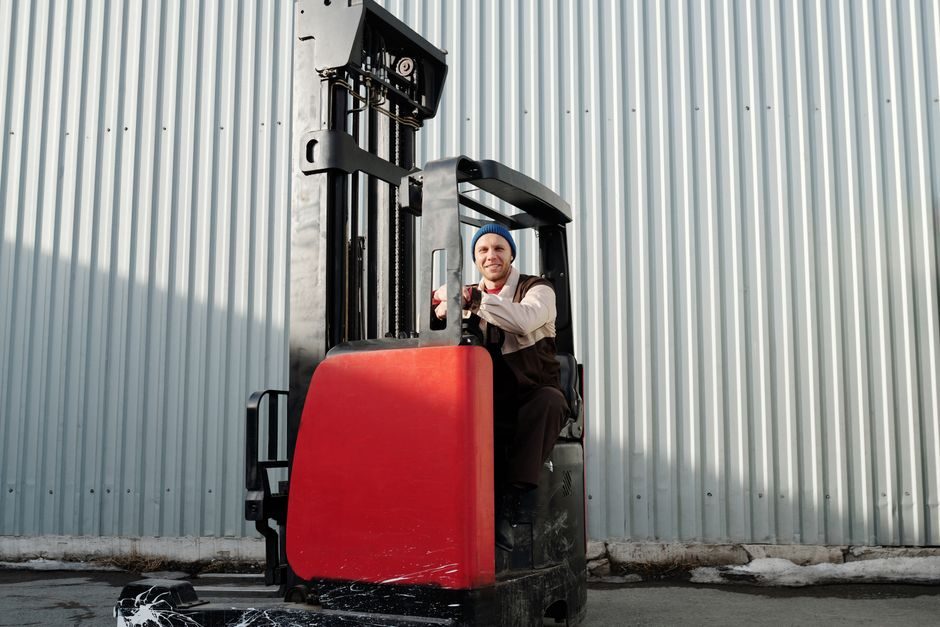
Rough terrain forklifts are typically offered in 1.5–3.5 t, 5.0–10.0 t and high-voltage electric 1.5–3.5 t capacity bands, with mast lift heights of 2,700–7,000 mm depending on series, per Hangcha Europe's published XF and XH series data dated 2026-06-02 [S5].
The class covers construction, lumber, agriculture, beekeeping, landscaping, quarry and dockyard duty, and the right unit is defined as much by chassis format and tyre package as by rated capacity [S4][S6][S7]. For a quick primer on the broader forklift family, see the forklift encyclopedia entry.
Capacity and Lift-Height Bands Across the 2026 Market
The Hangcha XF rough-terrain range is structured in three discrete capacity tiers: 1,500–1,800 kg, 2,500–3,500 kg and 5,000–10,000 kg, with the smallest tier limited to 3,000–6,000 mm of lift, the mid tier offering 2,700–6,500 mm, and the heavy tier reaching 3,000–7,000 mm — a structural choice that lets dealers quote a tier rather than a custom build [S5]. Hangcha's XH high-voltage rough terrain series covers 1,500–3,500 kg at 3,000–6,000 mm lift, providing an electric alternative in the same capacity window [S5]. JCB's rough terrain construction line spans 1.0–3.7 t, with 4WD masted and telehandler variants covering construction site and yard handling [S6].
Hummerbee's compact articulated platform positions the class down to sub-2 t payload, with a configurable platform marketed as the most flexible in the compact rough-terrain segment, and a dedicated beekeeping variant as a niche-format option [S7]. Sellick's S-series adds 15,000–16,200 lb (≈6,800–7,350 kg) capacity, tow forklifts, and truck-mounted variants — the last of which loads/unloads at the trailer rather than on the yard [S8].
Drive, Tyre and Ground-Clearance Levers
Rough terrain units differ from a standard warehouse forklift in three load-bearing mechanical decisions: 4WD vs 2WD, tyre diameter and tread pattern, and chassis ground clearance, all of which the Hangcha XF datasheet ties to specific capacity tiers rather than free options [S4][S5]. JCB's rough-terrain product line is built on 4WD masted and telehandler chassis for mud, gravel and unfinished sub-base [S6]. Auslift markets a 4WD rough-terrain scissor lift alongside boom lifts for hire, which sets a comparable 4WD standard in the access-equipment class operating on the same ground conditions [S3].
High-voltage lithium rough-terrain electrics — as offered in Hangcha's XH series — replace diesel powertrains in noise- and emission-sensitive yards while staying within the 1,500–3,500 kg capacity band [S5]. Sellick's tow-forklift format, with 4WD and an integrated tow coupling, is engineered for off-road towing and trailer recovery, decoupling load carrying from prime-mover function [S8]. For a parallel heavy-material-handling comparison, see this mining dump truck payload and drive-layout spec walkthrough.
Diesel vs High-Voltage Electric: Decision Criteria
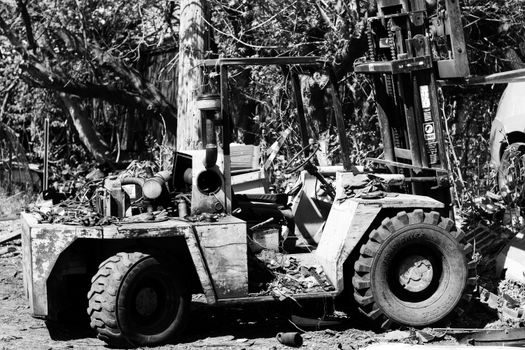
Diesel remains the default for outdoor, off-grid, and heavy-load applications, while high-voltage lithium electrics are now offered in 1.5–3.5 t rough-terrain form factors, per Hangcha's XH series datasheet of 2026-06-02 [S5]. Electric units in this class trade 2,000+ kg of upper-tier capacity for reduced noise, no on-site exhaust, and the ability to operate inside semi-enclosed yards where diesel particulate would otherwise need ventilation. Diesel still wins on fuel logistics, ambient temperature tolerance and maximum load: the XF 5.0–10.0 t band has no electric equivalent in the same manufacturer's range [S5].
Selection therefore reduces to three criteria: rated load above 3,500 kg forces diesel, indoor or covered-yard operation favours the XH electric platform, and shift profile (single vs double) decides whether battery swap or opportunity charging fits the duty cycle [S5]. JCB keeps a diesel-centric lineup for the rough-terrain construction segment, with no electric rough-terrain model listed on the 2026-06-15 product page [S6].
Specialised Formats: Telehandler, Compact Articulated, Tow and Truck-Mounted
Hangcha's XH series adds a high-voltage telehandler variant that combines rough-terrain chassis with telescopic boom reach, extending the use case from pallet handling to placing loads at height on uneven ground [S5]. JCB's rough-terrain range likewise spans masted and telehandler configurations, marketed into construction, masonry and agricultural applications [S6].
Hummerbee's compact articulated loaders target a different duty profile — construction, tree care, landscaping, dairy farming and beekeeping — at sub-2 t payload with a hinged chassis for tight-site manoeuvrability [S7]. Sellick extends the format further with three distinct specialised units: the S150 / S162 masted rough-terrain forklift, a tow-forklift for off-road recovery, and a truck-mounted forklift intended to ride on a trailer to the worksite [S8]. For a spec-bands comparison on similar compact heavy-equipment, see the dock leveler sizing and selection guide.
Sourcing Notes: Maker Brand, Tier and Lead Time
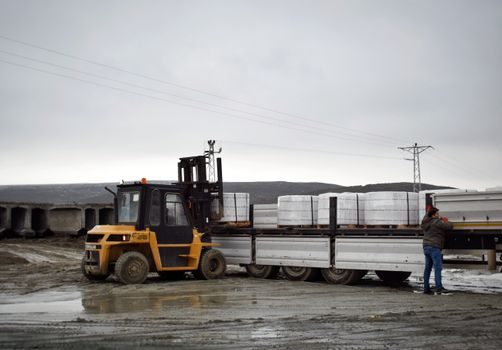
Hangcha America and Hangcha Europe maintain a dedicated rough-terrain product line and a US dealer network out of Rock Hill, SC (888-652-8395) and a Houston, TX office (281-962-4900) [S4]. The XF and XH series are listed as in-production units with public datasheets in metric capacities, allowing direct European-spec quoting [S5]. The MASTER brand rough-terrain forklift, listed on ECVV, is a representative export-supplier option with a 1-unit minimum order and 10,000-unit annual supply ability — useful for buyers trialling a single pilot unit before scaling [S2].
JCB's rough-terrain range is country-routed on its website, with a UK selection hub covering construction-sector units [S6]. Auslift in Australia is positioned as a hire-and-sale access equipment house rather than a manufacturer, which makes it a useful channel reference for buyers seeking 4WD rough-terrain scissor lifts and boom lifts as adjacent fleet [S3]. For research-stage autonomy work relevant to rough-terrain navigation, the Tejallll/AutonomousNavigation-RoughTerrain GitHub repository (2026-04-18) tracks the academic side of the problem [S1]. For an overview of the rough-terrain forklift class itself, see the rough terrain forklift encyclopedia page.
Selection starts from load in kg, lift height in mm, drive format (4WD diesel vs high-voltage electric) and ground-clearance need, then narrows to a chassis type — masted, telehandler, compact articulated, tow or truck-mounted — before vendor and lead-time are fixed.
For component-level specifications, see linear guide.