
Robot-loaded coordinate measuring machines have crossed from custom one-off cells into catalog products, with ZEISS Integration Series alone spanning manual ergonomic loaders, pallet changers, driverless transport systems, and 100% in-line cells that pass workpieces through the measuring volume on a moving conveyor [S1]. The same vendor offers an online ROI calculator returning cost-per-part and break-even point for a configured loading system [S1].
Independent ROI sources converge on a payback band: AMD Machines cites 2,500+ delivered automation cells and a published benchmark report on cost ranges and payback distributions [S2], while KC Robotics gives an "industry-proven average" of 24 months for robotic systems generally [S3]. The Association for Advancing Automation (A3) publishes a free Robot System Value Calculator comparing manual labor cost against a 20-year robotic system life [S5]. For a basic primer on the host machine class, see the CMM encyclopedia entry.
What CMM robot loading actually replaces
Loading and fixturing is the documented bottleneck in CMM throughput, not the measurement itself. Lemes, Strbac, and Cabaravdic (University of Zenica) show that for complex parts the measured object must be repositioned multiple times so the probe can reach features on different faces, and each reposition forces a redefinition of the local coordinate system [S4]. ZEISS counters this by offering five classes of loading solution: manual ergonomic loaders, semi-automatic loaders, fully automatic loaders, driverless transport systems (DTS) linking production to the metrology room, and inline cells where the part passes through the CMM measuring volume on a conveyor for 100% inspection [S1].
For shops weighing robotic tending on a construction-machinery-and-equipment line, the right comparator is not a generic "robot ROI" but the labor-plus-throughput model described below. ZEISS positions the maximum-utilization argument around eliminating setup dead time so the CMM itself runs more hours per shift, rather than around removing headcount per se [S1]. The first sentence of any honest business case should therefore state current machine-utilization percentage and current CMM-hours-per-shift, not headcount.
ROI model: the three contributions and how big each is
AMD Machines separates the savings into labor, quality (scrap/rework), and throughput, and explicitly warns that throughput is "harder to quantify, so they often get left out" yet frequently dominates [S2]. The labor side starts with fully burdened cost, not base wage: AMD applies a 1.45x burden multiplier, while stating that a 1.3x-1.6x band covers most US manufacturing environments [S2]. A worked example: a $20/hr two-shift operator has base annual wage $41,600, burdened cost $60,320, and two operators displaced equals $120,640/year, but AMD recommends assuming 1.5 FTEs displaced per cell because a monitor is still needed for changeover and first-piece inspection [S2].
Quality savings scale with current scrap rate minus the automated cell's residual rate. AMD notes automated lines "typically reach 0.5%" scrap, and the calculator lets the user enter both numbers [S2]. KC Robotics states robotic systems commonly perform at 90-99% efficiency, citing a Tier 1 automotive drivetrain case where FANUC ArcMate 100iC robots with Fronius TPSi 4000 welders and a laser seam tracker dropped rejected-part volume low enough that the nameplate OEM removed its resident inspection team within two months [S3]. Throughput gain is the hardest lever: it requires knowing current bottleneck (CMM or upstream machine), and AMD's tool deliberately omits throughput value to force conservative modeling [S2]. Mitsubishi Electric's machine-tending ROI guidance likewise treats unattended-hours as the dominant payback driver for low-mix CNC cells [S6].
Decision criteria: in-line, at-line, or off-line with robot load
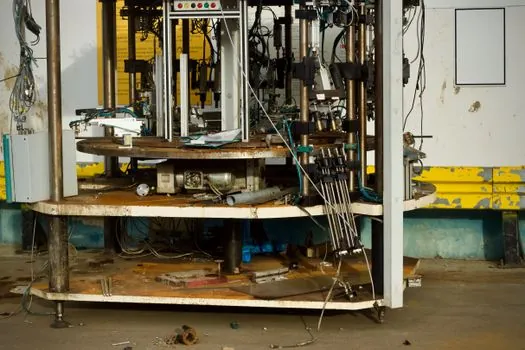
The choice between a fully inline CMM cell, an at-line sample-inspection cell, and a traditional offline CMM with a robot loader is driven by four criteria: required inspection coverage, part temperature sensitivity, mix variability, and floor footprint. ZEISS markets 100% in-line cells for the case where the part on the conveyor can pass directly through the measuring volume, eliminating workpiece handling and surfacing errors immediately [S1]. The vendor separately notes that even CMMs not designed for the production floor can be deployed at-line in a temperature-controlled enclosure for sample inspection, accepting reduced coverage for tighter thermal control [S1].
For a comparison grid a procurement engineer can defend, the four options rank as follows. (1) Inline 100% inspection: highest coverage, highest integration cost, lowest residual handling, requires thermally stable CMM and stable part temperature. (2) At-line sample inspection: medium coverage, medium cost, requires a buffer or sample-selection mechanism, protects metrology environment. (3) Off-line CMM with automatic loader: lower coverage, lower cost, maximum flexibility on part mix, preserves existing CMM spec. (4) Off-line CMM with manual ergonomic loader: lowest cost, retains human loading, suits low-volume or heavy-payload work. ZEISS delivers all four as catalog or adapted products from a single Integration Series, including a remote-controlled mobile honeycomb plate (CARFIT eMOBEE) for body-shop metrology logistics [S1].
Metrological cost: does the robot hurt measurement accuracy?
The Zenica study tested a 5-DOF Mitsubishi Electric Melfa RV-2AJ holding parts inside the workspace of a ZEISS Contura G2 CMM with a 700 x 1000 x 600 mm measuring range, and stated the goal as quantifying the "metrological cost" of substituting a stable clamp with a robotic gripper [S4]. Their three hypotheses were: physical feasibility of positioning the part with a first-generation robot, that integrated system uncertainty stays within the CMM manufacturer's specified limits, and that uncertainty scales with part mass [S4]. This body of work matters to any engineer worried that a robot fixture will degrade CMM accuracy below drawing tolerance.
The paper is the most cited reference for the dynamic-fixture concept, and the Lemes et al. result is that the CMM-robot pair can stay inside the host CMM's stated accuracy envelope for the tested payload band, with mass-dependent degradation beyond it [S4]. The implication for specification writing is that robot-loaded CMM cells must carry an uncertainty budget covering the worst-case part in the production mix, not the lightest or the median. A related electrical-automation consideration is the handshake between the robot controller and the CMM controller: a misalignment on measurement-trigger timing or coordinate-system origin propagates as systematic error, so the integration specification should name the trigger protocol and the coordinate-frame exchange format, not just "robot loading".
Where ROI falls apart: the common model mistakes

AMD's experience from 2,500+ deployments is that bad ROI models come from three specific errors: underestimating fully burdened labor, claiming 2.0 FTEs displaced when 1.5 is realistic, and omitting throughput value [S2]. The same source notes that a 1.5x overtime premium paid just to meet demand is itself a hidden automation saving if overtime disappears post-install [S2]. KC Robotics adds that the upfront number "can be overwhelming" and that buyers should not expect ROI before the second year of stable operation [S3].
A3's calculator frames the comparison over a 20-year robotic system life, so the operating-cost assumptions (power, spare parts, controller refresh) are exposed at the system level, not just at installation [S5]. For a quality-driven business case on a lamps-and-light-fittings supplier, the model should not be borrowed from a Tier 1 welder case study, because scrap rate, mix, and batch size drive both the labor and the throughput terms. AMD's interactive calculator exposes the two savings that apply to nearly every project (labor and quality) and explicitly leaves throughput off the default model so the user has to defend that number separately [S2].
Use cases that pay back fastest, and the ones that do not
CMM robot loading pays back fastest where three conditions stack: (a) the CMM is currently the bottleneck with utilization above ~70%, (b) parts are repeatable in geometry and weight so fixturing is stable, and (c) shift patterns include unsociable hours where manual loading is hard to staff. ZEISS cites Volkswagen Foundry Kassel at 30% time savings on the integrated quality assurance loop using tactile plus optical measurement and Integration Series loading [S1], and Schabmüller Automobiltechnik as a customized option for standing out on drivetrain-component inspection [S1]. The A3 calculator's 20-year horizon is most useful in exactly these cases, where the lifetime quality and labor benefit dwarfs the one-off integration cost [S5].
CMM robot loading pays back slowest where the part mix is high, batch sizes are small, and each new SKU needs a new fixture, because fixture cost and changeover time erode the labor saving. The Zenica 5-DOF work explicitly addresses this by treating the robot as a dynamic fixture, which can reduce the dedicated-fixture inventory per part number [S4]. A checking-and-testing-apparatus engineer specifying such a cell should still require the cell to quote cycle time, changeover time, and maximum supported part-mass range, with the uncertainty budget documented against the heaviest part. Watch for the next signal: published multi-vendor benchmark data for CMM-robot cells, similar to AMD's general-automation benchmark report [S2], and a converged cross-vendor standard for the robot-to-CMM coordinate-frame exchange.
Related analysis: Stud Welder Base Metal Minimum Thickness: Burn-Through Cutoffs by Process and Material.