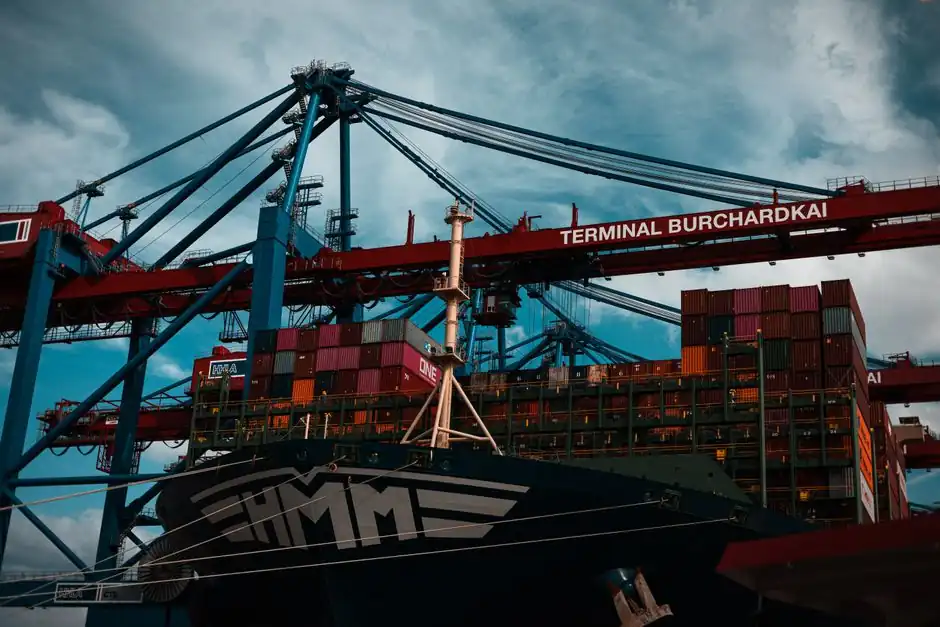
Port terminals and container freight stations (CFS) now treat the coding machine as part of the gate-to-vessel traceability chain, not as a back-office label printer, because every pallet, case, drum, and bulk bag leaving a yard carries a GS1 identifier that customs, the carrier, and the consignee re-scan downstream [S4].
A port-facing coding line typically handles 600-1,200 units per hour across heterogeneous substrates: corrugated shippers, LDPE shrink wrap, lacquered steel drums, HDPE jerricans, woven polypropylene sacks, and wooden crates, so the technology choice (CIJ, TIJ, laser, or TTO) is driven by the substrate matrix and the ISO/IEC 15415 barcode grade the broker demands, not by the OEM brand badge [S4][S6].
What "Coding" Means at a Port, and Why It Differs from Inland Warehousing
A coding machine prints variable data directly onto the product or its primary package using ink, a laser beam, or a heated ribbon, while a labeling machine sticks a pre-made adhesive label onto the surface; the two are not interchangeable, because labels peel off in salt-air humidity and on cold-chain reefer pallets, while an ink or laser mark stays on the substrate [S4].
At a port, the coder runs in two distinct positions: primary-pack (drum body, jerrican side, bag face) and secondary-pack (the corrugated shipper, the shrink-wrapped tray, the pallet sleeve), and a single yard often runs two machines in series, one of each, to satisfy both the GS1 Logistics Label (AI 00 SSCC) on the case and the regulated UN/IMDG identification on the inner pack [S4].
Port duty cycles are 16-24 hours per shift with seasonal peaks (pre-Chinese New Year, harvest export windows), so the spec sheet must show a mean time between failures (MTBF) figure, not a marketing "reliable" claim, and the maintenance interval on the printhead or ribbon must be stated in operating hours, not months [S1][S6].
The Four Coding Technologies Mapped to Port Substrates
Continuous inkjet (CIJ) ejects a continuous stream of electrically charged droplets deflected onto the substrate, and it is the default choice for curved or irregular surfaces such as 200 L steel drums, 25 L jerricans, and HDPE crates, because the printhead sits 5-15 mm off the surface and follows the contour without contact [S4].
Thermal inkjet (TIJ) uses a cartridge of 300-600 individually addressable jets fired by resistor heating; it delivers the highest native resolution (up to 600 dpi) at moderate speed and is favoured for date codes and 2D DataMatrix on cartons and pouches where print quality is graded under ISO/IEC 15415 at line speed [S4].
Laser marking (fibre, CO₂, or UV) ablates or foams the substrate surface with no consumable ink, which removes the solvent-handling issue that makes CIJ undesirable in ATEX-classified drum-filling halls; the trade-off is that the mark is a surface change, so contrast on bare aluminium or clear PET must be verified on a production sample, not assumed from a brochure [S4][S6].
Thermal transfer overprint (TTO) presses a heated ribbon against the substrate and is the only mainstream technology that delivers a fully opaque, scannable code on corrugated cases, kraft paper sacks, and shrink film at 100-400 mm/s, which is why it dominates port case-marking lines even though it has the highest per-mark consumable cost [S4].
For mixed port lines (a CFS that repacks food, chemicals, and general cargo on the same shift), the engineering trade is usually one CIJ head per drum/jerrican line plus one TTO head per case-packing line, with a TIJ on the export carton if the broker requires 2D DataMatrix at ISO/IEC 15415 grade C or higher [S4].
Selection Criteria: The Five Numbers That Drive the Decision
Substrate and contrast distance are the first gate. CIJ ink must wet the surface (works on non-porous plastics, metals, glass) while TTO ribbon must transfer onto a smooth, non-porous, heat-tolerant face (works on coated corrugated, BOPP-laminated film, gloss cardboard); laser needs a surface chemistry that foams or carbonises under the chosen wavelength, and UV laser is the workaround for clear film where fibre or CO₂ would pass through [S4][S6].
Line speed, stated in metres per second or units per minute on the conveyor, is the second gate, and the manufacturer datasheet must quote the speed at the chosen resolution and barcode grade, because CIJ can print 5 m/s of plain text but drop to 1 m/s once a 2D DataMatrix is added [S4].
Mark permanence and chemical resistance are the third gate at any port that handles lubricants, agrochemicals, or IMO-declared cargo, because the same case that gets a date code today may sit in salt-air storage for 6 months; the cure time of the ink (CIJ: 1-2 s to surface-dry, 24-72 h full cure), the rub resistance per a tape-pull test, and the isopropyl-alcohol or MEK wipe resistance must all be in the OEM data sheet, not just "industrial-grade" wording [S4][S6].
Connectivity and data integrity are the fourth gate, because the GS1 Logistics Label on a port case is now expected to carry SSCC (AI 00), GTIN (AI 01), batch (AI 10), serial (AI 21), and a Best-Before date in machine-readable form, so the coder must accept ERP/WMS data over Ethernet/IP, PROFINET, or OPC-UA and apply the correct GS1 Application Identifier prefix on every unit, with no manual re-keying at the line [S4][S7].
Environmental rating and ATEX/IECEx zoning are the fifth gate in any drum-filling or solvent store, and the coder cabinet, printhead, and ink reservoir must carry the Ex d / Ex e marking that matches the zone classification, with the ink's flash point declared on the SDS so the hazardous-area approval is not invalidated by an incompatible ink swap [S4].
Who Should and Should Not Specify Each Technology
CIJ is the right call for a port terminal or tank farm that marks 200 L drums, 25 L jerricans, and HDPE crates at 600-1,200 units/h on curved, non-porous surfaces, and it is the wrong call for a CFS that needs high-resolution 2D codes on every export carton, because the native resolution and contrast on corrugated will not clear the broker's barcode audit. [S2]
TTO is the right call for a CFS or palletising hall that marks corrugated shippers, shrink-wrapped trays, and BOPP-laminated film at 100-400 mm/s, and it is the wrong call for an open-yard drum line, because ribbon waste in outdoor humidity and wind becomes a contamination and slip hazard.
Laser is the right call for a paint-line or drum manufacturer that needs permanent, ink-free marks on metal or PET, and the wrong call for a CFS that runs mixed substrates on a single conveyor, because a wavelength change (fibre to CO₂ to UV) takes 15-30 minutes and forces a line stop every time the SKU mix changes.
Portable / handheld coders, including 60 mm large-character inkjet units, are the right call for spot-marking, re-work, or yard pallets that missed the inline coder, and the wrong call as the primary line coder, because handheld throughput tops out near 100-200 marks/h and the human operator becomes the variable that breaks GS1 conformance [S1][S2].
Real Use Cases on a Port Line

A 200 L steel-drum filling line for lubricant export typically runs one CIJ printhead per lane, 5-10 mm standoff, MEK-based or ketone-free ink to meet the local air permit, with a message stack covering UN/IMDG number, packing group, manufacturing date in YYYY-MM-DD, batch, and a 1D Code 128 carrying the same fields; the line speed here is 60-120 drums/h per lane, well inside CIJ's comfort zone [S4][S6].
A CFS case-packing line running export corrugated at 15-25 cases/min typically runs one TTO head per case conveyor with a 30-55 mm wide ribbon, printing a 2D DataMatrix that encodes SSCC + GTIN + batch + serial, and a human-readable line below; the TTO head is mounted on a traversing arm so the same head marks cases of differing width without retooling [S4][S7].
A reefer yard that pre-marks pallets before plug-in typically uses a handheld 60 mm large-character inkjet or a portable coding machine for the pallet sleeve SSCC and the cold-chain handling code, because the inline coder cannot reach the pallet face; battery life, drop resistance, and wireless WMS sync are the deciding specs, not print resolution [S1][S2].
For shippers who need faster, sharper codes on export cartons, thermal inkjet inkjet coding machine deployments at the master-carton station deliver 600 dpi GS1 DataMatrix that passes ISO/IEC 15415 grade C at 1.5-3 m/s, the threshold most 3PL brokers now audit against, and TIJ's cartridge swap is fast enough that the line does not stop on a colour or substrate change [S4].
Limitations, Failure Modes, and Sourcing Watch-Outs
CIJ failure mode #1 is the printhead nozzle clog from ink drying during a 4-minute line stop, so any port CIJ must have an auto-purge / auto-start routine that cycles the nozzle on a programmable interval, and the operator must log the purge count per shift to predict the next service [S1][S4].
TTO failure mode #1 is ribbon wrinkle or break on dusty corrugated, which destroys the barcode grade even though the human-readable line still looks fine, so the OEM must publish a dust tolerance spec and a recommended pre-dust-removal station (rotary brush, ioniser) for the line builder to quote against [S4][S6].
Laser failure mode #1 is contrast drift on clear or coloured substrates as the laser optics age, so a port laser install needs a 90-day re-verification against a known-grade test card, and a service contract that ties contrast to a measured reflectance value, not to "looks OK" [S4].
Sourcing watch-out: handheld and portable coder brochures rarely state the ink or cartridge shelf life in tropical humidity, the IP rating of the printhead against yard rain, or the wireless protocol (Wi-Fi 2.4 GHz vs 5 GHz, Bluetooth 5.x) used to pull WMS data, and these are the three specs that fail in the first 90 days of a port deployment, so the purchase order should quote each one [S1][S2].
Sourcing watch-out: regulatory pressure on unit-level serialisation is the structural change behind the 2026 coder refresh cycle, and the buyer's guide at [S7] flags that anti-counterfeit and DSCSA-style mandates are forcing sites to move from "batch printing" to "dynamic, unit-level serialisation" on every line, so any new port coder that cannot serialise per-unit on the fly will be obsolete before the second-year service interval [S7].
Standards, Specs, and the 2026 Refresh Cycle
Every port coder must satisfy four standards stacks in parallel: GS1 General Specifications and GS1 Application Identifiers (AI 00 SSCC, AI 01 GTIN, AI 10 batch, AI 21 serial, AI 17 expiry) for the data content; ISO/IEC 15415 (2D symbol grade) and ISO/IEC 15416 (1D symbol grade) for the print quality; OSHA GHS Hazard Communication plus US DSCSA and EU Falsified Medicines Directive for the regulated industries; and the UN/IMDG Code plus ATEX 2014/34/EU or IECEx for the hazardous-area zones around drum and solvent lines [S4].
The minimum print-quality gate most 3PL brokers now enforce is ISO/IEC 15415 grade C (≥ 60% contrast, ≥ 70% modulation) on every unit, verified with a calibrated verifier on a statistically valid sample, and any coder datasheet that does not list the achievable grade at the rated line speed should be treated as unverified [S4].
For a yard full of forklifts, dust, and salt spray, also confirm IP54 or higher on the printhead enclosure, the ink or ribbon storage temperature range (CIJ ink is typically 5-35 °C storage, TTO ribbon tolerates a wider range), and the Wi-Fi or Ethernet protocol for the yard network, because a coder that drops off the WMS at shift change is worse than no coder at all [S1][S2][S7].
The 2026 refresh cycle is not a like-for-like swap. The [S7] buyer's guide and the Senieer technical brief both flag that the transition is from "simple batch printing" to "dynamic, unit-level serialisation", so the purchase spec should require per-unit serial generation, GS1 AI 21 support, ERP/WMS handshake, and a documented upgrade path for 2D barcode grading on the line, not a price-quote on the previous-generation machine [S5][S7].
Trackable next signals to watch: the GS1 General Specifications update cycle for 2026 (any new AI for chain-of-custody on port cargo), the next revision of the UN/IMDG Code for marking of lithium-battery shipments, and the 2026-2027 EU Falsified Medicines Directive delegated acts for re-packaging at port pharmacies, each of which will reset the coder spec at any port that handles those cargo classes.
For component-level specifications, see logistics packaging.
See also our earlier report, Best Manometer for HVAC: 2026 Spec Map and Field Selection Guide.