Electronics handling lines in 2026 specify coding equipment by substrate and throughput, with CIJ printers winning curved enclosures, TTO dominating flexible film and label stock, and CO2/fiber laser coders standard on cable jacket and bare-metal runs [S3].
The MTBF envelope has widened: a modern CIJ runs 12,000-20,000 hours between major service, TTO 8,000-15,000 hours, and laser 25,000+ hours on the source with a 20,000-hour pump diode [S3]. Monthly solvent cost for a CIJ still runs 8-15 percent of capex, which is the single largest line item most electronics OEMs underestimate [S3].
Three Technology Tracks, Defined by Substrate and Speed
CIJ printers jet 50-100 micron droplets at 5-7 m/s and survive IP54-NEMA 4 cabinet washdown, which is why they still own bottling, canning, and curved-plastic enclosure lines in electronics finishing [S3]. Modern 2026 cabinets integrate a 7-inch HMI, USB/Ethernet message upload, and 1-6 line print heads delivering print heights of 1.4-12.7 mm, so a single head covers most PCB and casing date-code formats [S3]. The failure mode to engineer around is the MEK- or ethanol-based solvent train: operators must manage VOC capture per local air permits, and the cabinet has to sit on a vented drip tray [S3].
TTO is the default for flexible packaging, vacuum pouches, and label stock running 30-600 prints/min. A heated 25-55 mm wide ribbon presses against the substrate, then peels at 110-150 degrees, with print head lifetime rated 25-50 km of ribbon by the manufacturer [S3]. Ribbon chemistry is non-negotiable: wax for paper, wax-resin for coated film, full resin for BOPP and PE [S3]. A 2026 TTO chassis supports 300 m ribbon rolls, real-time encoder feedback, and 300 dpi at 600 mm/s [S3]. For component-bag and ESD-pouch coding on SMT lines, this is the workhorse class. Related spec work for adjacent handling cells sits in coding machine spec map for cold chain logistics, which covers condensation, low-temp ink, and washdown overlap that applies to any humid electronics cleanroom.
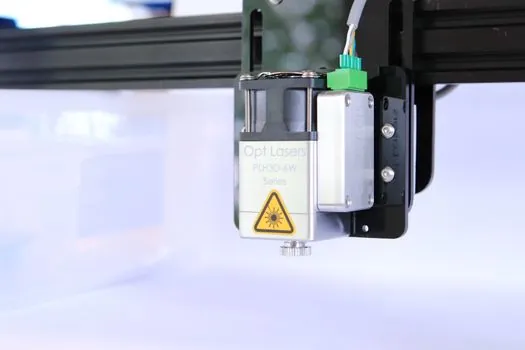
Laser coders, both CO2 at 10.6 micron for film, paper, and glass, and fiber at 1.06 micron for metal and cable jacket, have zero consumable cost per mark and IP65-rated optical heads, but capex runs 2-4x a comparable CIJ [S3]. Operators inherit fume extraction and a Class 4 laser safety perimeter per IEC 60825-1, which is a real capex line for any greenfield electronics plant [S3].
Spec Gate: Five Numbers to Lock Before RFQ
Lock the substrate and print area first. Curved surface above 50 mm diameter points to CIJ; flat film, label, or foil points to TTO; bare metal or cable jacket points to fiber laser [S3]. For an electronics OEM that means CIJ on ABS enclosures, TTO on reel packaging, and fiber laser on connector shells and cable.
Line speed and dwell drive the second call. TTO at 600 mm/s is realistic for 30-200 cycles per minute, CIJ holds 5-7 m/s with no speed cap on most lines, and fiber laser maintains mark quality above 200 m/min on cable jacket [S3]. Third, resolution and contrast: 200 dpi is the CIJ floor, 300 dpi is the TTO default, 600 dpi is a laser option, and pharma-grade 2D DataMatrix grading per ISO/IEC 15415 still requires Grade C or better at line speed, confirmed with a graded verifier rather than a spec sheet [S3].
Fourth, IP and cabinet rating. IP54 is the minimum for washdown, IP65 for hose-down zones, and 304 or 316 stainless is the cabinet baseline for food and pharma adjacent electronics lines [S3]. A typical 2026 TTO chassis is built around a 304 SS frame with a sealed ink path rated IP54 [S3]. Fifth, message change latency. CIJ reaches first readable mark within 1-2 m of start, TTO needs a 50-100 mm ribbon-to-substrate dwell and a calibrated peel angle, and laser marks are instantaneous once past a 1-3 second cold-start warm-up [S3].
CIJ vs TTO vs Laser: Four-Criterion Comparison for Electronics Handling
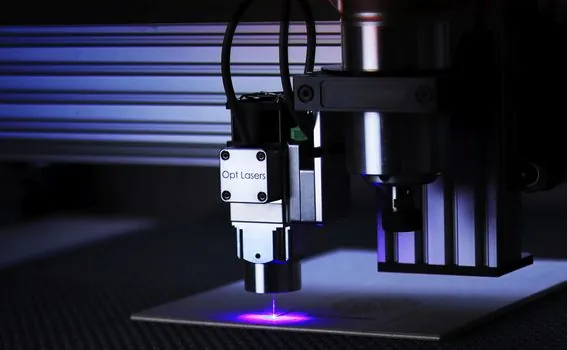
Print-technology choice is decided against substrate, mark permanence, line speed, and total operating cost, not a single headline number [S5]. For an electronics handling line, the four-criterion matrix reads as follows. On substrate fit, CIJ accepts plastic, glass, and metal at 1-10 mm standoff, TTO needs a flat or slightly crowned surface, and laser covers film, paper, glass, metal, and cable jacket without contact [S5]. On mark permanence, laser ablation and annealing survive abrasion, chemical wash, and sterilization, CIJ ink permanence depends on solvent and substrate chemistry, and TTO is mid-range and prone to ribbon-wear smearing if peel angle drifts [S5]. On line speed, CIJ is the only option that runs unbounded above 7 m/s, TTO tops out around 600 mm/s and 600 cycles/min, and laser is gated by mark area and source power, with 200-2,000 characters/s depending on configuration [S5].
On total operating cost, contact coders are lowest in capital but consume ink ribbon or pad, CIJ consumes solvent-based ink at 1-3 mL per 1,000 characters depending on substrate and dpi, and laser eliminates consumable ink but adds electricity and fume-extraction load [S5]. The pattern that has held since 2024 is that contact coders win on capital cost, TTO wins on consumable cost per mark for flexible packaging, and laser wins on total cost of ownership over a 7-10 year horizon once solvent and downtime are priced in [S5].
Integration and Connectivity for Smart Factory Lines
Modern coding machines connect directly to MES, ERP, and quality management software, automating data flow and eliminating the transcription errors that plague manual entry [S6]. Critical integration capabilities are real-time data exchange via Ethernet, OPC-UA, or industrial protocols, plus automatic job recall that loads the correct codes based on SKU or production order [S6]. A 2026 CIJ or TTO without OPC-UA is a 2022-spec machine in a 2026 MES environment, and most electronics OEMs now write OPC-UA into the coding station RFQ as a hard requirement [S6].
Selection rule on integration mode is simple. Offline coding machines are standalone stations where an operator loads a part, prints, and unloads, suiting low-to-mid volume, large or awkward parts, and frequent changeover. Inline units mount on a conveyor and are triggered by a photo-eye, encoder, or PLC handshake as the package passes, suiting fixed-format, high-speed lines where the print station must keep cadence with downstream filling machines and coding machines of the adjacent cell [S5]. Throughput on the offline side is operator-bounded; on the inline side, the bottleneck is the printhead's max line speed and the dry-time of the ink, not the operator [S5].
Ink and Ribbon Chemistry by Substrate
One of the benefits of modern coding machines is that they can use a variety of different inks. On a dark background such as black plastic, high-contrast pigmented ink is required; on glass bottles, high-adhesion inks are preferred because the surface is shiny and often carries a layer of moisture through which the ink must adhere; bottlers may also need washable inks for returnable containers [S8]. The same logic maps to electronics: pigmented black-on-black is common on ABS enclosures, and high-adhesion ink is mandatory on any silicone-coated or plasma-treated surface.
TTO ribbon selection is the parallel decision. Wax ribbon suits paper labels, wax-resin suits coated film, and full resin is mandatory for BOPP and PE, with print head life rated at 25-50 km of ribbon by the manufacturer [S3]. A "no plate making required" TTO with intelligent job recall is the 2026 default for ingredient lists and similar variable-data marks on flexible film [S7].
Who This Map Is For, and Who It Is Not For
This map fits electronics OEMs specifying date codes, lot codes, and 2D DataMatrix on ABS enclosures, reel-packaged components, ESD pouches, cable jackets, and connector shells, with throughputs from 30 cycles/min on a manual packing bench to 600 cycles/min on a fully automated SMT finishing line. It also fits contract manufacturers running mixed-substrate SKUs on a single conveyor and asking which print technology to standardize on. The class of operator that should look elsewhere is anyone specifying coding for variable-information labels in a regulatory pharmaceutical environment, where validation per 21 CFR Part 11 and GAMP 5 dominates the spec, and the print technology is secondary. [S3]
Trackable Signals for the Next Two Quarters

Two signals are worth watching on the 2026-08-27 cutoff. First, MTBF claims from CIJ vendors are creeping toward 25,000 hours as sealed print heads replace modular nozzle designs, and a vendor-side field report at that level will reset the cost-per-mark math above. Second, OPC-UA companion specifications for coding stations are moving from draft to released status through 2026, and any new MES tender in electronics handling will treat that release date as the go/no-go gate for new coding stations. Watch for both before re-quoting. [S3]
Spec-level background on the components involved: material handling.