
Five OEMs, Carrier Corporation, Daikin Industries, Danfoss A/S, Bitzer SE, and Baltimore Aircoil Company (BAC), anchor the global cold storage equipment revenue share in 2025, per the Transparency Market Research top-vendor listing [S5]. The same source pegs the 2025 cold storage equipment market at USD 57.2 Billion, with North America commanding 34.2% of that revenue and Walk-in Coolers/Freezers holding 36.6% by type [S5].
Adjacent cold chain equipment scope reads lower: Grand View Research puts the broader market at USD 24.1B in 2025, expanding to USD 29.3B in 2026 and USD 97.4B by 2033 at an 18.7% CAGR [S3], while Fortune Business Insights reports USD 40.34B in 2025 stepping to USD 46.52B in 2026 toward USD 152.06B by the early 2030s [S1]. The dispersion between the three houses reflects definitional scope, not contradiction, and procurement teams should pin down equipment-type coverage before comparing numbers.
Top 5 Manufacturers and Where They Sit in the Stack
Carrier Global Corporation and Daikin Industries Ltd. are the two integrated system OEMs with the broadest refrigeration platform exposure, both integrating next-generation refrigerants, inverter-driven compressors, and smart monitoring inside modular cold storage [S5]. Emerson Electric Co. sits in the component pool via refrigeration controls and compressors, a layer below the system integrators but critical to spec-in decisions on control valves and electronic expansion valves [S5]. Danfoss A/S and Bitzer SE cover compressors and frequency drives, while Baltimore Aircoil Company (BAC) leads on evaporative cooling and heat-rejection equipment used at the refrigeration plant boundary [S5].
For procurement, the practical split is three-tier: system OEMs (Carrier, Daikin), component OEMs (Danfoss, Bitzer, Emerson), and heat-rejection specialists (BAC). Specifying on this basis, rather than on the broader "cold chain equipment" label, is the cleanest way to keep RFQs apples-to-apples across vendors. For a working procurement playbook on this category, see the cold chain equipment procurement spec-first buying rules and 2026 sourcing map.
Market Sizing Across Three Research Houses
Grand View Research values the cold chain equipment market at USD 24.1B in 2025, USD 29.3B in 2026, and USD 97.4B by 2033 at an 18.7% CAGR [S3]. Zion Market Research puts the same market at USD 19.26B in 2024 expanding to USD 104.44B by 2034 at an 18.4% CAGR [S2]. Fortune Business Insights reports USD 40.34B in 2025 and USD 46.52B in 2026, projecting USD 152.06B over the long horizon [S1].
Transparency Market Research, restricting scope to cold storage equipment (a sub-segment), gives USD 57.2B in 2025 climbing to USD 116.3B by 2036 at a 6.7% CAGR [S5]. The vaccine storage subset sits at USD 0.86B in 2024, growing to USD 1.21B by 2029 at a 7.2% CAGR [S7]. Numbers diverge because each house includes different product baskets (refrigeration compressors, insulated containers, monitoring IoT, vaccine cold boxes, transport refrigeration), and buyers should match scope before quoting vendor share.
Regional Share and Application Mix
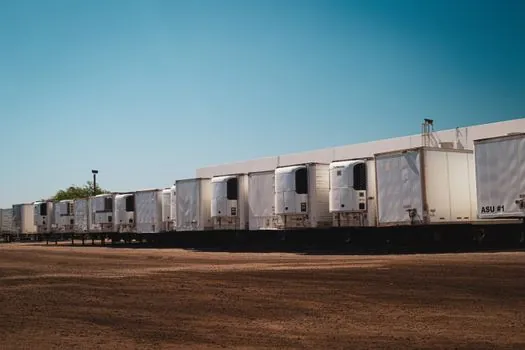
North America is the largest region for cold chain equipment, holding approximately 40% of the global market share, with the United States leading and Canada following [S6]. Transparency's cold storage subset confirms North America at 34.2% revenue share in 2025 [S5], a tighter reading because the segment scope excludes transport and monitoring.
By application, the meat segment is growing fastest and is forecast to dominate the cold chain equipment market [S2]. By equipment type, Storage Equipment leads globally and Walk-in Coolers/Freezers led the cold storage sub-segment with 36.6% share in 2025 [S2][S5]. Refrigerated Containers, Modular Cold Storage, Blast Freezer and Chiller, and Chilling Tunnels round out the type split defined in the Transparency taxonomy [S5]. Insulation spec and ceiling assembly matter at the warehouse scale; see the suspended ceiling selection for cold storage warehouses spec gates and span logic guide for envelope detailing.
Comparison: Top OEMs Across Four Buyer Decision Criteria
Side-by-side, the five named OEMs behave differently across four criteria a process engineer cares about: refrigerant platform, controls depth, install footprint, and compliance posture. Carrier and Daikin both push low-GWP refrigerants and inverter compressors inside modular cold storage; Daikin's strength is integrated chiller and condensing unit breadth, while Carrier leans on global service density and the Carrier Refrigeration controls stack [S5]. Danfoss and Bitzer are component-driven, with Danfoss dominant in electronic expansion valves, solenoid valves, and frequency drives, and Bitzer focused on semi-hermetic and screw compressors for medium-to-large tonnage plants. BAC covers the heat-rejection boundary, with adiabatic and hybrid fluid coolers specified for ammonia and CO2 plant rooms.
For European projects, F-gas regulation pressure makes low-GWP platforms a hard gate; for North American projects, the gate is more about code compliance (ASHRAE 15, UL 471) and the availability of factory-trained service. Emerson's component footprint crosses all five, since its control valves and sensors are used inside OEM panels regardless of system vendor [S5]. Procurement teams that score vendors on these four axes, rather than on list price alone, typically converge on two or three qualified bidders instead of five.
Standards, Refrigerants, and Compliance Gates Buyers Should Track

Cold chain equipment in the vaccine and biopharma lane must satisfy World Health Organization PQS performance protocols for freezers, cold rooms, vaccine carriers, cold boxes, and refrigerators used in immunization supply chains [S2]. For refrigeration machinery specifically, the working standards stack includes ASHRAE 15 (safety for refrigerant systems), UL 471 (commercial refrigerators and freezers), and the F-gas regulation cluster (EU 517/2014 plus its Kigali Amendment phase-down) for low-GWP platform selection [S5].
Energy efficiency gates now travel with the equipment: inverter-driven compressors and EC fan motors on condensers and unit coolers are baseline in new European builds, and IoT-linked monitoring with cloud analytics is moving from option to spec on multi-site retail cold storage [S5]. Emerson, Danfoss, and Bitzer each publish component-level control and compressor curves that should be requested at RFQ stage; OEM system vendors typically bundle these but rarely expose them in detail.
Failure Modes and Constraints Buyers Underestimate
Three failure patterns show up across the carrier, walk-in cooler, and modular cold storage lanes: refrigerant leaks at brazed joints after vibration cycling, control valve hunting when electronic expansion valves are undersized for the load range, and heat-rejection shortfall when ambient design temperature is set too low. Walk-in cooler and freezer walls fail at the floor-to-wall coving first, then at ceiling panel-to-panel joints; the fix is welded or foamed-in-place coving and a continuous vapor barrier, not mechanical fasteners. Modular cold storage suffers when the structural floor is not flat to spec, which racks panel joints and breaks the gasket seal. [S5]
On the controls side, mixing 4-20 mA analog sensors with digital bus architectures (such as Foundation Fieldbus or PROFIBUS PA) without proper gateways causes data loss; HART remains the FSK overlay on analog loops and is not a drop-in for native digital fieldbus. Specifying both sensor output type and bus protocol at RFQ, rather than after award, avoids a common retrofit cost.
Signals to Track Over the Next Two Quarters
Watch three signals: F-gas quota phase-down pricing in 2026, which is pushing mid-tier buyers to CO2 (R-744) and ammonia (R-717) platforms; Carrier and Daikin product releases on low-GWP modular cold storage, which set the de facto benchmark for incoming RFQs; and vaccine storage equipment growth, forecast at a 7.2% CAGR from USD 0.86B in 2024 to USD 1.21B by 2029 [S7], a small but rigorous segment that pulls the broader market toward tighter WHO PQS-style compliance.
Adjacent demand drivers worth tracking include ferrosilicon supply for steel and solar (cold storage plant steel content is non-trivial) per the ferrosilicon demand outlook 2026-2030, and silicone rubber demand for gaskets and door seals per the silicone rubber demand 2026-2030 note, since both feed the cold storage enclosure bill of materials.
Detailed specification references: cold chamber machine, cold milling machine, and cold box core machine.