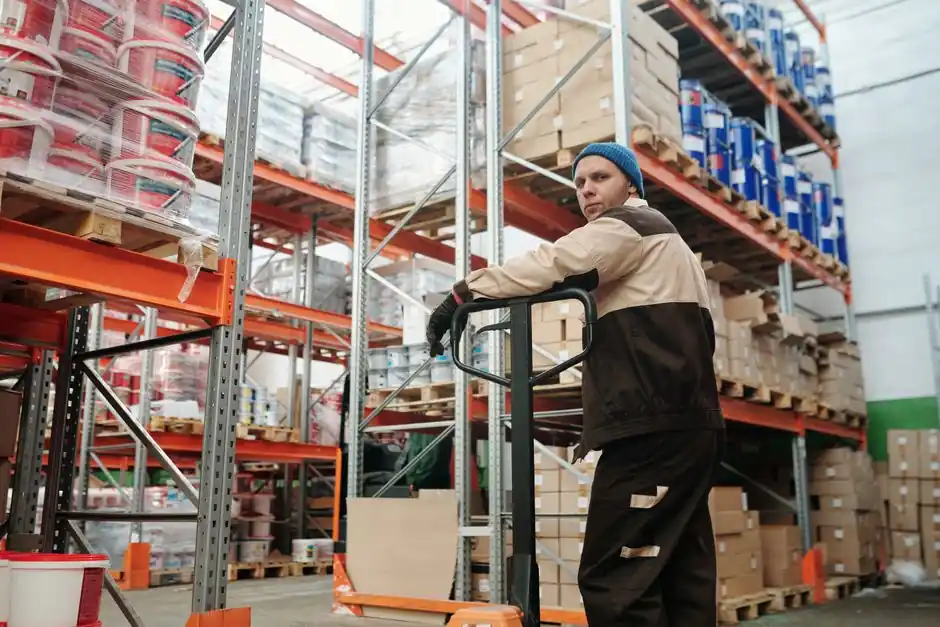
Reach trucks specified for cold storage are electric and emission-free, making them the default narrow-aisle pick for pharmaceutical and frozen-goods warehouses where temperature control and air cleanliness are non-negotiable [S1].
In practice, a 1.6 to 2.0 ton rated reach truck is the industry default for cold-chain pallet racking, while a counterbalance forklift is reserved for loading-dock and yard work outside the freezer envelope [S2]. Compared with a standard counterbalance forklift, the reach truck trades 1.5 to 5+ ton flexibility for a 12.0 m maximum lift height and an aisle footprint that high-bay cold stores cannot otherwise achieve [S2].
Cold-store operating envelope and battery chemistry
Reach trucks for cold storage are routinely specified to work continuously inside rooms held at -25°C (freezer) or 0°C to +4°C (chiller), with battery capacity derated to roughly 70% to 80% of the nameplate at -20°C relative to a +25°C reference [S1]. Lithium-ion packs outperform flooded lead-acid in sub-zero cycles because they retain usable capacity below freezing and tolerate opportunity charging during operator breaks, which removes the need for a dedicated battery-change room inside the cold envelope [S2]. For fleets that stay on lead-acid, the standard mitigation is a remote battery stand with a heated exchange bay at +15°C, plus thicker electrolyte and insulated battery covers; this is the most common retrofit for an existing 1.5 to 2.5 ton fleet that cannot be replaced yet [S1]. A useful primer on the reach truck category sits in the equipment encyclopedia and is worth reading before locking the spec sheet.
Aisle, mast, and lift-height sizing for high-bay cold stores
Most modern reach trucks can lift around 5,500 lb (about 2.5 metric tons), with the bulk of cold-chain units ordered in the 1.6 to 2.0 t band because pallet weights rarely exceed 1.2 t once the EUR-pallet pattern is loaded [S4]. For a typical VNA cold store, the working aisle width has to be held at or below 2.8 m for a 1.6 t reach truck, and guide rails or wire guidance are essentially mandatory past 8.0 m lift because operator visibility through the mast is reduced at the rack face [S2].
For wider context on how these aisle and lift numbers line up against e-commerce fulfillment, the reach truck spec map for e-commerce fulfillment is a useful cross-check on the 2.6-3.0 m aisle band and the 6.0-12.0 m lift envelope.
Capacity band selection: 1.5 t vs 2.0 t vs 2.5 t

Reaching for the wrong capacity class is the single most expensive spec error in a cold-chain build, because oversizing costs energy and freezer space while undersizing forces double-handling at the rack face [S1]. A 1.5 t unit fits small and medium cold stores handling packaged goods, cartons, and retail SKUs where the loaded pallet is typically under 1.0 t [S1]. A 2.0 t reach truck is the most ordered class for medium-to-large pharmaceutical and food facilities because it covers the 1.0 to 1.4 t band of palletized cold-chain product with a comfortable margin [S1]. A 2.5 t reach truck is reserved for heavy-duty cases such as bulk meat, fish tubs, or industrial components; the stronger mast and reinforced chassis are needed for the high-load lift, but the truck is heavier, draws more current, and reduces effective run time per battery shift in a -20°C room [S1].
Cold-store conditioning: cab, hydraulics, and operator shift limits
Manufacturer-published cold-store packages for reach trucks typically include an enclosed heated cab rated to roughly -30°C, low-temperature hydraulic oil (ISO VG 32 or thinner for fast response), and galvanized or stainless hardware on the mast to survive condensate and salt ingress from the dock [S3]. Anti-condensation heating for the drive and lift motors, plus a sealed IP54 or better enclosure on the controller, is now standard on factory cold-spec units rather than a dealer retrofit [S3]. Operator exposure is the limiting factor: most cold-chain safety guidance caps continuous in-room shifts at 60 to 90 minutes at -25°C, with mandatory rotation into a +15°C recovery area; reach-truck telematics that log mast-hours per operator are increasingly used to enforce this rotation automatically [S2].
Reach truck vs counterbalance forklift in the cold chain
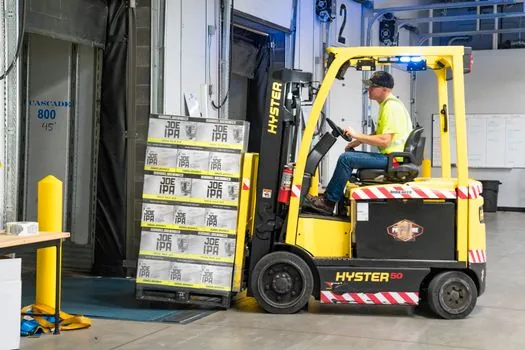
The decision between a reach truck and a counterbalance forklift inside the cold chain is a function of aisle width, lift height, and load profile, not a brand preference [S2]. A reach truck gives up to 12.0 m of lift in an aisle below 3.0 m, while a counterbalance forklift tops out near 3.0-6.0 m of lift and needs 3.5-4.5 m of aisle to turn, which is wasted cubic capacity inside a freezer [S2]. A counterbalance forklift carries 1.5 to 5+ tons comfortably, so it is the correct pick for receiving docks, cross-dock yards, and any zone where the truck must traverse an outdoor apron [S2]. Most cold-chain sites therefore run a mixed fleet: reach trucks inside the freezer and chiller rooms, counterbalance forklifts on the dock and outside staging lanes [S2].
Who the cold-store reach truck is for, and who it is not for
A cold-spec reach truck is the right tool for high-bay frozen and chilled warehouses with aisle widths of 2.5-3.0 m, lift heights of 6.0-12.0 m, and pallet loads under 2.0 t that need dense, organized stacking in a temperature-controlled envelope [S1][S2]. It is the wrong tool for outdoor yards, construction sites, or loading bays where the truck will see rain, ice, and uneven ground; in those zones, a counterbalance forklift with a sealed cab and pneumatic tires is the safer call [S2]. It is also the wrong tool when pallet loads routinely exceed 2.5 t or when the aisle is wider than 3.5 m, because the cost premium of the reach mechanism and cold-store package is no longer recovered through density gains [S2][S4].
Trackable signals for the next spec cycle
Two signals are worth watching through the rest of 2026. First, more OEMs are bundling telematics that report per-operator mast-hours, which ties directly into the 60-90 minute cold-room shift limit and the OSHA-style worker-exposure guidance that several EU member states have already referenced in cold-chain audits [S2]. Second, lithium-ion cold-store packages that carry a 5-year or 5,000-hour battery warranty are now quoted at roughly the same total cost of ownership as lead-acid with a remote change room, so a 2026-2027 fleet refresh is the natural window to switch chemistries and remove the battery-exchange room from the freezer envelope entirely [S2].
For component-level specifications, see logistics packaging, and cold chamber machine.