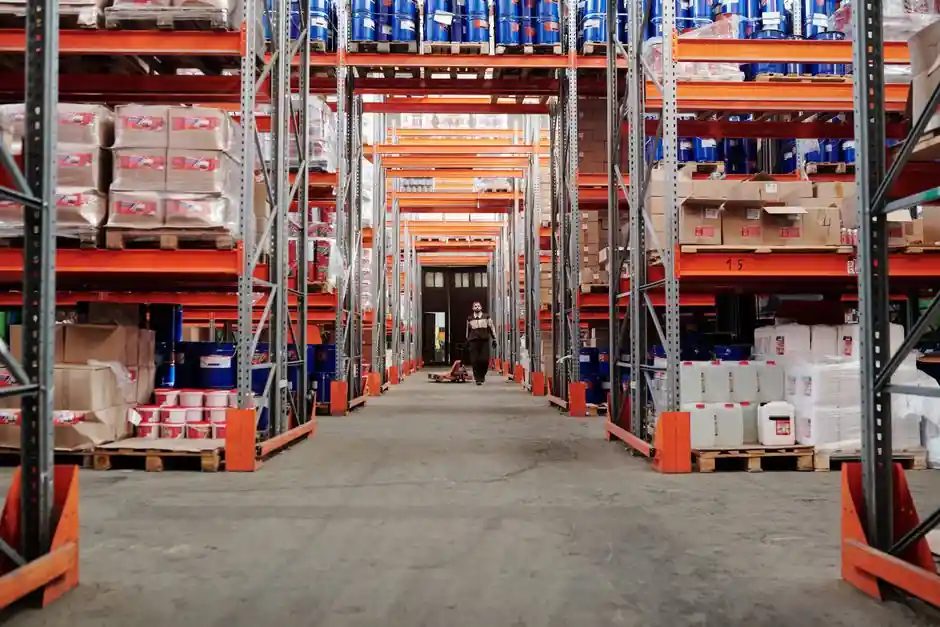
Reach trucks configured for e-commerce fulfillment typically operate in 8-10 ft aisles, lift to 20-40+ ft, and handle 1.6-2.0 t (3,000-6,500 lbs) of palletized inventory on smooth indoor floors [S3][S4].
The format is electric, narrow-chassis, and pantograph-equipped, purpose-built for high-density selective rack rather than for outdoor yards, dock work, or piece-pick bays where order pickers or counterbalanced forklifts retain the edge [S1][S2].
Aisle Width, Lift Height, and Capacity Bands
Reach trucks for e-commerce fulfillment slot into narrow-aisle (NA) class equipment, with operating aisle widths commonly quoted at 8-10 ft (approximately 2.4-3.0 m) and lift heights spanning 20-40+ ft (roughly 6-12 m) [S3][S4]. Rated capacity sits in a narrower band than counterbalanced forklifts, typically 1.6-2.0 t for high-lift reach models, while counterbalanced machines cover 1.5-5+ t across a much wider duty envelope [S3].
For dedicated indoor pallet racking where vertical storage is the priority, a reach truck is the correct tool; for cross-dock, trailer loading, or any work touching the yard, a counterbalanced forklift remains the right call [S2][S4]. E-commerce facilities that combine pallet put-away with case picking often run a mixed fleet: reach trucks for full-pallet storage aisles plus an order picker (or stock picker) for piece-level fulfillment bays [S1].
Reach Truck vs Order Picker vs Counterbalanced Forklift
The three truck classes divide cleanly by job-to-be-done. A reach truck moves full pallets in and out of narrow-aisle racking using a pantograph reach mechanism; an order picker lifts the operator with the forks so a worker can pick cases or eaches directly from rack bays; a counterbalanced forklift uses a rear chassis counterweight to handle mixed indoor/outdoor loads at 3.0-6.0 m lift heights [S1][S3][S5].
For e-commerce fulfillment specifically, the typical split is reach trucks in reserve storage and replenishment aisles, order pickers in forward-pick faces, and counterbalanced forklifts at receiving and shipping docks. A facility that tries to push reach trucks into dock duty quickly runs into clearance and trailer-loading issues, since reach mast geometry is not optimized for frequent truck entry and exit [S1][S2].
Power, Battery, and Indoor-Only Operating Envelope
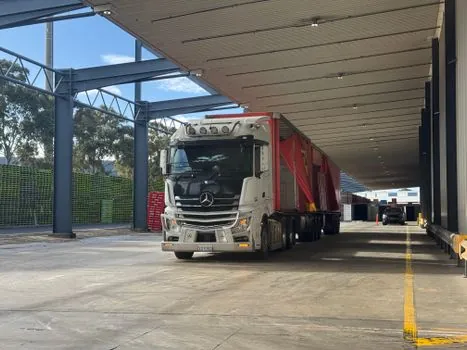
Reach trucks in e-commerce fulfillment are battery-electric only, with no diesel or LPG option in standard configurations, because the duty cycle is indoor, air-quality-sensitive, and centered on smooth concrete floors [S2][S5]. Lithium-ion battery packs are now the default for new fleets, with typical warranty terms of 5 years or 5,000 operating hours on reach models versus 7 years or 10,000 hours on counterbalanced units, reflecting the heavier duty cycle and larger battery capacity on the latter [S3].
That indoor-only envelope is a hard constraint. Reach trucks are not specified for rough terrain, outdoor yards, or any environment with floor irregularities beyond a flat, sealed warehouse slab, and operating them outside that envelope damages the mast, the pantograph, and the load wheels over time [S4][S5]. A e-commerce facility that needs a yard truck should spec a separate diesel or LPG counterbalanced unit rather than over-reach a reach truck.
Throughput Drivers in Fulfillment Workflows
For reach trucks in an e-com warehouse, throughput is governed by travel speed within the aisle, fork extension/retract cycle time, and lift/lower speed at height, not by raw horsepower [S1][S2]. Stand-up counterbalanced forklifts win on long cross-aisle travel and dock loops, but lose in storage aisles where a reach truck's tight turning radius and pantograph reach let the operator place a pallet in a deep rack bay without breaking the aisle [S2][S5].
The most productive high-density warehouses align truck class to workflow stage: counterbalanced at receiving, reach truck in reserve storage, order picker at pick faces, counterbalanced again at shipping [S2]. Single-fleet facilities that try to run a reach truck through the whole receiving-to-shipping loop typically see 20-40% lower storage density and slower cycle times compared with a properly segmented fleet, a range that operator-side sources attribute directly to aisle-fit and lift-height mismatches [S4].
Selection Criteria and Decision Checklist

Five specs drive a reach truck selection in e-commerce fulfillment: (1) required lift height to the top beam plus 150-300 mm clearance, (2) rated capacity at full lift (not just at ground level, since capacity derates with height), (3) minimum aisle width matched to the racking supplier's truck clearance envelope, (4) battery voltage and amp-hour rating sized for the shift profile, and (5) mast type (single-stage, two-stage, or triplex) matched to the residual free-lift requirement of the facility [S2][S3][S4].
If any of those five does not close, the right answer is a different truck class. Below 8 ft aisle width, a turret truck or articulated VNA forklift takes over from a standard reach truck; above 40+ ft lift height, a high-mast reach or a different VNA class is required [S4][S7]. For typical e-commerce reserve storage at 25-35 ft lift heights with 9-ft aisles, a standard 1.6-2.0 t electric reach truck remains the workhorse spec.
Where Reach Trucks Are the Wrong Tool
Reach trucks are the wrong tool in three common e-commerce scenarios: (a) piece-pick each-level fulfillment where an order picker is safer and faster, (b) dock and trailer loading where stand-up or sit-down counterbalanced forklifts are rated and dimensioned for the duty, and (c) any outdoor or rough-floor environment where the narrow chassis and mast geometry cannot take the abuse [S1][S2][S4].
A related failure mode is specifying a reach truck for very narrow aisles (VNA) under about 8 ft. A standard reach truck is engineered for narrow-aisle, not VNA duty; below roughly 8 ft, an articulated VNA forklift or a turret truck with wire guidance becomes the correct spec, since a reach truck's chassis width and outrigger geometry will not clear the rack and the truck uprights simultaneously [S7]. E-commerce facilities building greenfield should confirm the racking supplier's minimum aisle dimension and then back-fit the truck class to that number, not the other way around.
Track the small-forklift segment through 2026: the GMI small-forklift market analysis continues to flag reach trucks, order pickers, turret trucks, and pallet stackers as the four equipment classes riding the e-commerce fulfillment build-out, and that segmentation is the clearest external signal for what fleets new DCs are ordering in 2026 [S6].
Detailed specification references: dump truck, and truck scale.
For related coverage, see Shell molding machine selection for agriculture machinery castings.