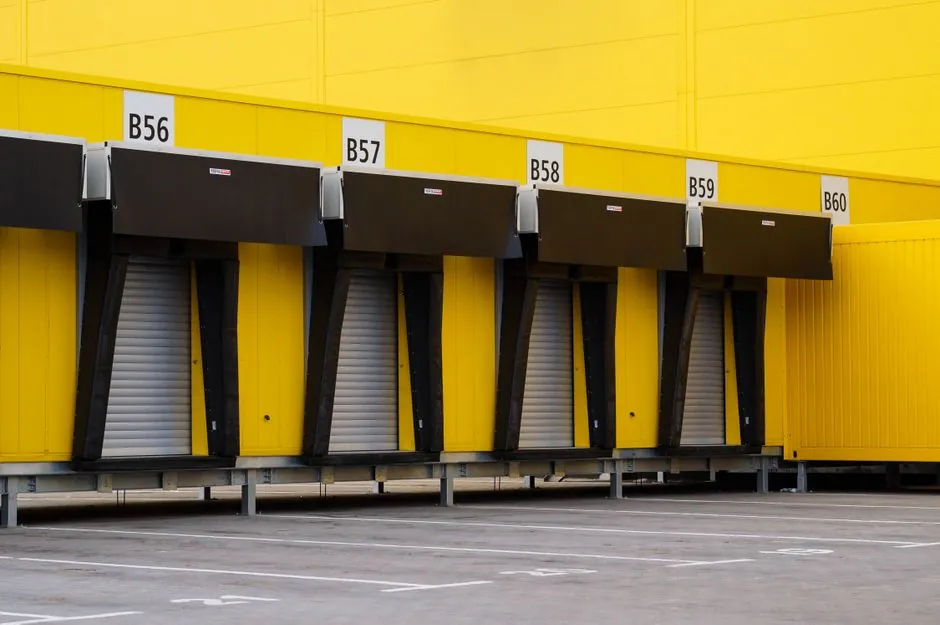
Apparel distribution centers handling palletized garment cartons, hanging-rack trucks, and poly-wrapped floor loads typically specify hydraulic dock levelers in the 25,000-35,000 lb dynamic capacity range with 6 ft or 7 ft lips, per current dock-equipment planning frameworks [S4]. The selection driver is cycle count: a high-turn apparel DC running eight or more trailer swaps per dock position per shift exceeds the duty envelope where mechanical (spring-return) levelers remain economical, and shifts the spec toward hydraulic or vertical-storing designs [S4][S1].
The dock leveler is the adjustable bridge between a fixed warehouse floor (typically 48 in. above grade) and a variable truck bed height that swings 6-12 in. above and below dock level depending on trailer suspension and load, so the leveler's working range and lip extension must cover the realistic trailer fleet, not just one carrier's standard trailer [S1]. A standard dock leveler for apparel work handles lighter individual pallet loads (a full pallet of poly-bagged apparel is often 1,200-1,800 lb) but the forklift itself, commonly a 5,000-7,000 lb electric unit with a 2,500-3,500 lb load, is what the leveler deck has to carry at speed across the lip.
Why Apparel DCs Land on Hydraulic, Not Mechanical
Hydraulic dock levelers are the default in higher-cycle and heavier-traffic operations; mechanical levelers suit lower cycle counts, while air-powered models sit between them, according to current new-warehouse planning guidance [S4]. Apparel distribution is cycle-driven rather than weight-driven: peak receiving windows around Black Friday, end-of-season resets, and store-replenishment cutoffs push daily door counts well past the 8-12 cycle/day threshold where mechanical leveler springs start to fatigue and operator-controlled descent becomes a productivity drag.
Hydraulic levelers in this service class are commonly rated for 300,000-500,000 lift cycles before major rebuild versus roughly 100,000-150,000 for mechanical, so the lifetime cost-of-ownership crossover for an apparel DC running 10+ cycles/day occurs inside five years, before counting the labor saved on push-button operation versus pull-chain manual release. A push-button hydraulic leveler also returns to stored position in roughly 15-25 seconds versus 30-45 seconds for a typical mechanical, which compounds across 20+ trucks per shift [S4].
Capacity Sizing: Lift Truck Plus Load, Not Pallet Weight
Capacity rating should reflect the heaviest forklift plus its heaviest load with an appropriate safety factor, not the nominal capacity of the lightest forklift the facility might use [S4]. For an apparel DC, the governing load is usually a counterbalanced electric rider forklift (5,000-7,000 lb truck plus 2,500-3,500 lb load) crossing the lip at speed, which can impose momentary dynamic loads above the static pallet weight. Specifying 25,000 lb dynamic capacity covers most rider-forklift service, while 30,000-35,000 lb ratings cover clamp-truck and stand-up reach applications used in narrow-aisle garment storage.
Vertical-storing dock levelers (Rite-Hite RHV class, among others) are increasingly specified where mixed-trailer fleets include swing-door, roll-door, and refrigerated trailers, because the leveler stores vertically inside the pit rather than projecting outward, which avoids contact damage from low-hanging roll-door tracks and low-boy reefer units [S3]. For an apparel DC taking mixed general and temperature-controlled loads, a vertical-storing leveler trades a higher first cost for a more forgiving envelope with non-standard trailer rear profiles. The standard dock leveler in this comparison is a pit-mounted hinged-lip hydraulic; the vertical-storing variant is a separate category that doubles as a dock door when raised.
Lip Length: 6 ft vs 7 ft for Standard Trailers
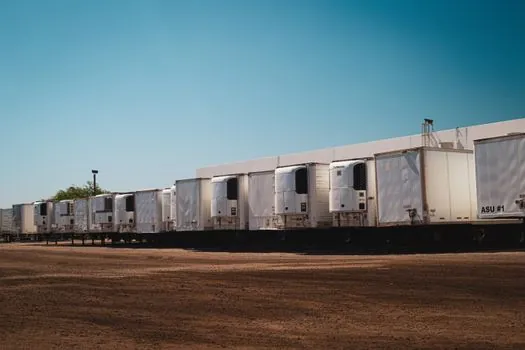
Lip extension must reach the front of the trailer bed reliably, and 6 ft lips cover most 53 ft dry-van trailers with the trailer backed square to the dock. 7 ft (or in some lines, 7 ft 6 in.) lips are specified where driveway approach grades, canted dock approaches, or refrigerated trailers with rear step plates are common, because a 6 ft lip can fall short of the load bed by 4-8 in. on a low reefer [S4].
For an apparel DC, the typical trailer is a 53 ft dry van at standard 48-50 in. bed height, so a 6 ft lip handles the nominal case. Where the same DC also receives 48 ft trailers and pup trailers for LTL splits, a telescopic lip dock leveler (e.g., G 9000 / G 9200 class) extending to roughly 12 in. of additional reach covers the variance without dock realignment, an upgrade that is far cheaper to spec at design than to retrofit in concrete [S3][S4]. A useful side-by-side with non-dock warehouse equipment appears in this platform trolley spec map for retail distribution, which addresses similar retail-throughput decisions on a different asset class.
Operating Range, Deck Width, and Pit Geometry
Working range above and below dock level determines which trailer bed heights the leveler can serve without binding or requiring the operator to manually shim. Standard hydraulic levelers offer roughly 12 in. above and 12 in. below dock level working range, which covers most 53 ft trailer suspension variance; vertical-storing levelers typically offer 12 in. above and 6 in. below, with the rest handled by the leveler's vertical travel itself [S3].
Deck width is a code-driven call. Standard pit widths are 6 ft 6 in. or 7 ft for nominal 8 ft or 10 ft wide trailer openings, and the leveler deck is usually 6 in. wider than the pit on each side. Apparel DCs picking between these often end up at 7 ft wide pits to handle wider pallet jacks and occasional clamp-truck forks. Pit depth matters for retrofit versus new-build: a 20 in. deep pit fits standard hydraulic hinged-lip models; vertical-storing levelers need 24-30 in. of pit depth plus vertical clearance above the door opening, which is a building-envelope decision best made before the slab is poured, not after [S4].
Apparel-Specific Failure Modes and Selection Traps

The six most common dock leveler failure points across the industry include impact or overload damage visible as indentations in the deck, leveler platforms that fail to sit flush with the dock floor, lip hinge wear, hydraulic cylinder seal failure, electrical control faults, and safety-leg/parking-rest malfunction, according to current service guidance [S2]. Apparel operations are particularly prone to lip hinge wear because hanging-rack trucks and garment-rack carts impose concentrated line loads on the lip while pivoting, rather than distributed pallet loads, and the lighter (and more numerous) pallet weight per square foot often masks the fatigue cycle count.
Poly-wrap residue, glitter contamination from hangtag trimmings, and lint accumulation are not typically on the OEM failure list but consistently show up in apparel-DC service tickets as causes of false safety-leg engagement and lip-seal sticking, because the optical or mechanical sensors that confirm the leveler is in the working position get fouled. Specifiers of dock leveler controls for apparel environments should look for sealed or recessed sensor housings and, where budget allows, optical or magnetic non-contact position sensing rather than exposed limit switches. Where the receiving mix includes hazmat (a separate decision tree, covered in dock leveler specs for chemical shipping), the same controls must also be compatible with intrinsically safe or explosion-proof requirements.
Comparison: Hydraulic vs Mechanical vs Vertical-Storing for Apparel
Against the four criteria that drive an apparel DC's spec, the leveler classes line up as follows. (1) Cycle life at 10+ cycles/day: hydraulic and vertical-storing both clear 300,000+ cycles; mechanical drops out around 100,000-150,000. (2) Operator productivity per cycle: hydraulic ~15-25 s; vertical-storing ~25-35 s (slower but safer); mechanical ~30-45 s. (3) First cost: mechanical lowest, hydraulic mid, vertical-storing highest by roughly 30-50% over standard hydraulic. (4) Mixed-trailer flexibility: vertical-storing best; standard hydraulic with telescopic lip close second; mechanical limited to standard-height standard-profile trailers [S4][S3].
Spec-side, that matrix points to a default of 30,000-35,000 lb capacity hydraulic hinged-lip with a 6 ft lip for an apparel DC running a homogeneous 53 ft dry-van fleet under 10 cycles/day per bay, and a shift to vertical-storing (RHV-class) for sites with a refrigerated mix or non-standard trailer profiles. Mechanical levelers, in the current planning framework, are positioned for low-cycle, low-traffic, budget-driven sites rather than throughput-driven apparel distribution [S4].
Vehicle Restraints, Interlocks, and Adjacent Decisions
Selecting the leveler in isolation ignores the most common root cause of dock injuries, which is trailer departure during loading, and the planning framework calls for specifying the vehicle restraint, the light-communication system, and the interlock sequence together [S4]. For apparel DC bays, an automatic wheel-restraint or shadow-hook restraint (such as the Dok-Lok class) combined with a green/red interior-exterior light communication system and an interlock that prevents the leveler from operating unless the trailer is positively restrained, is now the standard spec rather than an upgrade.
Related decisions include the dock seal or shelter: apparel DCs shipping into non-conditioned space typically use foam-padded seals, while conditioned DC space or cold-chain exposure calls for full seals or retractable shelters. These are picked in the same design pass as the leveler because seal geometry constrains the leveler's stored projection and the door header height, and changing one after the fact means reworking the others [S1][S4]. A broader overview of how loading-dock equipment categories interlock sits in this dock leveler specs for chemical shipping reference.
Trackable signals for the next planning cycle: (1) when an apparel DC is being designed, the leveler type, capacity, lip length, and pit depth should be locked in the design-development phase rather than the finish schedule, per current planning guidance [S4]; (2) lifecycle-cost crossover between mechanical and hydraulic hits around year five at 10 cycles/day, so retrofit decisions can be made on operating-hours data, not capex speculation; (3) vertical-storing leveler adoption in mixed-fleet retail DCs is the clearest trend signal in the current OEM catalog mix, though site-specific ROI still depends on trailer-profile variance [S3].
The underlying component specifications are covered under distribution cabinet, and power distribution.