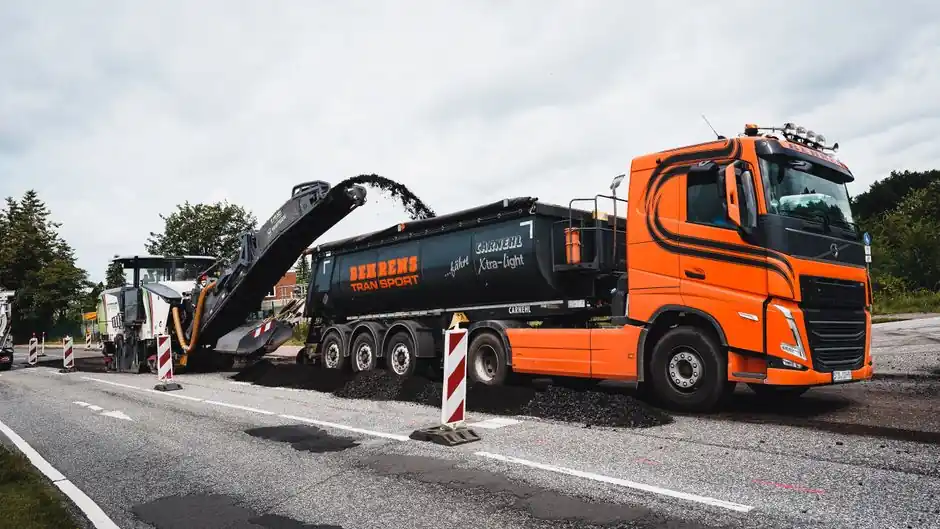
Cold milling drum width classes sort cleanly into four practical bands, and selecting the wrong one is the single biggest productivity mistake on a milling job: 0.35 to 1.3 m for utility and patch work, 1.0 to 1.5 m compact-highway, roughly 2.0 m half-lane, and 2.0 to 4.4 m full-lane machines [S1][S2].
Wirtgen's published small-milling range starts at 14 in (0.35 m) on the W 35 XRi, climbs through 20 in, 2 ft, 3 ft 3 in and 3 ft 11 in models, with the compact class topping out at 4 ft 11 in (1.5 m) on the W 150 Fi/XFi [S1]. Beyond that, half-lane and full-lane machines take over, with documented cut widths reaching 14 ft 5 in (4.40 m) in a single pass [S1][S6].
Drum width classes and the cut each one actually makes
Cold planer sizing runs from trailer-tow mini units to high-production full-lane machines capable of milling up to 16 ft (4.9 m) wide and over 12 in (300 mm) deep in one pass [S3]. The split is not arbitrary: small machines handle partial pavement rehabilitation and milling tie-ins, while large machines remove entire asphalt pavements cost-effectively [S1]. Within that envelope, the Wirtgen catalogue lists milling widths from 14 in (W 35 XRi, 45 kW / 60 hp) up to 14 ft 5 in in a single pass on the largest rear-loading models, with maximum milling depths from 4 in on the smallest unit to 12 to 13 in on the compact and large classes [S1].
For a working engineer the key spec is the drum width itself, not the marketing class label. Compact cold planers in the 0.35-1.3 m band are the standard tool for patch repairs, trenches for utilities, around manhole covers and other tight-area work [S2]. The half-lane class typically mills 6 to 8 ft (roughly 1.8-2.4 m), and full-lane machines finish the job at 12 to 14 ft per pass [S6].
Highway-class milling: 2.0 m half-lane and 2.0-4.4 m full-lane drums
Highway resurfacing productivity is a function of passes, not raw drum width. Half-lane machines can remove up to 12 ft of pavement in a single pass, while full-lane machines reach 14 ft per pass on a typical overlay job [S6]. Wirtgen's large-milling class works at the upper end of that band, with documented working widths up to 14 ft 5 in (4.40 m) and working depths up to 1 ft 2 in (350 mm) in a single pass [S1].
The half-lane/full-lane choice is driven by lane geometry. A standard 12 ft (3.66 m) traffic lane is best served by a full-lane machine in one pass; a 2.0 m class drum then handles half-lane cuts for tie-ins, ramp work, or staged construction where the machine must work in a live lane. The trade-off is logistics: a 14 ft cut needs a permit-load move and a 700+ kW engine, while a 2.0 m half-lane unit runs on three tracks and fits a standard lowboy [S2][S3].
Utility and patch-class milling: 0.35-1.3 m compact drums
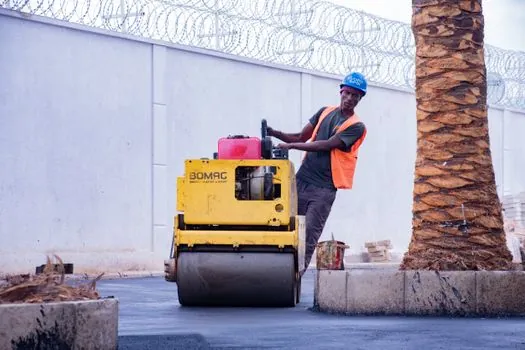
Utility work, patch repairs, trench reinstatement, and work around manhole covers all sit in the compact 0.35 to 1.3 m drum-width band [S2]. The smallest Wirtgen entries match that range directly: the W 35 XRi at 14 in (0.35 m) milling width with 45 kW / 60 hp maximum power, and the W 50 Ri-US at 20 in (0.50 m) with 105 kW / 141 hp [S1]. Above those, the W 60 Ri at 2 ft (0.61 m), the W 100 Ri at 3 ft 3 in (1.0 m) and the W 120 Ri at 3 ft 11 in (1.20 m) cover the upper utility and light-overlay range without crossing into the compact-highway class [S1].
On the attachment side, skid-steer cold-planer attachments mill 13 to 47 in wide, with maximum depths of 5 to 6 in on most units and up to 9 in on the larger models, which keeps them inside the utility envelope rather than the highway envelope [S4]. For crews running patch work, the practical working inventory is 18 in, 24 in, and 40 in width drums, with the two smaller sizes used for narrow tie-ins and the 40 in drum reserved for full-lane-width patches on parking-lot and municipal work [S5].
Compact-highway class: 1.0-1.5 m drums, the productivity crossover
Between the 1.3 m utility ceiling and the 2.0 m half-lane floor sits the Wirtgen compact class, a front-loading design that combines the manoeuvrability of a small machine with the productivity of a large one. Published compact-class widths are 3 ft 3 in (1.0 m) on the W 100 Fi, 3 ft 11 in (1.20 m) on the W 120 Fi / W 120 FTi, 4 ft 3 in (1.30 m) on the W 130 Fi, and 4 ft 11 in (1.50 m) on the W 150 XFi and W 150 Fi, all with 265 to 313 kW (355 to 420 hp) maximum power and maximum milling depths of 12 to 13 in [S1].
This is the band a city or county fleet usually targets for arterial resurfacing, where lane closures are short, half-width cuts are common, and a 2.0 m half-lane machine is over-spec. For deeper context on how this class fits a contractor's economic case, see the breakdown of Cold Milling Cost per Ton of RAP: 2026 Price Drivers.
Decision matrix: which drum-width class for which job
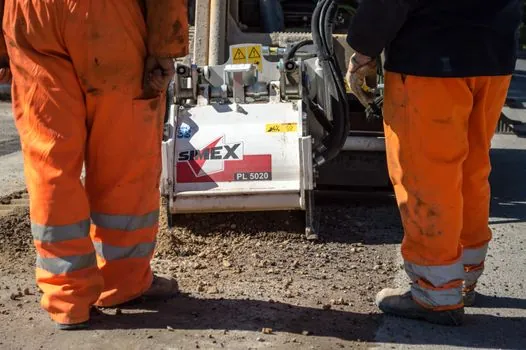
Match class to job on four criteria: required cut width, milling depth, manoeuvrability, and transport weight. For patch repairs, trench reinstatement, and work around manhole covers, the 0.35-1.3 m small/utility class is correct, with skid-steer attachments (13 to 47 in) covering the smallest cuts and Wirtgen W 35 XRi through W 120 Ri covering the rest [S1][S2][S4]. For arterial and urban-highway resurfacing, the 1.0-1.5 m compact class (W 100 Fi through W 150 Fi) gives 12 to 13 in of cut depth at 265 to 313 kW, which is the productivity crossover between utility and half-lane work [S1].
For full-lane highway work, the 2.0 m half-lane and 2.0-4.4 m full-lane classes are the only options, with Wirtgen's largest documented single-pass width at 14 ft 5 in (4.40 m) and a working depth up to 1 ft 2 in [S1]. Standard 12 ft traffic lanes are typically milled in two passes with a half-lane machine or one pass with a full-lane unit, and the high-capacity end of the class reaches 16 ft (4.9 m) wide and over 12 in (300 mm) deep in one pass [S3][S6].
Drum-swap technology and field constraints
Drum-width flexibility on a single machine is now an OEM selling point. Wirtgen's FCS light (Flexible Cutter System) enables rapid exchange of same-width milling drums, typically in less than two hours, so a contractor can re-task a compact-class unit between a standard 1.2 m drum and a fine-milling drum without a second machine [S7]. Cutting teeth on those drums are spaced 5/8 in (12 to 19 mm) apart in a conventional pattern, and tooth wear drives the maintenance interval rather than drum width itself [S3][S5].
The field constraints that override any class decision are cut depth, transport weight, and lane-closure geometry. A 2.0 m half-lane drum cannot reach a 350 mm cut on a 14 ft full-lane machine's productivity curve, and a 14 ft full-lane unit cannot fit a residential street with a 6 ft kerb-to-kerb clearance. The cold milling machine drum-width band is therefore chosen first, and the model within the band is chosen second, against power, weight, and milling-depth requirements [S1][S3].
For a working spec, track the next signal on Wirtgen's W 150 Fi replacement cycle, since 4 ft 11 in (1.50 m) is the current published ceiling of the compact class and any upward shift will redraw the boundary between compact and half-lane machines [S1].