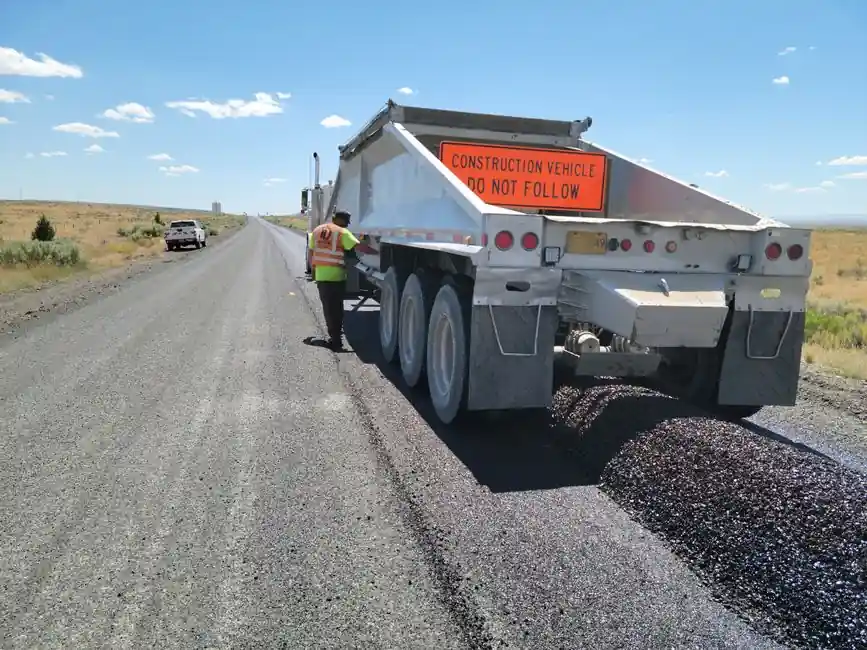
A combination roller is a tandem-style asphalt compactor with a single vibrating steel drum up front and a row of pneumatic rubber tires on the rear axle, a layout that delivers vertical compaction from the drum and a kneading, sealing action from the tires in one machine [S1][S3].
Typical operating weights run from about 1.5 t up to roughly 15 t, with 3 t to 5 t being the most common size class for commercial paving, road shoulders, and municipal work [S2]. The SAKAI TW354, a 47-inch (1200 mm) drum 3-ton-class combi unit operating at 5,865 lb (2,660 kg), illustrates the segment: 24 hp Kubota D1703 power, 3,120 vpm (52 Hz) drum frequency, and 4,630 lb (20.6 kN) centrifugal force [S2].
How the Two Compaction Stages Work Together
The vibrating front drum supplies primary compactive effort through static weight plus dynamic force, achieving roughly 75 to 85 percent of theoretical maximum density of the HMA immediately behind the paver screed, a baseline that the pneumatic rear bank then builds on [S5].
The rear pneumatic tires contribute a kneading effect, with each wheel able to oscillate and the rubber carcass itself flexing to match surface contour, eliminating the bridging that a rigid steel drum leaves over soft or uneven mix [S4]. In a typical multi-tire layout the front four tires rut the mat while the rear five counter-rut those impressions, producing both vertical compression and horizontal shear that tightens the aggregate structure [S4].
Steel Drum Roller vs Pneumatic Roller vs Combination Roller
Steel-drum rollers, in either static or vibratory form, deliver the highest peak density per pass and are the workhorse for highway mainline work, with drum widths commonly 35 to 85 inches (86 to 215 cm) and machine weights from about 0.9 t to 18 t [S5].
Pneumatic-only rollers cannot reach the same initial density as a vibratory steel drum, but they conform to the surface and seal the mat, which is why contractors use them in a train behind steel drum breakdown and intermediate rollers [S4].
A combination roller trades some of the pure steel-drum density ceiling for a one-machine solution, fitting the small-to-medium tonnage bracket where a separate pneumatic roller pass is hard to justify on mobilization cost or site space [S1][S2].
Selection Criteria That Actually Move the Decision
Job size and required density: a combination roller is the right call on parking lots, driveways, road shoulders, ramps, widening strips, and municipal streets; a full pneumatic-tire train behind a heavy tandem still wins on highway-class density targets [S2][S4].
Tire layout and ballast: front-row / rear-row tire counts and individual wheel oscillation, plus water/sand ballasting on the steel drum, set the achievable contact pressure and the kneading intensity; pneumatic rollers have to be ballasted to a target weight to hit spec density [S4].
Water and release-agent systems: steel drums spray water to stop HMA pickup and that water cools the mat, so triple-filtered spray systems and a separate release-agent tank matter when finish quality is on the line [S2][S5].
Engine tier and telematics: Tier 4 Final diesel platforms such as the 24 hp Kubota D1703 on the SAKAI TW354 are standard in this class, with telematics frequently offered as a factory option [S2].
Where Combination Rollers Fit, and Where They Do Not
Good fit: small and medium asphalt jobs, road shoulders, ramps, widening, parking lots, driveways, municipal and county roads, tennis and basketball courts, and bicycle paths, where the rear tire row will not damage a curb on tight turns [S2].
Limited fit: deep-lift highway mainline paving, where 18-ton-class vibratory tandems plus a dedicated pneumatic roller train are the standard configuration, and very large airports or container terminals, which demand heavier compaction equipment than the combi segment is built to deliver [S2][S5].
Another constraint: a single steel drum plus a tire bank cannot replace a true double-drum tandem for finish rolling on bridge decks and other confined steel-on-steel work, where two vibrating drums are typically specified [S7].
Operating Specifications Anchors for a 3-Ton-Class Combination Roller
Use the SAKAI TW354 data set as a reference anchor for the 3-ton class: drum 47 inches (1200 mm) wide, 27 inches (675 mm) diameter; operating weight 5,865 lb (2,660 kg); vibration 3,120 vpm at 52 Hz with 4,630 lb (20.6 kN) centrifugal force and 0.014 inch (0.36 mm) nominal amplitude; Kubota D1703 Tier 4 Final at 24 hp (18.2 kW) at 2,200 rpm; 10.6 gal (40 L) fuel and 53 gal (200 L) sprinkler tanks [S2].
On a typical pneumatic-only roller referenced in industry guidance, the front row of four tires creates a rut pattern that the rear row of five tires counter-ruts, and the machine is ballasted to a target weight to dial in the contact pressure on the mat [S4].
Standards, Sourcing, and Field Reality
Hot mix asphalt compaction in this class is governed by general HMA density targets rather than a single combi-roller standard, with 75 to 85 percent of theoretical maximum density achievable directly out from under the paver screed before rollers arrive [S5].
ROPS and seat belts are standard equipment on modern combination rollers in this size class, and halogen or LED work-light kits, strobes, and drum lights are typically offered as options alongside telematics packages [S2].
Trackable signals to watch in 2026: broader availability of intelligent compaction (IC) modules on combination rollers, and continued take-up of factory telematics on sub-5-ton combi units, both already listed as options on current OEM product lines [S2]. For related asphalt compaction equipment, see the asphalt paver and road roller reference pages, and compare vibratory bearing service intervals against this class via the road roller vibratory bearing cost breakdown field data.