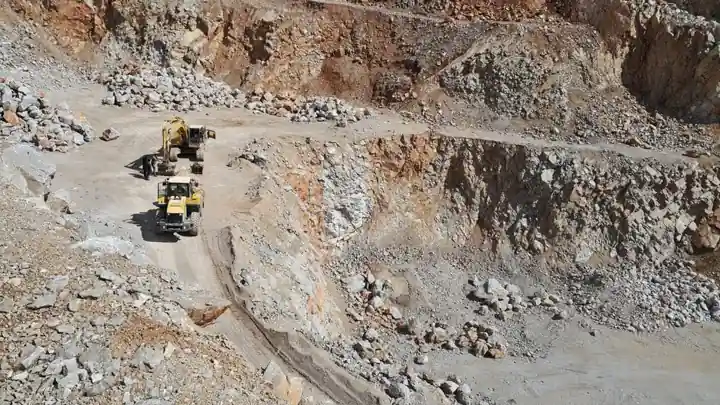
For landfill operations, the working envelope is narrow lanes over compacted clay or geosynthetics, low ground pressure matters more than peak horsepower, and the machine must deliver a uniform 50–300 mm cut while keeping RAP segregated for re-use as daily cover or cold mix feedstock [S1][S3].
Compact and small cold milling machine classes, with 100–160 kW (135–215 hp) engines, 1.0–1.3 m (3 ft 3 in to 4 ft 3 in) milling widths, and operating weights of 14,500–21,500 kg, fit the typical landfill access ramp, leachate-cell geometry, and haul-truck matching window [S2].
Why a mill, not a crusher or excavator, on the landfill cell
Cold milling cuts a defined depth automatically, returning a graded surface free of ruts and with longitudinal striations ready for re-compaction, with profile-grade accuracy within ±3 mm (±1/8 in) along each edge per ARRA milling guidance, a tolerance that crushed-rap alternatives cannot match [S1]. A full-lane cold planer run can reprocess 200–400 m²/h of aged asphalt cover into reusable RAP, material that historically was sent to landfill and that now substitutes for virgin aggregate and binder in line with documented recycling practice [S4].
For landfill cell re-grading and cap preparation, a cold planer class machine outperforms a hydraulic excavator with a mounted breaker on three counts: dust suppression is integrated, cutting depth is repeatable to the millimeter, and the milled RAP exits on a slewing discharge conveyor for direct truck loading rather than being double-handled with a bucket [S2][S3].
Size and class mapping for typical landfill tasks
Landfill work splits into three recurring tasks, each with a different machine match. Daily-cover reprocessing on a 3–4 m access lane wants a small rear-loader in the 45–105 kW (60–141 hp) bracket, 350–500 mm milling width is the lower limit, and operating weight stays under 7,500 kg to protect clay liners. Final cap removal over 200–400 m² cells calls for a compact class machine, 160–313 kW (215–420 hp), 1.0–1.5 m width, and 300–330 mm (12–13 in) max depth in a single pass, sized so one machine replaces a fleet of planers and a compactor on the same shift [S2][S6].
Large milling machines, with 14 ft 5 in (4.4 m) working width and 1 ft 2 in (350 mm) working depth per the Wirtgen product line, are over-sized for most landfill cells and create ground-pressure spikes that exceed typical 50–100 kPa bearing capacity on intermediate cover systems [S2].
Decision matrix: small vs compact vs large for landfill work
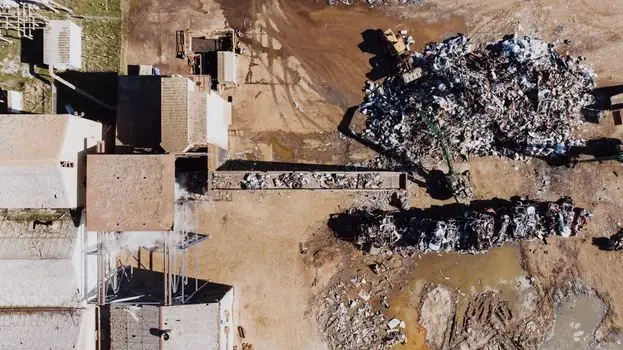
Across the three relevant decision criteria, ground pressure, milling width, and single-pass depth, the small class (W 35 XRi through W 120 Ri) covers 14 in to 3 ft 11 in widths at 4–12 in depths with 45–160 kW; the compact class (W 100 Fi through W 150 Fi) covers 3 ft 3 in to 4 ft 11 in widths at 11–13 in depths with 265–313 kW; the large class extends to 14 ft 5 in widths at 1 ft 2 in depth [S2]. For landfill cap work the compact class is the sweet spot: 1.0–1.5 m width, 300–330 mm depth, and 44,000–47,000 lbs (20,000–21,500 kg) operating weight that stays within geosynthetic liner load limits.
Rental fleets in the North American market skew toward Wirtgen because the W 100 Fi, W 120 Fi, and W 150 Fi are stocked as the default compact-class rentals, and that availability shapes what a landfill contractor can actually get on a 24-hour callout [S5]. For deeper cuts into full-depth asphalt caps, see the related spec map on cold milling machine selection for road construction width depth power and drum, which covers the same compact class in highway context.
Drum, cutter, and grade-control options that matter on a cap
Cutter spacing is the single biggest productivity lever: a 16 mm (5/8 in) pattern moves material fast for bulk cap removal, a 6.35 mm (1/4 in) pattern produces finer RAP suitable for direct reuse as daily cover aggregate, and the ability to swap drums on one machine in the same shift is what separates a modern mill from a 1980s unit [S4]. For landfill work, fine-milling drums and ECO cutter drums are the two options to evaluate, because they determine whether RAP goes back into the cell as structural fill or has to be hauled off-site [S2].
Grade control on a landfill must read from a non-contact reference, since stringline and ski are impractical over irregular caps. Dual grade, grade-and-slope, laser reference, and GPS coordinates are all options on current-generation mills, and one ground operator can now run either side of the machine instead of needing two [S4]. That single-operator capability, combined with automatic profile control to ±3 mm, is the main reason a landfill crew of four can run a 1.2 m compact mill productively where a 1990s planer needed six [S1][S4].
Engine power, weight, and the logistics around a landfill site
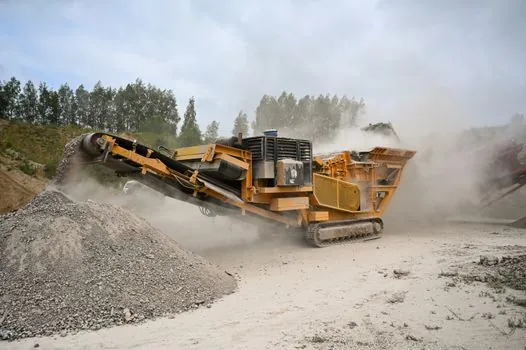
Landfill sites impose three hard logistics constraints: low-boy trailer access on a weighbridge, gate clearance typically 4.0–4.5 m, and a 30–40 kPa ground bearing limit on the working face during wet weather. Small-class machines at 10,000–16,400 lbs (4,500–7,500 kg) and 45–105 kW fit on standard tag-along trailers without permits in most jurisdictions, while compact class at 44,000–47,000 lbs (20,000–21,500 kg) needs a heavy-haul permit but still rolls on a standard low-boy [S2].
Engine power drives cutter-drum productivity more than travel speed: a 265 kW (355 hp) compact mill at 1.0 m width delivers roughly 30 m/min (100 fpm) cut rate at 50 mm depth, where a 105 kW small mill on the same cut is limited to 9 m/min (30 fpm) per documented 1980s-versus-modern comparisons, a 3× throughput gain from power and drum design alone, independent of operator skill [S4].
Operating cost, RAP economics, and what to track
Cold milling a landfill cap instead of excavating and replacing it saves the virgin aggregate extraction cost and the tipping fee on the disposed asphalt, and the recovered RAP substitutes for virgin binder at 1.0–1.5% by mass of mix in typical cold-recycle designs [S1][S4]. The global market for these machines is projected to grow from US$ 2,079.0 million in 2024 to US$ 3,259.7 million by 2034 at a 4.6% CAGR, which signals sustained rental-fleet investment and spare-parts availability through the next decade [S8].
Track three numbers on every landfill milling shift: square meters milled per liter of diesel (a useful proxy for cutter wear), tonnes of RAP diverted from disposal (the regulatory KPI), and profile-grade deviation in millimeters against the cap design (the engineering KPI) [S1][S4]. A compact class mill returning 200–400 m²/h with 25–30 L/h diesel burn is the realistic 2026 benchmark, and a rental fleet stocked with Wirtgen W 100 Fi through W 150 Fi class machines is where most North American landfill contractors will source that capacity [S2][S5].
Detailed specification references: cold chamber machine.