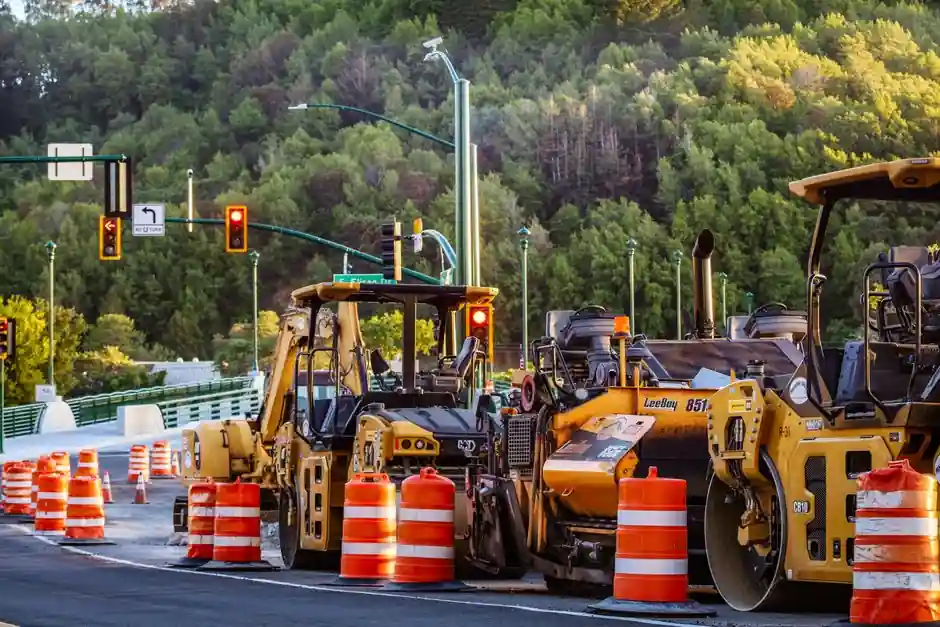
Cold milling machines are the workhorse for asphalt and concrete layer removal on demolition and rehabilitation sites, working widths spanning 1 ft 2 in to 14 ft 5 in (roughly 0.35–4.40 m) and single-pass depths to 1 ft 2 in (0.35 m) [S1][S6]. The class runs from 45 kW / 60 hp compact rear-loaders up through 313 kW / 420 hp large front-loaders, with operating weights from about 4.6 t to 21 t [S1].
For demolition scoping, cold milling sits between a demolition hammer (point-impact concrete breaking) and full structural excavation: it strips bound layers cleanly while leaving the sub-base intact for re-compaction or recycling. The 2024-to-2035 outlook for the equipment category shows a CAGR of 5.23%, with the global market moving from USD 1.69 B to USD 2.96 B [S7], which is consistent with steady demand from road-rehab and urban-renewal programs rather than a one-off spike.
Class Definitions: Small, Compact, and Large Milling Machines
Wirtgen's published portfolio splits cold milling into three operating classes, and the boundaries map directly onto demolition-task sizing [S1]. Small milling machines are wheeled rear-loaders: the W 35 XRi mills 14 in wide to 4 in deep at 45 kW / 60 hp with a 10,252 lb CE weight, and the W 50 Ri-US reaches 20 in wide to 8 in deep at 105 kW / 141 hp, 15,278 lb. Compact milling machines are front-loaders that bridge small and large, with the W 100 Fi at 3 ft 3 in wide, 13 in deep, 265 kW / 355 hp, and 44,092 lb; the W 150 Fi tops the class at 4 ft 11 in wide, 13 in deep, 313 kW / 420 hp, 46,958 lb.
Large milling machines in the same product family cover full-lane removal at high horsepower. For demolition, the rule of thumb is that small machines handle patch cuts, tie-ins, and floor rehabilitation in industrial buildings; compact machines cover urban street rehabilitation and partial-lane work; large machines run full-width highway removal and full-depth reclamation where the entire asphalt surface plus bound base must come off [S1][S5]. A skid-steer cold-planer attachment is a fourth option outside the Wirtgen classes, milling 13–47 in wide and averaging 5–6 in depth (some to 9 in), with depth-of-cut limited by the host machine's hydraulics rather than a stand-alone engine [S5].
Selection Criteria: Width, Depth, Power, and Weight
Four specifications decide fit on a demolition tender, and they are not independent. Milling width and maximum depth set the production envelope; engine power sets sustained cutting ability in dense concrete; operating weight sets transport legality and ground-bearing pressure on the slab you are milling [S1][S4]. A concrete demolition cut typically needs more aggressive bite per tooth than asphalt profiling, so power-to-weight ratio (kW per tonne) is the useful combined metric.
Concrete numbers from the Wirtgen data make the trade-off concrete. The W 120 Ri (3 ft 11 in wide, 12 in deep, 160 kW, 33,951 lb) delivers about 10.4 kW/tonne. The compact W 150 Fi (4 ft 11 in, 13 in, 313 kW, 46,958 lb) lifts that to roughly 14.7 kW/tonne, a 41% jump in cutting density for the same operator class. Where demolition includes reinforced or heavily patched concrete, contractors routinely spec the higher kW/tonne compact or move into the large class to keep ground speed up without stalling the drum [S1]. For projects that include bulk material handling after the cut, the wheel loader selection for port and terminal bulk handling map covers the matched downstream machine.
Drum Configurations and Cutting Tooling
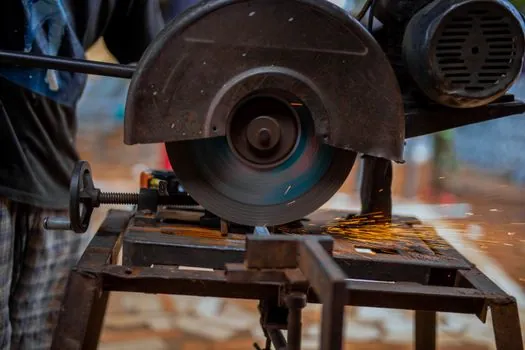
The milling drum is the consumable heart of the machine, and drum choice changes productivity more than engine choice on a like-for-like basis. Wirtgen's catalogue lists ECO cutters and fine milling drums as standard drum options across the small, compact, and large classes, enabling the same machine to run coarse removal or fine surface texturing for skid-resistance improvement [S1][S2]. Standard all-purpose drums suit full-lane asphalt removal; fine-milling drums run at higher line spacing (typically 8 mm or 6 mm) for thin-lift texturing and pavement-surface restoration.
Cutting tools are carbide-tipped bits arranged in a helical pattern on the drum, with bit spacing, bit count, and holder style driving both production rate and the gradation of reclaimed asphalt pavement (RAP) [S2]. Tighter spacing produces finer RAP suitable for trench backfill and road base; coarser spacing pushes higher throughput but leaves larger millings that may need crushing before reuse [S5]. On demolition sites where the milled material goes back into the project as cold-recycled base, the drum spec effectively sets the recycling chain that follows.
Application Mapping: Demolition vs Rehabilitation vs Full-Depth Reclamation
Demolition work splits into three tasks the equipment selection must answer: partial-depth removal (strip a worn asphalt or concrete overlay before resurfacing), full-depth removal (strip the bound layers down to granular sub-base), and full-depth reclamation (pulverize the bound layers in place and mix with the underlying base) [S5]. Cold milling is the right primary tool for the first two; full-depth reclamation is a milling-machine task but typically pairs the mill with a stabiliser or recycler for the in-place mixing pass.
For partial-depth removal on a demolition patch, the small-class rear-loader (W 35 XRi through W 60 Ri) is the standard match: 14–24 in milling width and 4–8 in depth handles utility cuts, trench patches, and transition milling at intersections [S1]. For full-lane urban demolition where the entire asphalt course is being removed prior to reconstruction, the compact class (W 100 Fi through W 150 Fi) at 3 ft 3 in to 4 ft 11 in wide and 13 in deep is the workhorse, with the added advantage of front loading and tight turning radius on confined city sites [S1]. For highway-scale demolition and full-depth reclamation, the large class and 350–400 hp engines come into play, with maximum milling depths reported at 13 in in some configurations [S5]. On sites where the demolition also feeds bulk earthmoving, the agricultural excavator selection write-up covers the matching loading-class spec.
Operating Economics: Fuel, Conveyor, and Material Reuse

Two cost lines dominate cold-milling demolition tenders: fuel burn at the drum and the value of the reclaimed material. Modern cold mills run Tier 4 final / Stage V diesel platforms with auto-load management that drops engine speed during non-cut phases, and conveyor systems are designed to load RAP directly onto waiting trucks with minimal spillage [S1][S4]. The conveyor configuration (front-discharge, rear-discharge, slewing) is therefore a real production variable on tight urban sites where truck spotting is constrained.
Material-reuse economics are central to the demolition case for cold milling over alternative breaking methods. Milled asphalt goes back into the project as RAP for cold-recycled base, trench backfill, driveway subbase, or shoulder material, with chemical stabilisers added in the recycler when higher bearing capacity is needed [S2][S5]. The "cold" process (no heating of the bitumen) preserves binder integrity in the reclaimed material, which is the technical reason cold-mill RAP re-bonds more effectively in a hot-mix reuse than millings from a heat-assisted process [S2]. That binder-preservation benefit is the cleanest line item in a demolition cost model.
Limitations and Failure Modes
Cold milling is the wrong tool when the demolition target is below the bound layers. A cold mill cannot break a reinforced concrete slab to rubble for removal; it planes the surface. For structural demolition of thick reinforced slabs, the mill can do a pre-thinning pass to reduce mass before a hydraulic breaker or crusher takes over, but it is not a stand-alone demolition tool on structural concrete [S2].
Depth and density also set hard upper limits. Maximum single-pass depth is 13 in on the compact class and the small class tops out at 12 in on the W 100 Ri / W 120 Ri, so any demolition cut deeper than that needs multiple passes or a different primary tool [S1]. Skid-steer cold-planer attachments cap out at 9 in depth with much lower production rates, and a 100 ft milling pass on a skid steer can take a full shift, so the attachment is sized to patching and small utility work only [S5]. Heavy vibration through the operator station and limited RAP gradation control are the documented trade-offs versus the larger stand-alone machines [S5].
Sourcing, Standards, and 2026 Procurement Notes
Major cold-mill OEMs in 2026 lineups include Wirtgen (the W-series portfolio cited throughout), Caterpillar (PM310 class), Wirtgen-owned brands, Dynapac, XCMG, SANY, and Liugong; the Indian 2025 dealer-channel price list for the XCMG XM1005H is published in the ₹1.70–1.80 crore ex-showroom range, with comparable Wirtgen compact-class units materially above that price band [S4]. That pricing spread is the usual pattern: Chinese OEM compact mills land 30–50% below European equivalent on ex-works price, with the gap narrowing once tooling, service contract, and parts availability are added.
Standards that touch cold-mill procurement in 2026 are mostly emissions-driven rather than machine-performance standards: Tier 4 final / EU Stage V for diesel engines on units sold into North America and Europe, with equivalent China NR4 and India CEV Stage V on units sold into those markets. No ISO standard governs milling-drum metallurgy directly; bit grade and holder style are OEM-specific, and carbide-tipped bit selection is treated as an operating-cost decision rather than a regulatory one. For demolition contractors standardising a fleet, the practical 2026 procurement check is engine-emissions tier, drum-and-bit availability through the local dealer, and conveyor geometry matched to truck heights on the typical job site.
Trackable signals for the next 12 months: Wirtgen and Caterpillar 2027 model-year launches usually appear at bauma Munich in early April, with key emissions and telematics updates; XCMG and SANY tend to refresh compact-class mills at bauma China (held in late November in Shanghai). Watch the OEM price lists in Q4 2026 for Tier 4 final / Stage V inventory clearance on outgoing compact-class models, which is when the most aggressive end-of-year discounts land.
For the relevant spec sheets and selection criteria, see cold milling machine, and cold chamber machine.