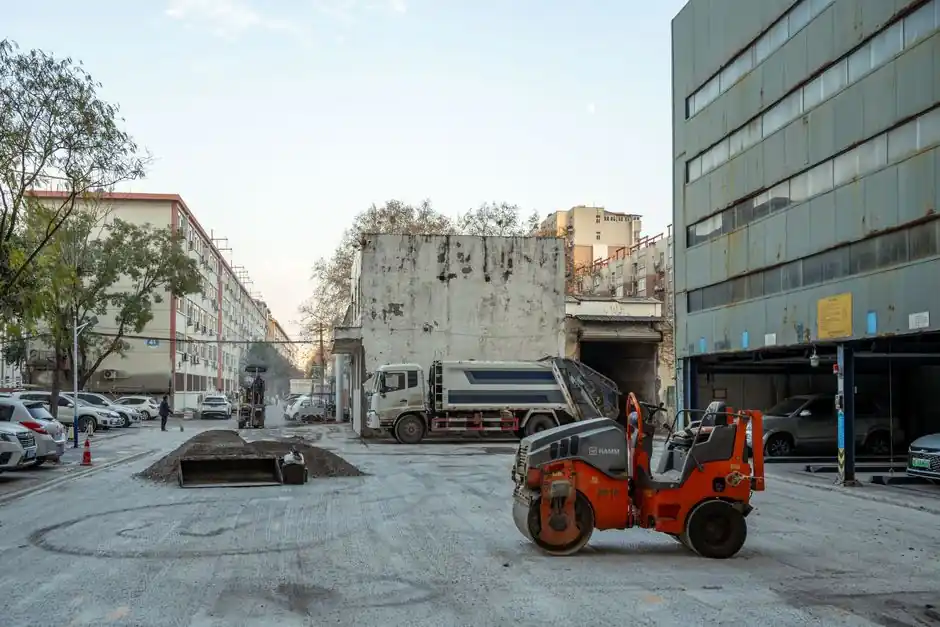
A cold milling machine is a removal asset: a rotary drum studded with carbide-tipped teeth grinds asphalt or concrete off the surface without heating it, then loads the resulting RAP (reclaimed asphalt pavement) onto a conveyor [S1][S5]. An asphalt paver is a placement asset: it receives hot-mix asphalt (HMA) from trucks and lays it as a uniform mat behind a screed at controlled thickness and pre-compaction.
The two machines do not compete on the same job; they sit on a critical-path sequence where the cold milling machine precedes the asphalt paver. Picking the wrong class of equipment, or specifying the wrong drum, is the single biggest reason milling productivity falls short on a rehabilitation contract [S2][S3].
Operating Principle and Cutting Action
Cold milling is purely mechanical: the drum rotates upward against the direction of travel, the carbide teeth strike the bound layer, and the fractured chips are thrown onto a conveyor. Water-spray dust suppression is standard on most modern units, and tooth life varies from "days to mere hours" depending on aggregate hardness and hidden road furniture [S1][S3].
An asphalt paver operates by transferring HMA from a receiving hopper through slat conveyors to a set of augers, then spreading it under a heated, vibrating screed. The screed (rather than the paver's engine power) is what determines mat density and smoothness; the paver itself does not achieve final compaction, which is done by separate rollers.
Working Width, Depth, and Power Range
Wirtgen's published small-class cold mills start at 14 in milling width and 4 in max depth (W 35 XRi, 45 kW / 60 hp, 10,252 lb CE) and scale to 2 ft / 8 in depth at 105 kW (W 50 Ri-US, W 60 Ri) [S3]. Compact-class machines sit at 3 ft 3 in to 4 ft 11 in widths with up to 13 in milling depth, drawing 265 to 313 kW (355 to 420 hp) and weighing 44,092 to 47,179 lb [S3].
The full Wirtgen envelope covers working widths from 1 ft 2 in to 14 ft 5 in and single-pass working depths up to 1 ft 2 in [S3]. Asphalt pavers, by contrast, are typically specified by paving width (8 ft to 30 ft on tracked highway units) and lay depth in 1 to 12 in lifts; the relevant comparison figure is throughput in tons per hour, not drum geometry.
ARRA Milling Classes and Depth Selection
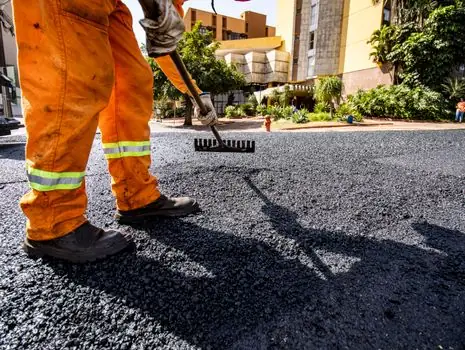
ARRA (Asphalt Recycling and Reclaiming Association) classifies milling into five depth regimes, and US Federal Highway Administration work typically references the same: Class I removes surface irregularities only; Class II goes to a uniform depth per plan; Class III adds cross-slope correction; Class IV mills to base or subgrade at full depth; Class V varies depth across the project footprint [S1]. Micro-milling is a sixth, thinner regime that removes 1 in or less and leaves a patterned texture useful for surface treatments or rumble-strip grinding [S1].
Choosing the class sets the cold mill size before the paver is even mobilized. A Class IV full-depth removal on a primary arterial calls for a large milling machine (W 200-class or similar) feeding a high-tonnage asphalt paver in a tight paving train; a Class I surface correction on a parking lot is comfortably handled by a W 50-class small mill followed by a compact paver or by a grader-and-roller finish [S3].
Cold Planer vs Generic "Asphalt Milling Machine"
Industry usage is inconsistent: "asphalt milling machine" is the broader umbrella term covering everything from compact skid-steer-mounted planers to 14 ft 5 in full-lane mills, while "cold planer" usually implies a self-propelled, GPS/laser-guided unit with automatic grade control [S2]. Boom & Bucket's 2025 thread and the Mico Equipment 2025 piece both treat "cold planer" as the precise, larger, deep-cutting subset and "asphalt milling machine" as the catch-all for surface milling, spot repairs, and patching [S2][S6].
For a spec-driven buyer the rule of thumb is: if the job requires automatic grade control, full-lane passes, or deeper than ~4 in cuts, you are buying a cold milling machine of the W 100 Fi or larger class. If the work is a 1 to 2 in surface key-up on a small lot, a compact milling attachment or small rear-loader is more cost-appropriate [S3][S6][S8].
Where Each Machine Fits, and Where It Doesn't

Cold milling machines fit pavement rehabilitation: removing raveling, bleeding, rutting, shoving, and ride-quality defects before resurfacing; adjusting curb reveals, manhole heights, and cross-slope for drainage; and producing RAP for reuse in new HMA [S1][S5]. They do not place new material, do not achieve final compaction, and on concrete are limited to surface grinding or dowel-bar-retrofit slotting rather than structural demolition [S5].
Asphalt pavers fit new construction, resurfacing overlays, and lift-by-lift placement on stabilized base. They cannot remove failed pavement, cannot correct a sub-base that has lost grade, and depend on a continuous feed of HMA at the correct temperature; a paving train that idles cools the mat and forces handwork. The two machines are complementary, not redundant, and a contract that mobilizes one without the other usually signals either a pure maintenance surface treatment or a full reconstruction with the opposite asset already on site [S2][S5].
Criteria-Based Comparison
On four decision criteria, the contrast is clean. Function: cold mill = removal, paver = placement. Primary spec metric: cold mill = milling width (in/ft) and depth (in) per pass, paver = paving width and laydown rate (tons/hr). Control system: cold mill = automatic grade control via sonic skis, laser, or 3D GPS on most modern units, paver = screed tow-point sensors and auger sonar for mat thickness. Output: cold mill = RAP chips on a conveyor, paver = compacted (but not final-density) HMA mat behind the screed [S2][S3][S5].
A Class II or III highway rehabilitation will typically spec a W 150 Fi or larger cold mill (4 ft 11 in width, 298 to 313 kW, 45,966 to 46,958 lb) feeding RAP trucks, then a tracked asphalt paver with a 10 to 16 ft main screed and 600 to 1,000 tons/hr capacity, followed by breakdown, intermediate, and finish rollers. A small-lot Class I key-up can be done with a W 50 Ri-US (20 in width, 105 kW, 15,278 lb) and a compact paver, or by a skid-steer-mounted planer where access is tight [S3].
Tooth Wear, RAP Economics, and Field Trade-Offs
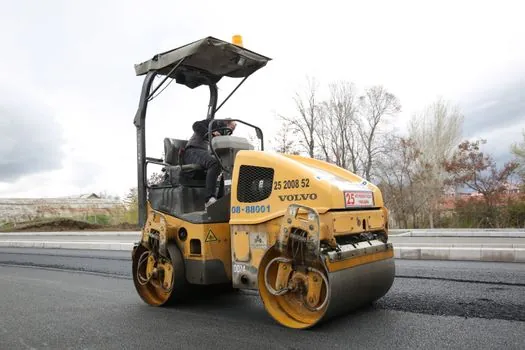
Cold milling economics are dominated by tooth consumption and conveyor throughput, not by the mill's sticker price. Contractors report tooth life "from days to mere hours" on hard aggregate or where rebar, manhole frames, or joint material are present [S1]. Water-spray systems are now standard on most rear-loading small mills to extend bit life and control airborne dust [S1][S3].
RAP from cold milling is the economic bridge between the two machines: it can be crushed and reintroduced as aggregate in new HMA, often halving material cost on a resurfacing job compared with full-depth hot-mix paving using virgin aggregate [S1][S4]. One 2021 mobile-home-park operator thread documented an asphalt-milling resurfacing at roughly half the price of a hot-asphalt overlay of equivalent specification, with the trade-off being shorter service life and a rougher surface texture under traffic [S4].
Failure Modes and Common Mis-Specs
The most common cold-mill mis-spec is under-sizing: a small mill on a Class IV full-depth removal burns teeth faster than the contractor can replace them and stalls production. The most common paver mis-spec is over-width: a 30 ft screed on a 12 ft residential street costs more in setup, loses mat temperature, and produces more handwork than a correctly sized 10 ft unit [S3].
On the milling side, ignoring the depth class is the failure mode behind most "the mill couldn't keep up" complaints; on the paving side, running a paver without a consistent truck feed or without matched rollers is the failure mode behind most density penalties. Both machines are only as good as the equipment train around them, which is why pairing decisions are made at the project level, not the equipment-purchase level [S1][S2][S5].
Standards, Guidance, and Sourcing
US highway cold-milling work is typically scoped against ARRA's Class I through V depth definitions, the same classes referenced by the FHWA [S1]. Wirtgen's published working-width and depth envelope (1 ft 2 in to 14 ft 5 in, up to 1 ft 2 in per pass) is the most-cited OEM specification range for fleet planning [S3]. For a side-by-side look at how a cold mill compares with a smaller carrier like a skid steer on the same job, the Skid Steer Loader vs Cold Milling Machine spec map covers the small-class decision; for the placement side of the train, a tracked-vs-wheeled paver decision follows similar width and throughput logic.
Trackable signals worth watching into 2026: drum-cutter design changes (ECO and fine-milling drums now ship across Wirtgen's small, compact, and large classes [S3]), and tighter integration of 3D GPS grade control on compact-class mills, which is moving the line between "asphalt milling machine" and "cold planer" toward the precise end of the spectrum [S2][S3].
Detailed specification references: cold chamber machine.