
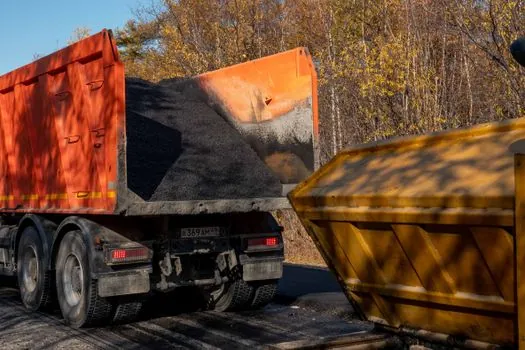
An asphalt paver is a self-propelled machine that receives hot-mix asphalt from dump trucks, distributes it across 1.8-9 m via conveyors and augers, and pre-compacts the mat with a heated, vibratory screed before any roller arrives on the mat [S6]. A road roller is a separate machine class that follows the paver, using static weight, vibration, or pneumatic tires to drive density to spec on subgrade, base, or finished asphalt layers [S1][S2].
The two machines are sequential partners, not substitutes: the paver sets width, thickness, and pre-compaction; the roller closes air voids and locks in density [S2]. Choosing between them is a project-stage question (placement vs compaction) and a fleet question (own both, rent, or subcontract one side), not a like-for-like equipment decision.
Functional Boundary: Placement vs Compaction
The paver's primary use is laying hot-mix asphalt (HMA) during construction of flexible pavements, with a front hopper, a conveyor, and a rear screed that spreads the mix and gives preliminary compaction before final rolling [S1]. The paver's job is to deliver uniform thickness, smooth surface, and consistent mat temperature while laying the asphalt [S1].
The road roller's primary use is compaction of pavement layers, soil, or aggregate bases after they are laid, with three sub-classes covering most jobs: static rollers for granular base, vibratory rollers for deeper compaction, and pneumatic-tired rollers for finishing asphalt surfaces [S1]. The roller's role in asphalt work is to follow the paver, compress and densify the mat, and minimize air voids to enhance durability [S1].
Laydown Rate, Width, and Lift Depth: The Numbers That Decide Spec
Modern tracked and wheeled pavers cover laydown widths from roughly 1.8 m to 9 m, with placement rates in the 10-100 t/h range depending on model class and auger configuration [S6]. Pavers are built around a moving factory concept: a truck feeds the hopper, conveyors carry the mix rearward, augers spread it across the screed width, and the screed floats on the mix, leveling by its own weight plus heating and a vibration package [S2][S7].
Rollers are sized in tonnes and amplitude/frequency pairs. Subgrade compaction targets depths of 30-80 cm and is dominated by large-tonnage single-drum vibratory rollers above 20 t, often paired with sheep-foot static rollers on clay fills for deep extrusion and interlayer bonding [S4]. Pavement-surface compaction targets flatness, density, and a track-free finish, with the mat temperature window dictating amplitude, frequency, and pass count, because asphalt is thermoplastic and cracks if rolled too cold or shoves if rolled too hot [S4].
Selection Criteria: Tracked vs Wheeled Paver, and Roller Sub-Class
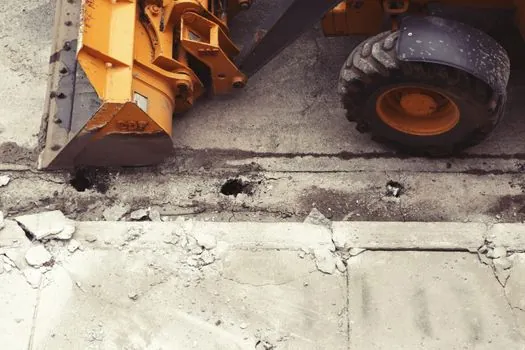
Tracked pavers move on tracks instead of tires, spreading machine weight and keeping the unit steady on soft, uneven, or new aggregate; they are the default for highways, large parking lots, and any site where stability matters more than travel speed [S3]. Wheeled pavers run on rubber tires, trade some traction for faster movement between work zones, and are common on residential streets, patch jobs, and urban repairs where maneuverability dominates [S3].
Roller selection breaks the same way. Vibratory rollers above 20 t cover deep subgrade work; static sheep-foot rollers handle clay subgrades through concentrated protrusion pressure; pneumatic-tired rollers finish the asphalt surface by kneading the mat without crushing aggregate [S1][S4]. Plate compactors cover a different envelope, granular soils and small asphalt patches, and are not a substitute for rollers on mainline paving [S5].
Decision Matrix: Paver vs Roller, Criterion by Criterion
On function, a paver places and pre-compacts; a roller densifies and finishes; the two are sequential, not interchangeable [S2]. On width envelope, pavers span 1.8-9 m laydown and run 10-100 t/h, while rollers cover whatever width the paver laid, repeated in overlapping passes [S6]. On depth envelope, rollers cover 30-80 cm subgrade lift in deep mode and a thin wearing course in finish mode, with the mat temperature window controlling pass timing [S4].
On material fit, pavers are HMA-specific (modified and hot-mix asphalt), while rollers handle cohesive clay, non-cohesive sand and gravel, cement-stabilized soil, and HMA across different sub-classes [S1][S4][S5]. On cost, the paver carries a higher upfront cost due to its screed, hydraulics, and grade controls, while rollers are a more versatile investment that also compacts soil and base layers on non-paving jobs [S2].
Use Cases, Limitations, and Common Failure Modes

Pavers fit highway pavements, urban roads, runways, and large parking lots where uniform thickness, smooth surface, and consistent mat temperature control are non-negotiable [S1]. Rollers fit anything that needs density: subgrade lifts, cement-stabilized bases, granular bases, and the asphalt wearing course above [S1][S4].
Common failure modes split by machine. Paver failures show up as mat segregation, screed-heater cold spots, and auger starvation on long pulls; a wider screed beyond the truck feed rate caps laydown at 10-100 t/h and forces stop-and-go paving, which translates into temperature joints and density loss [S6][S7]. Roller failures show up as over-compaction (aggregate crushing, mat shoving at high temperature), under-compaction (high in-place air voids, premature rutting), and surface checking (cold rolling, transverse cracks from rolling below the cessation temperature) [S4]. For an in-place density reading outside spec, the paver is rarely the cause; the roller pattern, amplitude, frequency, and mat temperature at the rolling zone are the variables to audit [S4].
Who Should Buy or Rent Which Machine
A paving contractor laying HMA full-time needs both, owned, because paver availability and roller availability must match on every shift; the bottleneck is whichever machine is not on site [S2]. A general earthworks or road-building contractor who only occasionally paves should rent a paver (specialized, high utilization threshold) and own rollers (versatile across soil, base, and asphalt) [S2][S5].
A municipal roads department doing patch work and small overlays is better served by a wheeled paver in the 1.8-4.5 m class plus a pneumatic-tired and a small vibratory roller, than by a large tracked mainline paver that cannot reposition between jobs [S3]. A large highway or airfield project needs a tracked paver at 6-9 m laydown, paired with at least three rollers (breakdown vibratory, intermediate pneumatic, finish static) sized to keep pace with the 10-100 t/h placement rate [S3][S6].
Standards and Sourcing Anchors
Specifying a paver and roller fleet ties back to standard mat-density targets (typically 92-97% of theoretical maximum density depending on layer) and to standard mix-temperature windows; mat temperature at the rolling zone, not ambient air, is the gating parameter for pass count and amplitude [S4]. For the subgrade side, lift thickness of 30-80 cm and the above-20 t single-drum vibratory class dominate current spec sheets, with sheep-foot rollers retained for clay fills [S4].
For related equipment-pair comparisons (motor grader, bulldozer, backhoe) on the same jobsite, see the Motor Grader vs Backhoe Loader spec cut and the Bulldozer vs Backhoe Loader spec cut, which share the subgrade-prep half of a paving train. For fleet-cost framing, the Bulldozer vs Skid Steer Loader spec cut covers the small-site end of the same decision tree. Trackable next signals: OEM release of 9 m+ electric-drive pavers, and revisions to any standard governing HMA rolling-temperature windows; either would shift the paver-vs-roller fleet math on the next bid.
For the relevant spec sheets and selection criteria, see roller bearing.