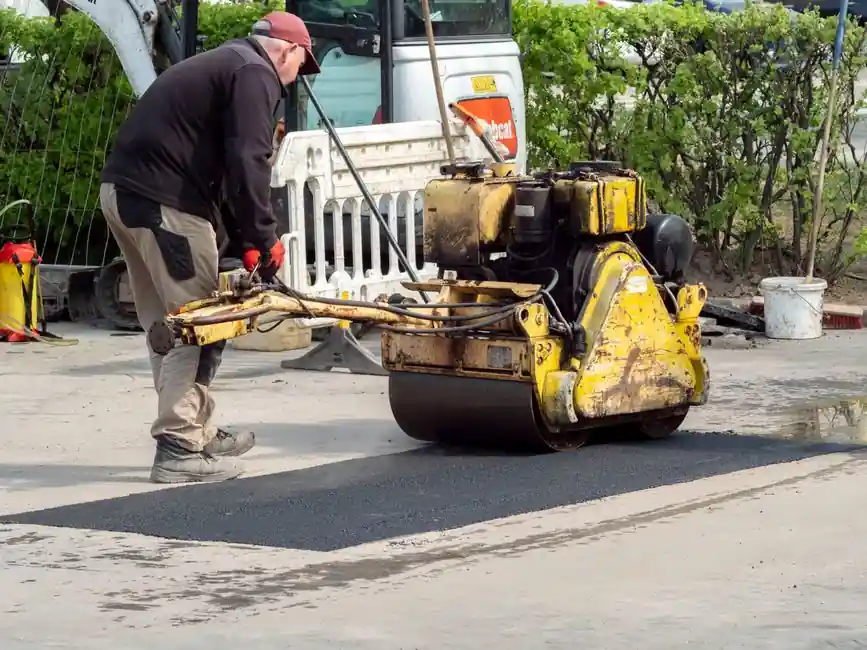
Skid steer loaders fitted with hydraulic paver attachments cover trench resurfacing, driveways, sidewalks, and parking-lot patches at adjustable widths of 36–96 inches and lift thicknesses of 2–6 inches, drawing 13–25 GPM at 2,000–3,500 PSI from the carrier [S4].
Dedicated asphalt pavers are self-propelled tracked machines with integrated hopper, augers, and a heated screed, sized for continuous mainline paving at lift widths commonly above 8 feet and placement rates a skid-steer rig cannot match [S1]. The two machines overlap on small jobs and diverge sharply once length of pull, mat thickness uniformity, or production tonnage enters the decision.
Spec envelope: carrier paver attachment vs dedicated paver
A skid-steer paver attachment package weighs 800–1,500 lb, holds 0.3–0.6 cubic yards in the hopper, and relies on the carrier's auxiliary hydraulics: 13–25 GPM flow, 2,000–3,500 PSI operating pressure, 1/2 inch flat-face ISO couplers, and a case-drain line on high-flow models [S4]. Paving width is adjusted by bolt-on extensions or hydraulic width change between 36 inches and 96 inches; heated screeds are optional for cold-weather work [S4].
A dedicated asphalt paver is a standalone machine: self-propelled on rubber tires or tracks, with its own diesel, an auger/conveyor system that meters mix from a multi-ton hopper to a full-width floating screed, and a heated vibratory or tamper screed that pre-compacts the mat. The skid steer, by contrast, is a prime mover that gains paving capability only through an add-on attachment [S1][S2].
Selection criteria: hydraulic flow, cooling, and reservoir size
Luke Gribble of John Deere Construction & Forestry and Kevin Coleman of Caterpillar both flag hydraulic performance as the first filter: the carrier must deliver the gallons per hour the attachment demands, and pressure (PSI) is what lets a cold planer or screed actuator repeatedly shear compacted asphalt [S1]. Coleman adds two non-negotiables for milling-side work, a side-by-side cooler (hydraulic oil cooler and engine radiator in one package, not stacked) so both share cooling airflow equally, and an oversized hydraulic tank that lets fluid cool before it is recirculated [S1].
For a paving attachment alone the same logic applies but in milder form: 13–25 GPM, 2,000–3,500 PSI, and a reservoir sized to absorb return-flow heat. A skid steer on wheels also performs best on hard, flat surfaces such as concrete, asphalt, pavement, or rock, while a compact track loader is the better choice on soft soil or mud [S3].
Who each option is for, and who it is not
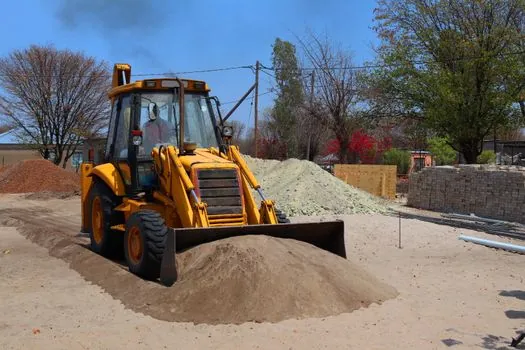
A skid steer with paver attachment is built for pavement maintenance contractors, utility crews, and municipal patch gangs working on trench resurfacing, sidewalk and bike-path construction, driveway repair, parking-lot patching, and shoulder work [S2][S4][S5]. Sarah Peckskamp of Bobcat makes the economic case bluntly: the fewer machines a contractor owns or rents to complete a job, the greater the profit margin, and a single skid steer can swap between planer, sweeper, breaker, wheel saw, vibratory roller, four-in-one bucket, and paver [S1].
It is not the right tool for mainline highway lifts, long continuous pulls, or tonnage rates above what a 0.3–0.6 cubic yard hopper can sustain, because the carrier must shuttle back to a mix truck, and the non-heated screed (on most units) limits cold-weather mat quality. A dedicated asphalt paver, by contrast, is sized for continuous runs where the contractor needs sustained placement rate, heated screed pre-compaction, and automatic grade and slope control.
Decision matrix: skid steer + paver attachment vs dedicated paver
Set against four decision criteria, the contrast is clear. Production rate: a skid-steer rig places material in batch cycles limited by hopper size (0.3–0.6 cubic yards) and carrier travel speed; a dedicated paver runs continuously from a multi-ton hopper with auger feed. Paving width: skid-steer attachments span 36–96 inches with bolt-on or hydraulic adjustment [S4]; dedicated pavers commonly exceed 8 feet and reach 20+ feet on highway-class machines. Capital cost and fleet complexity: a skid steer is a multi-purpose carrier that earns its keep across planing, sweeping, and material handling [S1]; a dedicated paver is a single-purpose asset. Site access: the skid steer pivots 360 degrees in close quarters beside other machines or obstructions, trailers between small jobs, and can complete supporting milling or cuts ahead of a larger planer [S1]; a dedicated paver needs consistent haul-truck access and a longer clear corridor.
Use a skid steer loader with paver attachment when the job is under about a few hundred square feet, access is constrained, the fleet already runs skid steers, and mat temperature control can be managed by haul timing. Specify a dedicated asphalt paver when lift length runs into the hundreds of feet, lift width exceeds 8 feet, tonnage per shift is measured in hundreds of tons, and consistent pre-compaction from a heated screed is required.
Job-site technique and safety limits
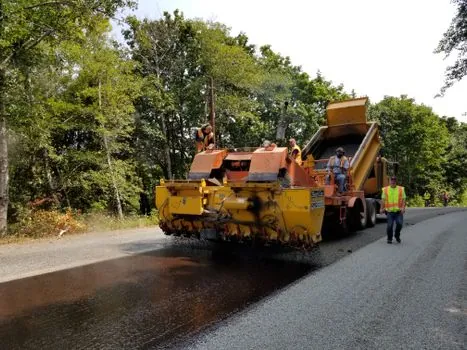
Roadrunner's MTS skid-steer paver spreader pairs a quick-attach mount with hydraulic width adjustment for trench paving, backfilling, and road-shoulder widening, while the MT model uses a bucket mount and manual width change; both are rated for controlled depth and spread width across the work face [S2]. Setup sequence: secure the attachment, connect hydraulic hoses and confirm flow direction, fill the hopper, test screed movement at low engine speed, then move forward at a slow, consistent travel speed while monitoring thickness and edge alignment [S4].
Safety limits are non-negotiable: keep bystanders at least 15 feet from moving parts, do not reach into the hopper or belt area while running, disconnect hydraulics before cleaning, and avoid paving near steep drops or unstable ground [S4]. On hot-mix work, heat-resistant gloves, steel-toe boots, and eye protection are the minimum PPE.
Standards, sourcing, and limits of the comparison
No ISO or ASTM placement-rate standard governs skid-steer paver attachments, and the typical-range figures quoted here (13–25 GPM, 2,000–3,500 PSI, 36–96 inch width, 2–6 inch lift, 800–1,500 lb attachment weight, 0.3–0.6 cubic yard hopper) are manufacturer-published ranges aggregated from attachment builders [S4]. Mainline asphalt paver performance is governed separately by machine-class specifications the OEM publishes per model; cross-comparing the two on placement tonnage is therefore a category error, since one is an attachment on a carrier and the other is a dedicated placement machine.
Trackable signals for the next planning cycle: attachment builders continuing to widen the upper end of paving-width adjustment toward 96 inches and beyond, more heated-screed options migrating down-market from dedicated pavers into the attachment class, and carrier makers pairing side-by-side coolers with high-flow hydraulics to support milling-plus-paving duty cycles on a single skid steer [S1][S2][S4]. For related comparisons on compact equipment and compaction roles, see the road roller vs skid steer decision map and the asphalt paver vs road roller spec cut.
Spec-level background on the components involved: backhoe loader.