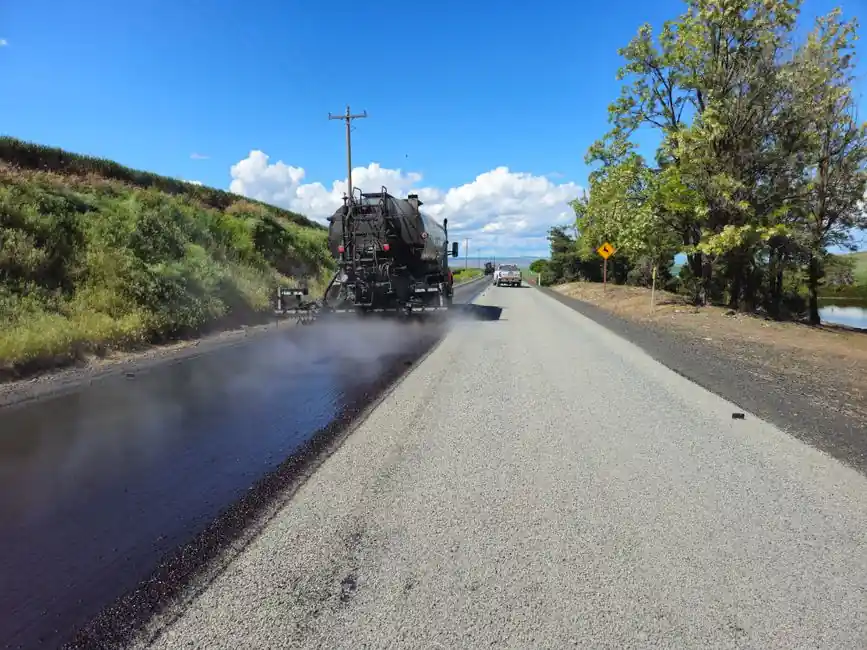
A road roller and a cold milling machine are sequential machines on the same resurfacing train, not substitutes, and 2026 spec sheets confirm the divide: rollers sit in the 1-22 t band compacting lifts of 100-200 mm, while half-metre to 2 m cold mills run 80-450 kW cutting depths of 0-300 mm [S1][S5].
Confusion arises because both machines list width and depth as headline numbers, but the physics are inverted: a roller's "depth" is the loose-lift thickness it can densify before traffic, while a miller's "depth" is the failed pavement it removes per pass. This map walks the four gates that actually separate a buying decision in 2026, with model-code examples drawn from current OEM catalogs.
Process Position: Miller First, Roller Last, Paver in the Middle
A cold milling machine is the first major plant on a resurfacing contract, stripping bound asphalt or concrete with a rotating drum studded with conical tungsten-carbide picks, loading the millings onto a conveyor, and leaving a textured surface that bonds with the next lift [S3][S7]. The Dynapac high-capacity band calls for 1.0-2.2 m working width and 0-320 mm cutting depth on mill-and-fill highway work, and the same source notes that 1 cm of over-removal across 10 km forces an extra 490 t of asphalt to be paved back to grade [S3].
A road roller is the last machine on the train, compacting the fresh mat the paver placed. Dynapac frames the process as mill, sweep, tack, pave, and then compact, with the cold planer always followed by a road sweeper and sometimes high-pressure cleaners before the new wearing course goes down [S3]. A contractor who buys a roller thinking it replaces a miller will simply press the failed surface back into service and watch the cracks migrate through the new lift within a season [S3][S4].
Spec Comparison: Four Criteria Side by Side
Width and depth mean different physics on each machine. On a cold mill, width is the drum swath stripped per pass (0.5-2.0 m in the Shantui 2026 catalog, 0.35-1.0 m in the Dynapac city-work class), and depth is the failed material removed (0-300 mm on a 1 m mill, 0-320 mm on a 2 m highway mill) [S3][S5]. On a roller, width is the compaction drum footprint (typically 1.2-2.1 m on tandem and single-drum units), and the relevant depth is the loose lift thickness, which Dynapac's process notes set at 100-200 mm before roller compaction for full density.
The four criteria that actually separate the buying decision: (1) process position, where the miller removes and the roller densifies; (2) production basis, with milling measured in m² of surface removed per shift and rolling measured in tonnes of mix compacted per pass; (3) tooling, where mills carry 100-200 carbide picks on the drum and rollers carry steel or rubber drums at 30-80 Hz vibratory frequency; (4) drive chassis, where rollers split into tandem, single-drum, and pneumatic-tyre classes and mills split into wheeled and crawler chassis with hydraulic or mechanical drum drive [S4][S5][S6].
For comparison on a representative 2026 contract, the Shantui 1 m cold mill at 150-200 kW pairs against a 12-14 t tandem vibratory roller in the 75-100 kW class; the Wirtgen-style 2 m highway mill at 350-450 kW pairs against an 18-22 t single-drum soil roller or a 16-20 t pneumatic-tyre roller for the wearing course [S5]. The 0.5 m mill at 80-130 kW is the realistic small-job match for a 3-5 t ride-on roller used on patch work and trench reinstatements.
Diesel Power, Weight, and Ground Pressure
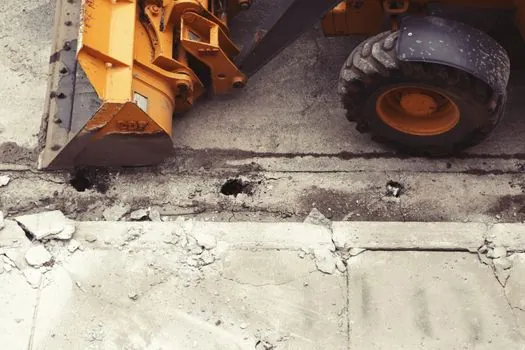
Cold milling power scales with drum width and cutting depth. The Shantui envelope is 80-130 kW for a 0.5 m mill at 100 mm depth, 150-200 kW for the 1 m class at 0-300 mm depth, and 300-450 kW for the 2 m class on compacted asphalt or cement-stabilized gravel, with cutter drum speed in the 90-120 rpm band and line speeds of 0-30 m/min [S5]. Highway-class mills in the Dynapac high-capacity band sit on the upper edge of that range, with 2.2 m drums and 320 mm max cutting depth reserved for night-time mill-and-fill contracts on otherwise busy roads [S3].
Roller power and weight scale with compaction force, not removal force. A 12-14 t tandem vibratory roller typically runs 75-100 kW to drive vibration at 30-50 Hz on the drum and 40-60 Hz on the rear, with centrifugal force in the 150-250 kN band. A 1-2 t walk-behind plate compactor, the smallest member of the roller family, runs 3-6 kW and is the right answer for trench reinstatements behind a 0.5 m mill but is not a substitute for it [S4]. Crawler mills must hold ground pressure below 40 kPa on soft subgrade, a gate that does not apply to rollers because they compact a finished surface, not a subgrade [S5].
Dust, Water, and Conveyor: The Secondary Gates
Three secondary gates separate a working mill from a liability: conveyor swing and discharge height, on-board water tank capacity for dust suppression, and the hydraulic system that drives side-shift and drum elevation [S6]. Pipeline right-of-way work in 2026 calls for 1.2-1.5 m track units because the conveyor has to load standard highway trucks, and the wheeled equivalent is reserved for paved urban tie-in sections at each end of the line where maneuverability matters more than ground pressure [S6].
Rollers have a different secondary gate set: water tank capacity for drum wetting on asphalt passes, vibration on/off for granular vs bound layers, and a drum-edge sprinkler to prevent pick-up on the fresh mat. A roller without vibration is a static roller, useful only for finish rolling on thin lifts, and is the wrong spec for the 100-200 mm lifts that follow a mill-and-fill train [S3][S4]. The Dynapac high-capacity process explicitly requires a sweeper and sometimes high-pressure cleaners between mill and pave, a step that has no analog on the roller side of the train [S3].
Failure Modes: Why Substituting One for the Other Loses Money
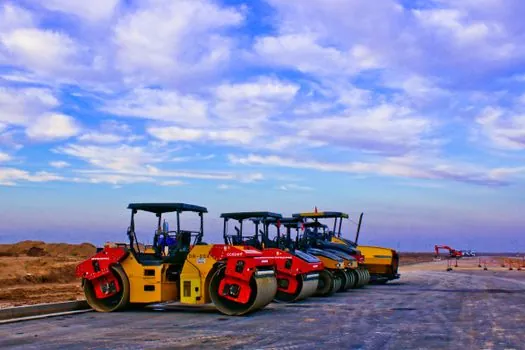
Substituting a roller for a miller leaves the failed bound layer in place, and the new overlay cracks through within a season because the reflective crack migrates upward through the fresh mat [S3]. Substituting a miller for a roller leaves the fresh mat at 85-92% of theoretical density, which is below the 95-97% range most highway wearing-course specs require, and the surface ruts under traffic within the first summer [S3][S4].
The Shantui 2026 catalog places the four chassis-and-drive permutations per width (wheel-crawler times hydraulic-mechanical) at the same price band, so a buyer cannot use cost to dodge the chassis question: a 2 m wheel mill at 18-22 t empty will exceed most rural bridge axle loads, and the crawler variant becomes mandatory on any soft subgrade or mud-prone feedlot [S5]. On the roller side, the equivalent gate is drum type: a sheepfoot or padfoot drum is required for clay or silt subgrade, a smooth drum for asphalt, and a pneumatic-tyre drum for the intermediate seal and finish rolling on hot mix, with no single drum covering all three [S4].
Standards, Sourcing, and 2026 Catalog Reality
Buyers in 2026 source cold mills from Chinese OEM catalogs (Shantui 0.5-2 m width range, ORIEMAC grouping cold mills with motor graders and asphalt pavers under road construction machinery) and used inventory (1995 Bitelli SF-210 tracked units resold through Middle East, Africa, and Europe channels on Plantandequipment.com, dated 2026-07-18) [S5]. Roller sourcing overlaps the same channels but adds the small-plate compactor class for trench reinstatement, which sits below the roller line in most catalogs.
For a deeper look at the roller side of the train, the Road Roller vs Skid Steer Loader 2026 decision map covers the compact-equipment gate where tandem rollers and skid steers compete on the same patch-work contracts. The Road Roller vs Backhoe Loader 2026 spec map covers the heavier end where single-drum soil rollers and backhoes both show up on subgrade prep. The Dynapac cycle frames mill, sweep, pave, and compact as one continuous process, so a fleet that owns a miller without a roller, or a roller without a paver, is buying half a train [S3].
Trackable signals into late 2026: Shantui and Wirtgen 2 m class pricing on crawler chassis, Bitelli used-inventory turnover on Plantandequipment.com, and any new 2.2 m drum width above the current 0-320 mm depth ceiling would reset the highway-class mill envelope.
Detailed specification references: cold chamber machine.