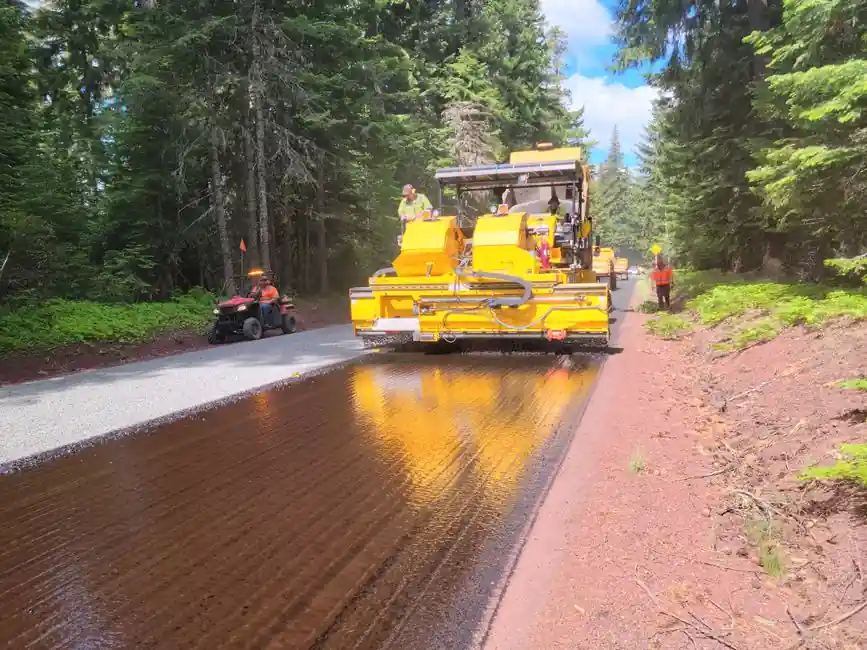
Diamond grinding removes surface irregularities from concrete pavements caused by faulting, curling, and warping, with closely spaced diamond blades typically taking off about 1/4 inch (6 mm) per pass to leave a longitudinal corduroy texture [S1][S2].
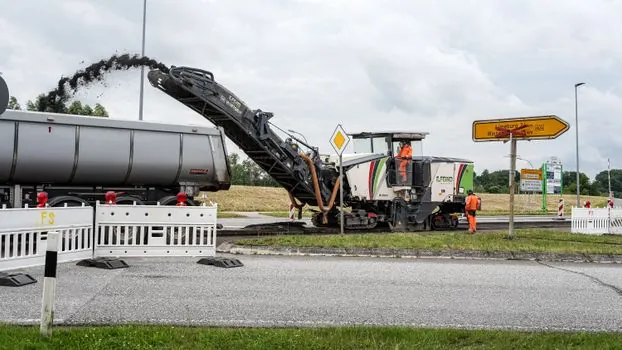
Cold milling, in contrast, uses a wider drum of carbide-tipped tools to strip 1-4 inches (25-100 mm) of asphalt or concrete in a single pass, making it the heavier removal option when thickness, material recovery, or profile change drive the project [S3][S5].
Cutting Tool Geometry and Surface Texture
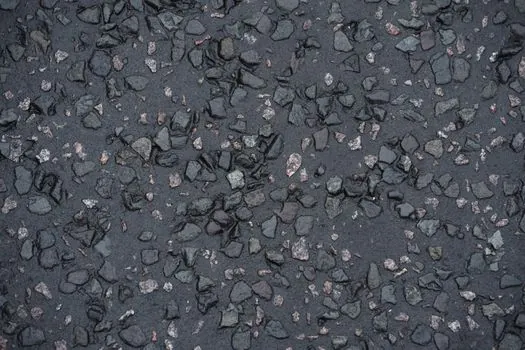
Diamond grinding stacks diamond-impregnated blades on a shaft at roughly 50-60 blades per foot (165-195 per metre) running circumferentially, producing a land area between grooves of about 0.08-0.12 inch (2-3 mm) and a longitudinal texture that holds skid resistance under traffic [S1]. Cold milling drums carry fewer, larger carbide bits welded in helical patterns, with typical spacings of 0.6-0.75 inch (15-19 mm) that leave a much coarser, more open surface suitable for an overlay or new wearing course rather than direct traffic [S3][S5]. The result is two visibly different textures: a fine, directional corduroy after grinding versus a pitted, transverse-to-rotation pattern after milling, which is why a cold milling machine is rarely a substitute for grinding on bare concrete.
Depth of Cut and Production Rate
FHWA guidance on diamond grinding holds the removal window to roughly 1/8 to 3/8 inch (3-10 mm) per pass because the technique is calibrated to flatten the existing slab profile, not to remove structural material [S1]. Cold milling routinely operates at 1-4 inches (25-100 mm) per pass, with high-power half-lane and full-lane machines capable of deeper cuts in multiple passes, which is the primary reason milling is selected for thickness reduction before an overlay [S3]. The depth difference drives production: a half-lane cold mill can remove 1 inch of asphalt from one lane-mile in roughly 1-2 hours under typical conditions, while diamond grinding on the same lane-mile often runs 2-4 hours because the cut is shallow and blade-to-slab contact is dense [S1][S3].
Service Life and Ride Performance
ADOT's Maricopa County pilot, expanded to all feasible Regional Freeway projects in October 2023, recorded a service life of approximately 30 years for a diamond ground surface versus 10-15 years for a rubberized asphalt overlay, with noise levels that did not measurably rise over the monitoring period [S2]. Cold milling does not by itself extend service life; it is a removal operation whose benefit is realised only when followed by a new surface course, and its roughness and open texture are not intended as a final wearing surface [S3][S5]. For ride quality, a properly ground jointed concrete pavement can return International Roughness Index values to the 60-100 in/mi range from starting points above 150 in/mi, while milling alone does not produce a smooth finished ride on the milled plane [S1].
Noise, Skid Resistance, and Friction
The longitudinal corduroy from diamond grinding is widely cited as quieter than transverse tining or aged asphalt surfaces, with on-board sound intensity measurements typically 2-4 dB(A) lower than transversely tined concrete and 3-6 dB(A) lower than diamond ground textures that have been re-textured by traffic [S6]. Skid resistance on a freshly ground surface sits in the 50-60+ range on a typical ribbed-tire friction test, depending on aggregate hardness, and that benefit persists as the surface wears because the grooves are oriented along the traffic direction rather than across it [S1][S6]. A milled surface is louder and rougher at the tire interface, and the open pattern is designed to be sealed by a subsequent overlay, not to carry traffic long term, which is a key spec trade-off for any asphalt paver working directly behind a milling train [S3][S5].
When Diamond Grinding Is the Right Call
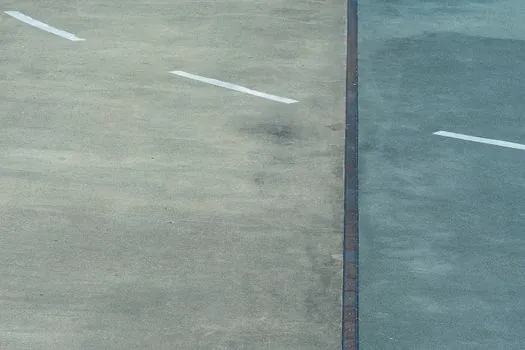
Specify diamond grinding when the existing jointed plain or jointed reinforced concrete pavement is structurally sound, when faulting is the dominant distress, and when the goal is to restore ride, friction, and noise without changing the surface elevation or losing structural capacity [S1][S2]. The FHWA Concrete Pavement Rehabilitation framework treats grinding as a stand-alone preservation tool or as the finishing step in a larger CPR programme, paired with joint resealing, dowel-bar retrofit, or full-depth repair as needed [S1]. It is not appropriate over asphalt bases, which is why ADOT excludes segments such as Interstate 10 between SR 85 and Verrado Way, Loop 202 South Mountain, and I-17 north of Anthem Way from its grinding programme [S2].
When Cold Milling Is the Right Call
Specify cold milling when 1 inch or more of material must be removed, when the existing surface is asphalt or a composite with fatigue distress, when the project requires a profile change for an overlay thickness, or when the contractor needs to recover the removed material as recycled asphalt pavement or recycled concrete aggregate for reuse in the mix [S3][S5]. Milling is also the right choice for removing a previous open-graded surface, restoring curb reveals and drainage, or correcting a cross-slope before a thin overlay. Compared with diamond grinding, milling is louder at the drum, generates coarser RAP, and leaves a surface that must be covered rather than opened to traffic.
Decision Matrix: Four Criteria, Two Operations
On removal depth, grinding is fixed at roughly 1/8-3/8 inch while milling spans 1-4 inches, so any project needing more than about 1/2 inch of cut defaults to milling. On noise, grinding's longitudinal texture is a quieter final wearing surface, while milling produces a rough pattern that is unsuitable as a finish. On material recovery, milling returns usable RAP or RCA at scale, while grinding generates a fine slurry that is generally not reused as aggregate. On cost, diamond grinding typically runs in the low single-digit dollars per square yard for the grinding pass itself, with Maricopa County's regional programme projecting multi-million-dollar savings versus a $1 billion 2020-2029 asphalt-replacement baseline, while cold milling is bid per square yard or per lane-mile at higher unit prices driven by depth and haul-off [S1][S2][S3].
Limits, Failure Modes, and Equipment Constraints
Diamond grinding cannot fix structural slab problems such as pumping, severe cracking, or D-cracking, and over-grinding can reduce the effective slab depth and accelerate joint faulting if the underlying support is poor [S1]. Cold milling on concrete with a hard aggregate can accelerate tool wear on carbide bits and produce a rough profile that is difficult to overlay uniformly, which is why some agencies specify micro-milling drums for tighter texture on preservation overlays [S3][S4]. Both operations require dust suppression and water management: grinding generates a fine cementitious slurry that must be vacuumed from the surface, while milling generates coarser millings that are loaded directly into haul trucks for stockpiling or recycling [S1][S5].
For 2026 project planning, the most trackable signals are ADOT's continued Maricopa County monitoring of the 30-year diamond ground surface and any updates to the FHWA CPR bulletin, both of which set the comparison baseline for grinding-versus-overlay-versus-mill decisions on the next concrete rehabilitation cycle [S1][S2].