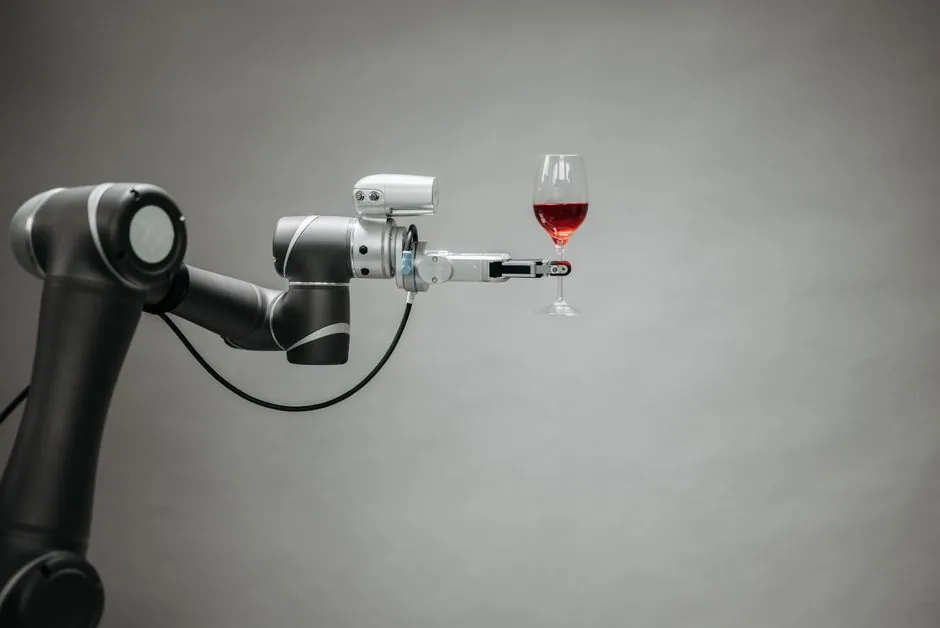
Collaborative robots operate through four ISO 10218 methods: safety-rated monitored stop, hand guiding, speed and separation monitoring, and power and force limiting [S2][S3][S5].
The classifications describe how a robot shares a workspace with people, not simply its arm geometry, payload, reach, or mounting arrangement [S1][S7].
Four Collaborative Operation Classifications
Collaborative robot operations include four types of collaborative operation methods. The method identifies the protective function that controls exposure to the robot while work is shared or performed near people.
Safety-rated monitored stop requires the robot to stop safely when a person enters the collaborative workspace. Hand guiding permits direct physical control by a person, while speed and separation monitoring manages motion through protective separation distances. Power and force limiting methods limit contact force or pressure and require evaluation of contact energy.
These are operation methods rather than permanent product labels. One collaborative robot can be applied under more than one method if the cell, task, risk assessment, and safeguarding arrangement support that design [S1][S5].
Safety-Rated Monitored Stop
A safety-rated monitored stop requires a person entering the collaborative workspace to cause a safe stop.
When a person enters the collaborative workspace, the robot must stop safely.
This method suits applications in which intermittent human access is expected, including machine tending and assembly tasks where a person periodically works at the same station [S1][S3].
Hand Guiding and Direct Human Control

Hand guiding allows a person to guide the robot directly, with the system limiting speed and force while taking control of the arm [S1][S3][S5]. The collaboration occurs through physical interaction rather than through a shared automatic cycle.
Hand guiding is relevant to path teaching, repositioning, and applications where an operator needs direct control over the robot end effector [S1][S3].
A hand-guiding application should not be treated as permission for unrestricted manual operation around an otherwise uncontrolled robot. The safety function, permitted contact behavior, and operating procedure remain part of the selected collaborative method [S1][S5].
Speed and Separation Monitoring
Speed and separation monitoring uses distance-based protective measures to reduce the risk of contact between the robot system and an operator [S2][S5]. Distance-based protective measures stop the robot before the required separation is violated.
When a person approaches, the robot may reduce speed as separation decreases and stop before the protective separation distance is violated. As the person withdraws and the monitored conditions are restored, the operating strategy can permit motion again [S1][S5].
This method fits variable human interaction, including loading, unloading, inspection, and assembly support around a moving manipulator. It is not suitable where an operator must remain within the robot's motion path while the tool poses a contact hazard, because speed control alone does not make every contact safe [S3][S5].
Power and Force Limiting
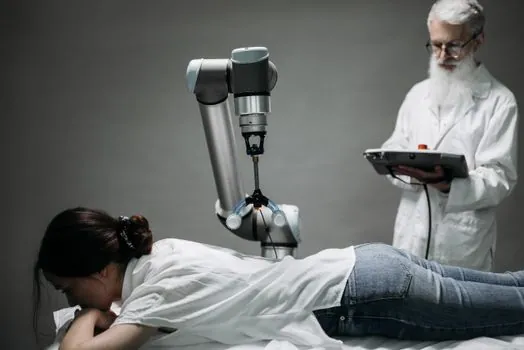
Power and force limiting permits contact by limiting the force or pressure that the robot system can transmit to a person [S2][S3][S5]. The robot, tool, workpiece, process, and motion behavior are evaluated together because the end effector can materially alter contact energy [S5].
Compared with speed and separation monitoring, the distinguishing control is direct contact-energy limitation rather than maintained separation from the robot [S1][S5]. Contact-risk assessment evaluates the robot, tool, workpiece, process, and motion together because the end effector can alter contact energy.
Power and force limiting requires task-specific risk assessment. Product claims alone do not establish that a complete application is collaborative.
Choosing Between the Four Methods
The decisive selection criteria are contact probability, required human interaction, process hazards, and the ability to maintain protective separation. Safety-rated monitored stop favors intermittent access, hand guiding favors direct control, speed and separation favors variable approach, and power and force limiting favors controlled contact exposure [S1][S3][S5].
For recurring operator attendance, safety-rated monitored stop offers the clearest stop-and-resume structure.
Application Fit and Non-Fit Conditions

Collaborative robots are designed to work in a shared workspace with human operators [S7]. Their four classifications can support applications involving assembly, machine tending, inspection, welding support, and material handling, provided that the selected operating method matches the actual human interaction [S3][S4].
A cobot is not automatically suitable for every unguarded task. Collaborative capability does not eliminate the need for a risk assessment, and external guarding or other safety devices may still be necessary depending on the application [S4]. Welding, cutting, heat, sharp edges, heavy payloads, and fast tooling can introduce hazards beyond arm contact.
For low-volume assembly, tabletop tending, or research work, a cobot can offer flexible deployment in a shared workspace [S7]. For a high-speed production line requiring unrestricted human access during motion, an articulated robot behind an appropriately engineered safety system may be the more defensible architecture.
Architecture Labels Do Not Replace Risk Assessment
Collaborative operation, arm architecture, and application mode are separate classification layers. A six-axis cobot, an SCARA robot, and a cobot configured for linear feed may use different motions, yet each still needs a documented safety strategy for its application [S1][S7].
The application risk assessment should identify the four operation methods as design options, then verify whether the selected robot, end effector, workpiece, process, speeds, separation scheme, and operator procedure can satisfy the intended method [S1][S5]. Validation belongs at the application level, not at the product-category level.