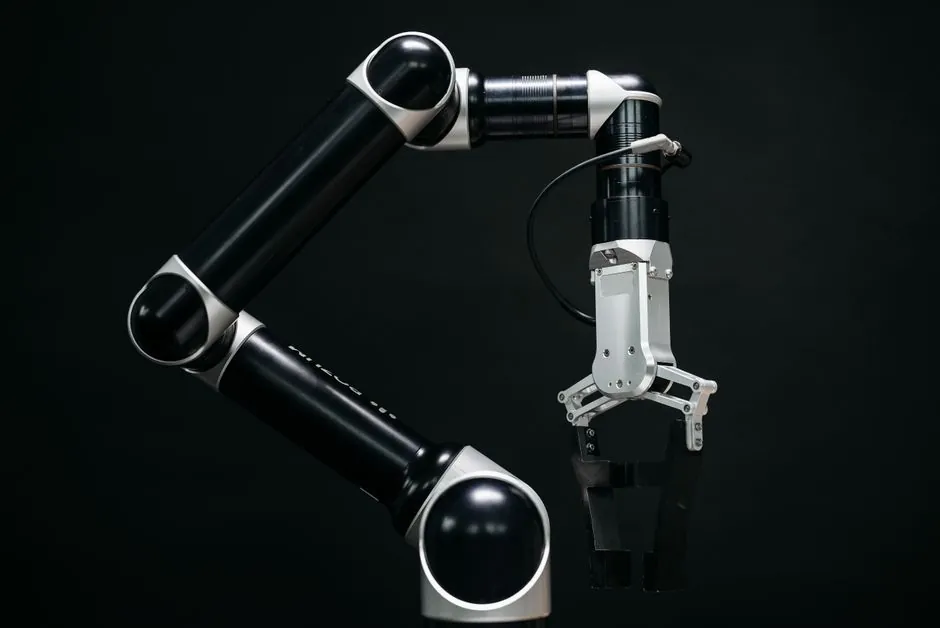
SCARA robots use 3 rotary axes and 1 linear axis to provide 4 degrees of freedom, combining fast X-Y positioning with rigid Z-axis insertion [S3].
Common SCARA classifications include compact, standard, high-speed or high-precision, high-load, and special-purpose machines, with typical price bands of $12,000–$36,000, $36,000–$78,000, and $78,000 or more [S2].
SCARA Architecture and Four-Axis Operation
A SCARA is a horizontal articulated robot whose name expands to Selective Compliance Assembly Robot Arm or Selective Compliance Articulated Robot Arm [S4]. Its architecture uses 2 parallel rotary joints for X-Y positioning, 1 vertical linear axis for Z movement, and a fourth rotary axis for tool orientation [S3].
SCARA robots have four axes, and their arm is compliant in the horizontal plane while remaining rigid vertically [S3].
The arrangement produces a characteristic kidney-shaped horizontal work envelope [S3].
Primary SCARA Robot Types
Compact SCARA robots are the entry classification, with the lower price band of approximately $12,000–$36,000 covering compact and standard configurations with basic functions suited to smaller jobs [S2]. Standard SCARA robots remain in the $12,000–$78,000 range depending on performance, while high-speed or high-precision, high-load, and special-purpose machines occupy the $36,000–$78,000 and $78,000-or-higher bands [S2].
High-load machines are separated from standard machines because they combine greater payload capability with structural demands suited to heavier handling [S2]. Special-purpose machines target application-specific requirements rather than general pick-and-place, while high-speed and high-precision models add demanding motion and positioning performance [S2].
These commercial classes overlap with the mechanical description of SCARA robots as serial or parallel two-link architectures [S4]. A serial SCARA uses conventional serial arm geometry, while a parallel SCARA uses a parallel-link arrangement, so architecture, duty profile, and performance class must be reviewed separately.
Selection Criteria by Application

Their vertical rigidity supports insertion tasks, including round-pin-to-round-hole assembly, while limited horizontal compliance helps tolerate small alignment errors without binding [S1][S4].
Payload, reach, vertical stroke, repeatability, cycle time, tool orientation, and environmental requirements should be checked together. The horizontal envelope is governed by 2 linked arm segments and is not equivalent to a cylindrical or Cartesian envelope, while the vertical stroke commonly falls within 100–400 mm [S3].
SCARA robots suit assembly, transportation, screw tightening, coating, palletizing, pick-and-place, and dispensing [S2][S3][S5]. A dedicated collaborative robot is the better starting point when the task requires direct human interaction, safer force control, or a broad range of motions outside a fixed horizontal work area.
SCARA, Articulated, and Delta Alternatives
SCARA robots outperform typical horizontal motion requirements because they combine a compact pedestal mount with short vertical tool travel, while their fixed swing-arm geometry restricts access around obstructions [S1][S4]. Articulated robots are available in 4-, 6-, and 7-axis units, and their flexibility, dexterity, and reach make them suitable for certain tasks [S1].
Against Cartesian systems, SCARA robots are commonly faster-moving and easier to integrate than Cartesian robots [S5]. A SCARA is therefore strongest for rapid, top-down assembly in a defined envelope, while an articulated robot wins for orientation changes, a delta robot wins for high-speed light-part handling, and a Cartesian robot wins for long, configurable linear strokes [S1][S4][S5].
Limits, Failure Modes, and Sourcing Checks
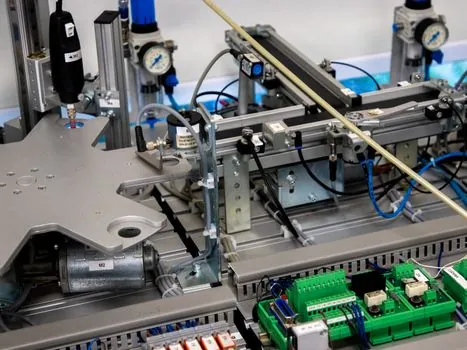
The main mechanical limitation is the fixed swing-arm design, which prevents a SCARA from readily reaching around or inside fixtures, jigs, and machine tools [S1].
SCARA mechanical assemblies typically include a base, rotation axis, parallel arm, lift mechanism, and end effector [S2]. Buyers should verify the rated payload at the required reach, allowable tool mass, vertical stroke, repeatability, cable routing, duty cycle, and end-effector orientation before accepting a model [S2][S3].
For compliance-sensitive assembly, verify that the selected controller and end effector preserve the intended relationship between horizontal compliance and vertical rigidity [S4]. For high-speed production, test the full motion path with the installed tool and payload because cycle time depends on more than nominal axis acceleration [S3].
The SCARA robot classification is therefore not a single performance grade: it combines a 4-axis mechanism with commercial classes ranging from compact equipment to high-load and special-purpose systems [S2][S3].
Track two procurement signals when evaluating a SCARA cell: the supplier must state whether the model is serial or parallel, and it must provide payload, reach, vertical stroke, and repeatability at the intended operating point rather than headline values alone [S2][S4].