
Roll-formed pallet rack is made from cold-rolled sheet steel, typically 12-16 gauge, with beam capacities running from 1,700 to more than 10,000 lb per beam pair [S2]. Structural pallet rack is fabricated from hot-rolled steel channels and beams, joined with bolted beam-to-upright connections, and is built to absorb forklift impact in heavy-throughput facilities [S3].
Both upright systems support the same basic selective-rack workflow, but the manufacturing route, steel grade, connector type, and downstream repair profile are different enough that the wrong pick shows up as either overspent capacity or chronic column damage. This article lines the two upright-frame families up against the criteria a process engineer actually uses to write a pallet rack spec.
How the Two Upright Frames Are Made
Roll-formed uprights start as flat steel coils fed through a sequence of roller dies, each pass bending the column closer to its finished closed or partly-closed profile. The bends and folds in the sheet are what give the column its stiffness, so a roll-formed section with more lengthwise bends carries more load than a flat-sided equivalent [S1][S2]. The punched teardrop pattern is stamped into the column at the same line, which is why roll-formed rack ships as a tool-free kit with safety clips and is the North American default for selective racking [S5].
Structural uprights are produced by hot-rolling raw steel into C-channel or I-beam sections that reach their full strength once cooled. The steel cannot be bent afterwards without compromising its integrity, which is the design intent: the profile stays rigid under repeated impact and high pallet loads [S3]. A commonly cited spec for these sections is a minimum 50,000 psi yield strength on the upright column, with beam-to-column connections designed for repeated stress rather than a single impact event [S4].
Beam-to-Column Connection and Its Consequences
Roll-formed beam-to-column connections are boltless. Beam-end tabs drop into the teardrop slots on the upright and seat under load, then a safety clip is driven in so a upward forklift strike cannot lift the beam back out. This is what makes roll-formed pallet rack re-pitchable with a mallet and a fresh safety clip, and why most selective warehouses reconfigure bay levels in-house [S5].
Structural rack uses bolted beam-to-column connections, with beams typically specified as C3 or C4 hot-rolled channel sections (3-inch or 4-inch open C-profile) bolted through pre-punched holes in the upright. The bolted joint is stronger and stiffer at the connection itself, but every beam change means unbolting, moving, and re-bolting, so reconfiguration labour is materially higher [S5][S3]. For a facility that rarely changes beam elevations, the bolted joint is the right trade.
Load Capacity and Frame Stiffness, Side by Side
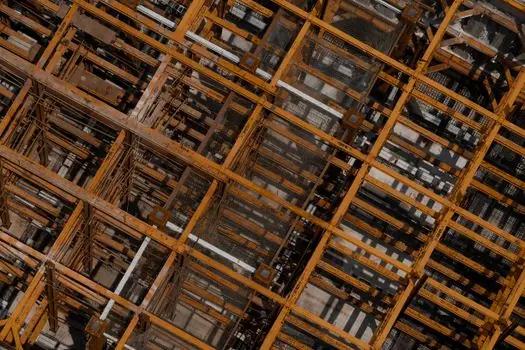
On a per-level basis, standard roll-formed selective racking typically handles 1-3 tons per level, while structural racking often exceeds 3 tons per level depending on the design [S4]. Beam capacity on roll-formed systems is documented in the 1,700-10,000+ lb per pair range, with the high end of that band reserved for closed box-beam pairs rather than step beams [S2].
Frame stiffness follows the same pattern. A roll-formed upright is a thin section doing a lot of structural work, and a dent from a forklift strike changes the effective cross-section so the column no longer carries what the published load chart says it carries [S5]. A structural column has more material in the same place, takes the same hit with less permanent deformation, and is the specifier's choice when rack damage history is part of the operating reality [S3][S5]. For facilities outside that risk band, the extra steel is overspec.
Decision Matrix: Roll-Formed vs Structural Upright
Comparing the two upright-frame families on the criteria that drive a rack spec: [S2]
Cost per pallet position: roll-formed is lower; structural is higher [S1][S2][S5]. Install speed: roll-formed is faster, no hardware at every joint; structural is slower, bolted at every joint [S5]. Re-pitching a beam level: roll-formed uses a mallet and a fresh safety clip; structural requires unbolt, move, re-bolt [S5]. Forklift impact tolerance: roll-formed bends under repeated contact; structural absorbs impact better [S3][S5]. Wet, freezer, wash-down environments: roll-formed's closed tube can trap moisture, while structural's open profile drains and dries [S5]. Typical per-level load: roll-formed 1-3 tons, structural over 3 tons [S4].
The matrix points to a simple rule: if the aisle sees repeated forklift contact, wet or wash-down conditions, or pallet loads that approach the upper end of the roll-formed band, structural rack earns its premium. If the operation needs reconfigurability, fast install, and the lowest first cost on standard pallet weights, roll-formed is the right pick [S3][S5].
Operating Environments and Failure Modes
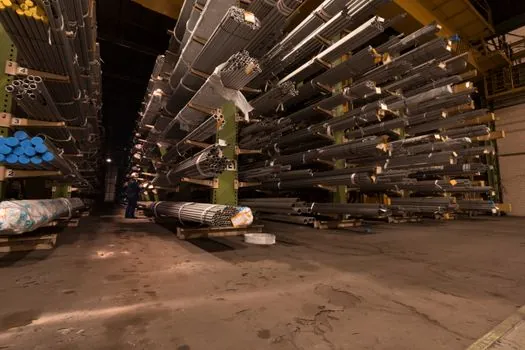
Roll-formed rack is most commonly found in environments with less intense storage needs, including retail and third-party logistics warehouses, and is the most widely manufactured rack type in the world, so replacement parts and add-on bays are easy to source [S2][S3]. The known failure mode is column damage from forklift impact that reduces the effective cross-section of the upright and invalidates the load chart; modern roll-formed fabrications have improved durability, but the thinner gauge still makes them more susceptible to impact than structural sections [S2].
Structural rack is the default in high-throughput distribution centres, food and beverage facilities, building-materials storage, and any environment where forklifts move fast and frequently [S3]. Documented failure modes include bent column legs and base plates from forklift contact, which is why OSHA's 1910.176(b) requires unstable or unsecured storage to be flagged, and why a real-world 2021 citation involved roughly 3,500 lb of stored product put at risk until the bay was isolated and professionally evaluated [S4]. Outside rack uprights and beam protectors are the cheaper half of the same trade, and on moderately busy roll-formed aisles they are often the right answer; structural rack is what gets specified when guards alone are not enough [S5].
Standards, Sourcing, and What to Verify on the Print
For sourcing, the storage rack market splits between roll-formed and structural fabrications, with both families commonly designed to RMI/ANSI MH16.1-style specification conventions and PE-sealed drawings for capacity. A specifier should confirm on the submittal: steel yield strength on the upright column (the 50,000 psi figure cited for structural columns is a useful floor, not a universal), base-plate thickness, beam channel size (C3 vs C4 for structural), and whether the beam-to-column connection is boltless teardrop or bolted [S4][S5].
For operations adding roll-formed bays next to structural, or vice versa, the easier path is to stay in the same family: parts, connectors, and re-pitch tooling match, and used-rack sourcing is straightforward. Cross-family mixing is possible but adds connector adapters and a second set of spare parts. The decision typically belongs in the rack-identifier and layout stage, before the floor is anchored, because swapping upright families after installation is a teardown, not a reconfiguration. For a deeper look at how pallet-handling attachments derate when bolted onto other equipment, the field guide on forklift fork length and width selection by pallet type covers the downstream spec side.