
At-height crews doing hot work or pipeline repair above grade should carry a personal 4-gas detector (LEL/O2/CO/H2S) with a catalytic bead or NDIR sensor, Ex d IIB or Ex ia IIC certification, and a 95+ dB audible plus 360° visible alarm [S1].
The detector itself does not stop a fall — a full-body harness with shock-absorbing lanyard does — but the wrong sensor, a dead battery, or a silenced buzzer can turn a small gas pocket on a scaffold into a fatality, which is why the detector selection and the PPE stack have to be specified together.
Catalytic Bead vs NDIR: Picking the Sensor for an Elevated Work Site
Catalytic sensors oxidise combustible hydrocarbon on a platinum-treated wire coil; the heat of reaction changes coil resistance, and a Wheatstone bridge turns that change into a 0–100% LEL reading, making them the cheapest path for general hydrocarbon monitoring in air [S1].
NDIR (non-dispersive infrared) units use a transmitter–receiver optical path; hydrocarbon vapour absorbs IR at characteristic wavelengths, so the detector measures attenuation rather than burning the sample, which is why IR is the default where the gas mixture may be oxygen-deficient (confined purges, manholes, post-fire atmospheres) or where catalyst poisoning is a known risk [S1]. For a hot-work crew cutting pipe 8 m up, catalytic-bead is acceptable; for a coating crew entering a freshly nitrogen-purged tank on an aerial lift, NDIR is the safer pick because a catalytic head will read low in low-O2 even when the hydrocarbon fraction is well above LEL.
Certifications and Protection Concepts That Actually Matter on a Boom
Combustible gas detection is mandatory wherever flammable accumulation can endanger workers or the surrounding public, so any detector carried onto an aerial work platform must be third-party certified to the protection concept of the zone in which the platform operates, not just "ATEX" stamped on the case [S1].
For Zone 1 continuous-presence tasks specify Ex d (flameproof enclosure) or Ex e (increased safety) with a temperature class that suits the gas group — T4 (≤135 °C) covers most hydrocarbons, T6 (≤85 °C) is required for hydrogen-rich atmospheres. For Zone 0 or confined-space entry on a boom, only Ex ia (intrinsic safety, ia level) keeps the ignition energy below the gas ignition threshold under two simultaneous faults, which is why hand-held personal detectors such as the Hanwei BX616 portable 4-gas unit are typically supplied in an Ex ia IIC version [S1]. Check the certificate, not the data sheet brochure: a 4-20 mA output that is "ATEX" but only Ex e will not survive a Zone 0 entry, and the boom man cannot tell until it is too late.
Fixed vs Portable: What Belongs on a Lift Basket

Fixed combustible gas detectors, often wall-mounted or duct-mounted (BS03 is a common example), give continuous area coverage powered from a controller loop, while portable units are clip-on personal monitors running on rechargeable Li-ion with a 10–24 h typical shift life [S1][S3].
For a typical at-height job — telecom tower painting, refinery pipe rack repair, rooftop HVAC — the portable personal monitor is the primary safety device because it moves with the worker; a fixed detector 10 m away on the ground tells the control room but not the man on the plank. The fixed gas detector does the perimeter job around the lift's stowed position, the portable does the breathing-zone job on the platform. Running both is common practice on multi-day turnaround work and is consistent with the Yaoan (Shenzhen) product split of 12 dedicated combustible units, 56 portable multi-gas models, and 51 fixed units all listed under one gas-detection catalogue [S3].
Alarm Output, Display, and the Working-at-Height Visibility Problem
Combustible gas detectors alert on high readings through both visual and auditory channels because relying on a single channel is a known failure mode in noisy industrial sites, and at height the worker is often wearing a hard hat that blocks peripheral sightlines [S1].
Specify at minimum 95 dB(A) at 30 cm for the buzzer, a top-mounted LED beacon visible 180°, and a vibrating belt-clip motor for the worker who is kneeling or facing away from the display. Multi-gas LCDs that show LEL%, O2%, H2S ppm, and CO ppm simultaneously let one instrument cover hot work, oxygen displacement, and toxics — which is why 4-in-1 portables now outsell single-gas LEL units in most contractor PPE catalogues. For comparison, North American channel ITM.com lists the Inficon 718-202-G1 single-gas combustible indicator at CAD 432.39 (regular CAD 497.00), a useful price point when budgeting spares for a 20-person crew [S4].
Power, Calibration, and the Bump-Test Routine That Keeps the Reading Honest

A catalytic-bead sensor is poisoned by silicones, lead, sulphur, and halogenated compounds, and the signal drifts with humidity, so a detector that has not been bump-tested on a known gas concentration on the day of use is an open-circuit safety device regardless of what the LCD says [S1].
Field routine: bump test at 50% LEL methane (or pentane for heavier hydrocarbon work) at the start of every shift, full span calibration every 30–180 days depending on manufacturer and exposure history, and sensor replacement at end-of-life (typically 24–36 months for catalytic, 5+ years for NDIR). For a height crew that climbs at 06:00, this means the calibration gas cylinder and demand-flow regulator need to be at the lift basket before the worker, not back in the toolbox 50 m down. Personal monitors with an on-board pump draw battery faster than diffusion units; if the job requires pre-entry sampling from the platform into a manhole, plan for a 10–14 h battery, not the headline 24 h marketing figure.
Matching Detector to Crew Role: Scaffolders, Welders, Painters, Telecom
Scaffolders doing cold erection in clean air often need only an O2/LEL combo with Ex d rating; bridge welders cutting above a fuel farm need full LEL/O2/CO/H2S in Ex ia with a vibration alarm; tower painters using solvent-borne coatings need an IR sensor because the solvent vapours will poison a catalytic head within weeks; telecom riggers on cellular monopoles in urban air usually work in clean atmosphere and can rely on a basic diffusion unit without a pump [S1].
The wrong pair is the welder carrying a single-gas LEL only — common because of price, the unit does not warn of CO buildup in the welding plume or O2 displacement in a shielded corner of the structure, both of which happen regularly on structural steel. For utility-scale solar installers, the gas risk is lower but the arc-flash risk is high, so a CO/H2S combination without LEL is sometimes the right pick — which is why a one-size detector policy across a mixed crew usually means the wrong instrument is in someone's pocket. The relevant procurement question is: what three or four task profiles will this crew cover this quarter, and which of the LEL detection options from the Hanwei / Yaoan / Inficon class covers all of them with bump-test infrastructure the site already runs?
Common Selection Mistakes on At-Height Contracts
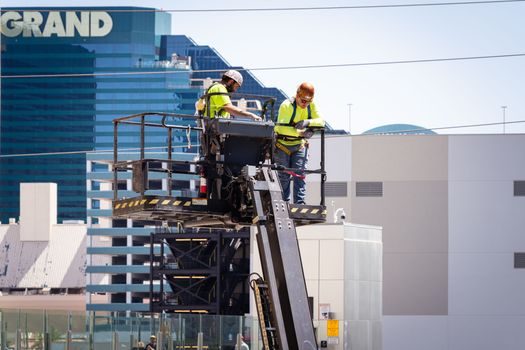
Three errors repeat on site: (1) buying a non-Ex detector because it is half the price — once it is on a refinery platform it must be withdrawn, and the cost of the throwaway is higher than the saving; (2) selecting a sensor by gas name without checking the gas group and temperature class — methane T1 and hydrogen T6 are not interchangeable; (3) trusting "water-resistant" housings as if they were IP-rated — a shower on a coastal platform or a steam venting from below can defeat a non-IP67 unit within hours [S1].
For buyers comparing across the 12 combustible gas detector product lines and 56 portable multi-gas models on the Yaoan (Shenzhen) catalogue, the practical filter is: certified Ex rating matching the zone, sensor type matching the gas and oxygen profile, alarm output matching the noise level on the platform, and a calibration routine the site supervisor can actually execute before the shift. Anything outside those four filters is marketing copy. The next decision layer — the in-depth specification, sensor cross-sensitivity table, and IEC 60079-29-1 performance check — is covered separately in the firefighting combustible gas detector spec map for 2026, and an at-height electrical-work LEL/Ex d/4-20 mA comparison lives in the electrical-work detector spec map — the same selection discipline applies, only the PPE stack on the harness side changes.