
Oil and gas operators specifying combustible gas detection in 2026 are choosing from at least three sensing families — catalytic bead, non-dispersive infrared (NDIR), and open-path infrared — with fixed-point, portable, and open-path form factors, priced across roughly US$100 to US$5,600 per unit on the Made-in-China supplier index of 328 manufacturers offering 984 products [S2].
Selection is driven by the target hydrocarbon, the classified hazardous area, the required response time, and the maintenance burden in service, rather than by a single "best" sensor. ESP Safety, a 1973-founded US fire-and-gas vendor serving global oil and gas producers, lists separate Vector catalytic/IR, SGOES infrared, and TGAES open-path models on its current product page, signalling that the industry treats these as parallel rather than competing choices [S3].
Sensing technologies and where each one fits
Catalytic bead (pellistor) sensors detect combustible gases by oxidising them on a heated catalyst and measuring the resulting temperature rise against a reference bead; they respond to a wide hydrocarbon range but can be poisoned by silicones, lead, and sulphur compounds, which limits their use in certain upstream gas streams. NDIR combustible sensors — such as ESP Safety's SGOES and Vector-Combustible IR — measure the optical absorption of hydrocarbons in a specific IR band, are immune to catalytic poisons, and tolerate exposure to high gas concentrations without sensor damage, making them a standard fit for hydrocarbon processing areas [S3].
Open-path detection (ESP Safety's TGAES line) uses a separate transmitter and receiver to monitor a beam — typically tens to hundreds of metres — for hydrocarbon absorption and is specified for perimeter monitoring of large process plots, tank farms, and LNG spill containment, where point detectors would require uneconomic counts. A working comparison: catalytic bead wins on low unit cost and broad gas coverage but loses on poison resistance; NDIR wins on poison immunity and fail-to-safety behaviour but is typically gas-specific per optical filter; open-path wins on coverage area per device but loses on pinpoint leak localisation [S3][S5].
Form factor, certification, and price bands
The 2026 supplier index separates the market into fixed combustible detectors, portable single- and multi-gas detectors, and toxic/O2 detectors, with the combustible category itself a sub-line of the broader gas-detection family — Yaoan (Shenzhen) lists 12 combustible gas detector SKUs alongside 51 fixed, 22 handheld single-gas, and 56 portable multi-gas SKUs, illustrating how a single vendor segments the technology [S5]. Made-in-China's index shows fixed industrial combustible detectors from established suppliers such as Qingdao Lubo Environmental Protection, Taizhou Hanyao, and Hebei Zehong at US$150–5,600 per piece MOQ 1, while Wuxi Yongan offers combined combustible/toxic leak alarm systems at US$85/piece and Jiangsu Jihua offers detectors at US$10–220 across MOQ 1–10 [S2].
For the European and Middle Eastern upstream market, the practical floor is ATEX or IECEx certification for Zone 1/Zone 2 hazardous areas, with performance tested against IEC 60079-29-1 for combustible gas detectors — ESP Safety carries approvals from FM, VDS, ABS, Nemko, TUV, and Exida on its fire-and-gas product line, the kind of multi-agency approval package that procurement teams typically require for offshore and refinery deployment [S3]. Sensor life on IR and catalytic heads is commonly rated in years, but mean time to calibration depends on environment; many vendors quote 3- to 6-month calibration intervals in refinery service as a working assumption for maintenance planning.
For upstream vs midstream vs downstream

Upstream wellheads and production separators deal with wet, sour gas containing H2S, and on these sites the SGOES-style NDIR combustible sensor is the usual choice because it does not suffer from the H2S and silicone poisoning that degrades catalytic beads, and because the gas composition is reasonably stable. Downstream refineries process mixed hydrocarbons with periodic catalyst changeovers, and point NDIR detectors with dedicated methane, propane, or pentane optical filters are commonly paired with catalytic-bead coverage in non-classified utility areas as a cost-balanced layout [S3].
Midstream gas storage and LNG facilities need both fixed point detection at compressor skids and loading bays and open-path detection across LNG bund walls and tank dikes; on these sites TGAES-style open-path is widely specified as a complementary layer to point detectors, not a replacement. An LEL-based alarm setpoint at 10–25% LEL is the typical default in refinery and offshore practice, with a second trip at a higher concentration, although the exact value must be tuned to the gas being measured and the area classification [S3].
Selection criteria matrix and use cases
A direct comparison on four decision criteria: (1) Target gas coverage — catalytic bead is broad-spectrum for C1–C8 hydrocarbons, NDIR is gas-specific per optical filter, open-path is calibrated to a representative hydrocarbon. (2) Poison resistance — catalytic bead is vulnerable to silicone/lead/sulphur, NDIR is immune, open-path is immune. (3) Coverage per device — catalytic bead and NDIR are point detectors with a few-metre radius, open-path covers tens to hundreds of metres along the beam. (4) Typical unit cost band — fixed NDIR/catalytic detectors on the 2026 China-supplier index sit at US$100–5,600 per piece, while a single-source portable detector with combined Ex/O2/CO/H2S/NH3/Cl2 sensing is listed at US$300–900 per piece with EU CE certification in the same channel [S1][S2][S5].
Use case mapping: a refinery operator with mixed hydrocarbon streams should default to NDIR fixed-point detectors on process units plus catalytic bead for low-cost coverage in non-classified utility rooms; an LNG terminal should layer open-path across bund walls on top of point detectors at loading arms; an offshore platform should specify ATEX/IECEx-certified NDIR or catalytic fixed detectors and combine with portable units for worker entry — the same rule that drives the multi-gas detector spec for confined space entry choice on a sister topic. Where work is performed at height on a tank or flare stack, the multi-gas detector selection for work at height guide carries over because drop-tested, ATEX-rated portables with audible/visual alarms are the engineering norm.
Standards, calibration, and sourcing realities
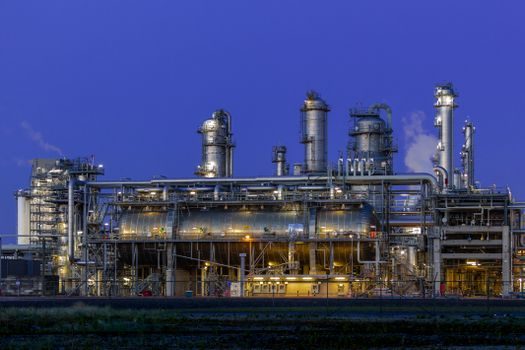
Fugitive-emission work on oil and gas facilities — the reason a gas detection layer is needed in the first place — is quantified using the United States Environmental Protection Agency (USEPA) and American Petroleum Institute (API) emission-factor methodologies that underpin both leak-detection-and-repair (LDAR) programmes and the placement of point detectors around process equipment, as documented in the open ScienceDirect emission-factor literature for oil and gas facilities [S4]. On the detection side, the performance benchmark for combustible gas detectors in hazardous areas is the IEC 60079-29-1 family of standards, with ATEX 2014/34/EU equipment directives applying across the European Economic Area and IECEx for the rest of the world — naming these as the framework the procurement team will check against on every datasheet.
Cross-reference: a process engineer new to the combustible gas detector category should treat the encyclopedia entry as the baseline taxonomy; teams that need area-wide coverage of a process unit will end up on the fixed gas detector page, while workers entering vessels will move to the portable gas detector reference. For multi-gas units with H2S and O2 channels, the multi gas detector and gas detector pages cover the same vendor landscape from a different angle. The supply picture itself — 328 manufacturers on a single B2B index with US$85–5,600 unit pricing [S2] — is dense enough that a structured RFQ to two or three vendors with auditable ISO 9001:2015 certification and explicit ATEX/IECEx certificate numbers is the most reliable path to a working detector.
Limitations, failure modes, and what to watch in 2026
The dominant failure modes in the field are sensor poisoning (catalytic bead), optical-window fouling (NDIR and open-path), and water/dust ingress on field enclosures, all of which push mean time between failures well below the headline MTBF if maintenance is skipped. Bump-testing on every shift and calibration against a known gas concentration on a 3- to 6-month interval remain the working baseline in refinery and offshore service, and a detector that has seen a high over-range exposure should be re-calibrated rather than trusted to self-recover — a point that is not always visible on a vendor datasheet [S3].
Watch points through 2026: vendor consolidation on the Made-in-China index is steady, with established suppliers holding ISO 9001:2015 plus ISO 14001 and ISO 45001 certifications and response times at ≤3 hours, and pricing on entry-level fixed detectors remains anchored around US$100–220 per piece at MOQ 1; the open-path and high-spec NDIR end of the market sits at US$3,895–5,600 per piece, which is the budget line that shifts when a project adds perimeter coverage [S2]. Treat any single-supplier quote below US$50 per piece on a Zone 1 fixed detector as a flag to verify the ATEX/IECEx certificate number directly with the issuing notified body before purchase.
Closing line: the next decision node is the area-classification drawing — once Zone 0, 1, and 2 boundaries are frozen, the sensor family, certification, and detector count follow, and a clean RFQ to two auditable vendors (each carrying ISO 9001:2015, ATEX/IECEx, and a multi-year calibration track record) will close the spec within a single procurement cycle.