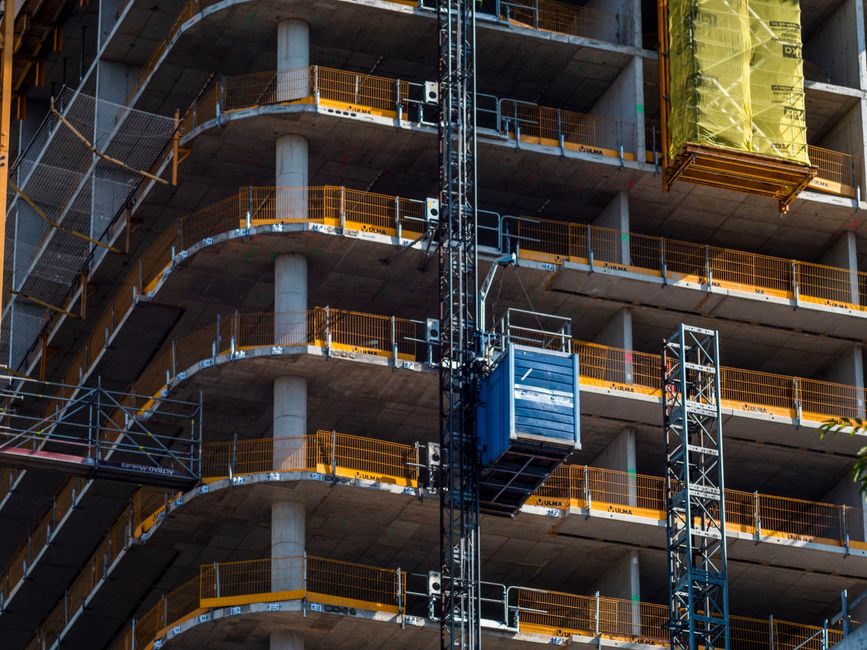
Construction-site combustible gas hazards differ from refinery duty: the target gases span methane, propane/LPG from heaters, gasoline vapour from fueling operations, and solvent fumes, while the background contains dust, water spray, and temperature swings from −10 °C to +45 °C [S1]. A combustible gas detector for this environment is therefore specified as a portable diffusion unit, not a fixed catalytic-bead head, unless the site is a permanent tunnel or cofferdam with continuous monitoring demand.
Three sensor technologies compete: catalytic-bead (pellistor) for LEL 0–100% measurement of most hydrocarbons, non-dispersive infrared (NDIR) for methane and propane where poisoning from silicones or leaded gasoline vapours would kill a pellistor in days, and metal-oxide semiconductor (MOS) for low-cost single-point alarms. For a working site engineer, the choice between portable gas detector and fixed gas detector is driven by whether the hazard zone is temporary (formwork, trench, confined space entry) or permanent (tunnel services, basement plant rooms).
Sensing Technology Comparison for Site Conditions
Catalytic-bead sensors output a Wheatstone-bridge millivolt signal linear in %LEL across 0–100% LEL and respond in under 30 s to a step change of 50% LEL methane, but they lose sensitivity when exposed to silicone sealants, phosphate ester hydraulic fluids, or hydrogen sulfide above 25 ppm — all common on construction sites [S1]. NDIR sensors for combustible gas use a 3.3–3.4 µm mid-IR absorption band for methane and 3.4 µm for propane, are immune to chemical poisoning, and drift under 5% of reading per year, but cost roughly 1.8–2.5× the price of an equivalent pellistor and do not detect hydrogen (no IR absorption at standard NDIR wavelengths). The third option, MOS, reacts to a wide range of reducing gases including CO and hydrocarbons but is non-selective and humidity-sensitive, making it suitable only for go/no-go alarms rather than quantified %LEL readings.
For mixed sites where welding off-gas adds CO and H2 to the atmosphere — H2 is the lightest combustible at LEL 4.0% vol and burns with an invisible flame — a multi-gas detector with separate electrochemical CO/H2S cells plus a pellistor or NDIR LEL channel is the standard configuration, following the sensor-stack logic in the firefighting multi-gas spec map.
Certification and Mechanical Spec Floor for Site Use
A construction-site combustible instrument must carry ATEX II 2G Ex db ia IIC T4 Gb for zone 1 (continuous hazard possible during excavation into contaminated ground) or at minimum Ex ib IIC T4, plus an ingress rating of IP65 for general outdoor use and IP67 for trench or cofferdam work where temporary flooding is possible. Drop testing to 1.5 m onto concrete is the de facto industrial floor, and the housing is typically glass-filled nylon or polycarbonate rather than the cast aluminium used on refinery fixed heads, because the 1.5 kg carry-weight budget on a chest harness is a hard ergonomic limit. Audible alarm output is specified at 95 dB at 30 cm and a high-visibility red strobe at 360°, with both alarms latching until manual acknowledgement so a worker leaving the hazard zone cannot silence the device without supervisor sign-off. [S2]
For confined-space entry into manholes, caissons, or freshly poured concrete voids where oxygen displacement and methane seepage co-exist, a toxic gas detector channel for H2S and CO is added to the LEL channel plus an O2 electrochemical cell (range 0–30% vol, accuracy ±0.5% vol), giving a 4-sensor diffusion unit that is the default specification across EU and UK construction confined-space regulations.
Selection Criteria: Portable Diffusion vs. Fixed Area Monitor

Portable diffusion units are specified where workers move — formwork stripping, pipe-laying in open trench, scaffolding erection near LPG-fired heaters, or hot work permits adjacent to solvent storage. The typical hire-fleet or site-pool unit has 2–4 gas channels, runs 14–18 hours on a single Li-ion charge, weights 200–350 g including the alligator clip, and uses a bump-test cradle rather than field calibration gas for daily verification. Fixed area monitors are restricted to permanent installations: tunnel-boring headings, basement mechanical rooms with LPG-fired boilers, and above-ground gas-meter cupboards; these use catalytic-bead or NDIR heads hardwired to a 4–20 mA or Modbus RTU controller, with a 12-month calibration interval. [S2]
The decision matrix a site engineer applies is straightforward: temporary hazard + mobile worker = diffusion portable with chest harness; permanent hazard + fixed workforce location = catalytic-bead or NDIR fixed gas detector with controller and strobe/sounder stack. For road or tunnel construction where excavation may intersect a buried gas main, the dual approach — a portable carried by the banksman plus a fixed head in the heading — is the norm, mirroring the equipment pairing covered in the bulldozer and road-construction selection map and the tunnel impact-drill spec map.
Calibration, Bump-Test, and Sensor-Life Discipline
Construction site instruments are bump-tested at start of every shift with 2.5% vol methane (50% LEL) in air, and the response must read between 45% and 55% LEL for the unit to pass — a tighter band than the 40–60% allowed on some legacy refinery protocols. Full calibration with certified span gas (typically 50% LEL methane ±2% analytical tolerance) is scheduled at 30-day intervals, or immediately if the bump-test reads low. Pellistor LEL sensors on a continuously operated fixed head last 3–5 years in clean refinery atmosphere but only 12–18 months on a construction site because of dust loading and silicone exposure, which is one driver for the migration to NDIR heads on long-duration tunnel and metro projects where the 10-year NDIR service life offsets its higher purchase cost. [S2]
Sensor replacement on a portable is a 30-second field operation using pre-calibrated plug-in modules with on-board EEPROM carrying the calibration coefficients; the instrument auto-recognises the new module and writes the install date into its log, which is then read by the site safety officer's IR or Bluetooth link at end of shift. This eliminates the on-site cylinder-and-regulator calibration step that historically took 5–8 minutes per unit and is the single largest time saving in construction safety logistics.
Where Construction-Site Selection Differs from Process Plant
Process plant (refinery, petrochemical) specifies a combustible gas detector for a known fixed gas — typically methane or pentane — in a known concentration band, with 4–20 mA HART output to a DCS and a 12-month calibration cycle, often with weather-protective sunshades and hurricane-rated enclosures. Construction site specification is the opposite: unknown gas, unknown concentration, limited calibration discipline, high mechanical abuse, and the requirement that a worker can clip the unit to a harness, forget about it for 18 hours, and still trust the alarm when it fires. This drives the design toward fewer sensors (2–4 rather than 6), larger displays readable in direct sunlight, single-button operation, and mechanical robustness over electronic sophistication. [S2]
The practical limit on a site-spec portable is that it will not substitute for a fixed gas detection system on a permanent installation, and a fixed catalytic-bead head should not be used on a 6-month construction project where it will be exposed to dust, rain, and mechanical shock from formwork handling for which it was never designed. Misapplying one to the other duty is the most common procurement error seen in mid-tier general-contractor safety departments, and it is the reason a gas detector selection on a construction site always begins with a site hazard inventory rather than a sensor datasheet.
Trackable signals for the next specification cycle: revision of IEC 60079-29-1 performance requirements for combustible gas detectors currently in the working-group pipeline, broader EN 50545-1 adoption for parking and tunnel ventilation gas detection, and the continuing price convergence between NDIR and catalytic-bead heads as MEMS IR sources replace traditional filament bulbs.