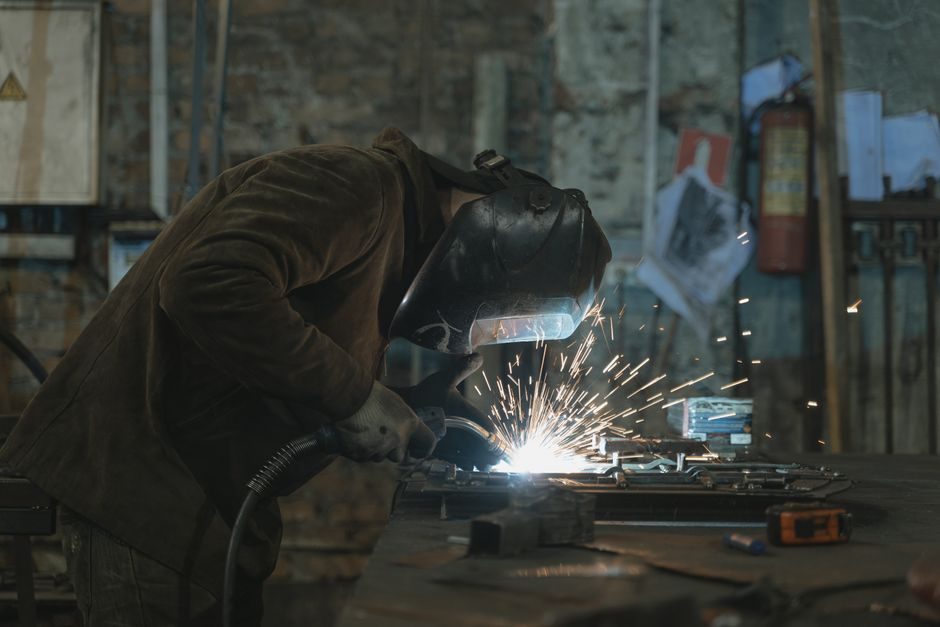
Welding environments generate a combustible-gas hazard profile distinct from refinery or pharmaceutical work: the primary fuel is acetylene (C2H2, LEL ≈ 2.5% v/v in air), frequently co-mixed with propane, propylene, methane, and hydrogen shielding-gas byproducts, with ignition sources (the arc itself) continuously present [S1]. A correctly specified combustible gas detector for hot work must therefore combine an LEL channel with O2 and a CO channel, an Ex d or Ex ib certified enclosure, and a response time short enough to alarm before the welder's breathing-zone concentration reaches 25% LEL.
For a hot-work permit on a tank, pipe spool, or structural member, a portable gas detector carried on the welder's belt is the standard form factor; a fixed gas detector belongs on the area monitor bracket at the work-perimeter, not on the welder. Hanwei Electronics' product line as published 2026-05-12 covers both form factors with catalytic and infrared sensor options on the same BX616 platform [S3].
Why LEL, Not ppm: the Welding Fuel-Profile Argument
Welding-grade fuels sit almost entirely in the LEL range rather than the toxic-ppm range, which dictates that the primary channel be a combustible-gas channel reported as %LEL, not a toxic gas detector channel reported as ppm [S1]. Acetylene's lower explosive limit sits at roughly 2.5% v/v in air, hydrogen at 4.0% v/v, propane at 2.1% v/v, and methane at 5.0% v/v — values that put the first alarm threshold at 10–25% LEL under most national fire codes, with 25% LEL the most commonly specified pre-evacuation alarm in Chinese and European welding hot-work practice [S1][S3].
The catalytic-bead sensor oxidises the fuel on a platinum-treated wire coil, and the heat of oxidation changes the coil resistance measured in a Wheatstone bridge; infrared sensors, by contrast, measure hydrocarbon-vapor absorption in a specific IR band and remain unaffected by poisoning compounds common in welding fume [S1]. For welding specifically, the trade-off is sensor poisoning: catalytic beads are degraded by silicone, lead, and phosphorus compounds often liberated from anti-spatter sprays and zinc-rich primers, so a welding-dedicated spec should default to an IR LEL channel or carry catalytic-bead spares on the job.
Catalytic vs Infrared vs MOS: a Welding-Criteria Comparison
Welding hot-work detector selection reduces to a four-axis comparison: poison resistance, response time, methane-cross-sensitivity, and unit cost [S1]. Catalytic-bead sensors are the lowest cost and respond in roughly T90 < 30 s to most hydrocarbons, but fail in silicone-rich welding fume; IR sensors cost 2–4× more, ignore catalytic poisons, and discriminate methane from propane by absorption band; metal-oxide-semiconductor (MOS) sensors respond to a broad range of reducing gases but are humidity-dependent and drift, making them a poor primary LEL channel in a welding permit [S1].
Where multi-gas capability is required — and for welding in a tank or confined space it almost always is — the multi-gas detector platform typically bundles LEL + O2 + CO + H2S in one head, with the LEL channel being the safety-critical element and the others addressing the asphyxiation and toxic byproduct hazards (carbon monoxide from incomplete combustion, hydrogen sulfide from slag decomposition) [S3]. The Hanwei BX616 portable 4-gas detector listed 2026-05-12 follows this LEL/O2/CO/H2S bundle [S3].
Response Time, Warm-Up, and Calibration Interval for Hot-Work
Hot-work permits typically require a pre-entry gas test with the detector response confirmed before the arc is struck, and most national regulations require a bump test at the start of every shift. A catalytic-bead LEL sensor needs roughly 30–60 s of warm-up from a cold start, and IR sensors typically stabilise within 60–90 s; both should be span-calibrated to a known methane-in-air or propane-in-air reference gas at intervals not exceeding 30 days under continuous service, with bump testing before each hot-work shift [S1].
Response time for an LEL channel should be specified at T90 ≤ 30 s for a step change to 50% LEL methane; the detector head on the BX616 portable platform and BS03 fixed platform published 2026-05-12 both meet that envelope in the manufacturer's published product list, though the datasheet T90 value should be confirmed against the specific sensor cell ordered [S3].
Explosion-Proof Enclosure and Electrical Interface
Welding work inside a classified zone — a tank that previously held a flammable liquid, a pipe header in a refinery, a ship's cargo hold — falls under IEC 60079-10 area classification, and the detector itself, being continuously energised in a flammable atmosphere, must be Ex d (flameproof) or Ex ib (intrinsically safe) certified for gas group IIA or IIB depending on the fuel [S1]. Acetylene specifically pushes the gas group to IIC, so an acetylene-rich welding environment (oxy-acetylene cutting, in particular) demands an IIC-rated cell, not a generic IIB unit.
Signal output is typically 4–20 mA analog with HART 7 overlay for the fixed gas detector channel, allowing it to feed both a fire-and-gas panel and a maintenance laptop; portable units communicate by Bluetooth or USB-C to a docking station for bump-test logs [S3]. A welding hot-work monitor on a fixed bracket should be wired to the site's fire-and-gas system with a relay output set to latch at 25% LEL and a second-stage alarm at 60% LEL.
Sampling Method: Diffusion vs Pumped for Welding
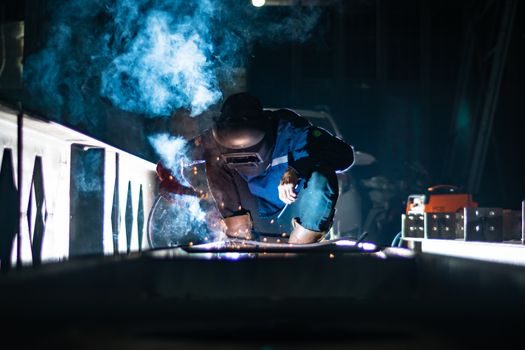
Diffusion-style sensors on the welder's chest strap work when the breathing zone is the measurement zone; pumped sampling with a 0.5–1 m hose extension is required when the measurement zone is inside a tank manhole, behind a baffle, or in a pipe stub where the welder's head cannot reach [S3]. Pumped units add roughly 1–3 s of transport delay per metre of sample line and a corresponding minimum flow-rate spec of 0.3–0.5 L/min through a hydrophobic filter; blocked-filter alarms are essential because welding fume rapidly clogs inlet filters.
For hot-work on a vertical pipe or column where the gas is heavier than air (propane, butane, gasoline vapour), the sample point should sit at the lowest credible pooling level, not at the welder's mask height — a configuration choice that often surprises welders accustomed to clipping the detector to the collar [S1].
Standards and Compliance Anchors
Performance is anchored to IEC 60079-29-1 for combustible-gas detector performance requirements, IEC 60079-29-2 for selection, installation, maintenance, and IEC 60079-10-1 for area classification; for North American sites, ISA 12.13 and NEC Class I Division 1 group mapping apply; for offshore and shipyard welding, the relevant additions come from the marine classification societies and from SOLAS Chapter II-2 for fire prevention [S1]. EN 60079-29-1 explicitly defines the response-time and poison-resistance criteria against which catalytic and IR LEL sensors are type-tested; selecting a detector that carries this certification — rather than a generic CE mark alone — is the cleanest way to discharge the specifier's liability on a hot-work permit.
For confined-space welding in a tank, a multi-gas detector spec for confined-space entry typically layers an additional oxygen-enrichment alarm at 23.5% O2 and a CO channel at 25 ppm 8-h TWA, on top of the LEL channel; welding inside a petroleum tank additionally requires a flammable-residue gas test with a separate IR sensor because the LEL reading on a catalytic bead can be suppressed by residual solvent vapour. Hot-work on construction sites, where the fuel profile is dominated by LPG and natural gas from temporary heaters, is covered under a distinct spec map emphasising area monitoring rather than personal monitoring.
The next specifier move is to confirm the fuel in the welding procedure specification (WPS) — acetylene, propane, propylene, or natural gas — and the zone classification of the work location, then size the detector on gas-group IIC versus IIB; the combustible gas detector selection for electrical work and construction-site maps cover overlapping but not identical sensor and Ex-rating combinations, so the WPS remains the controlling input. A bump-test record on the day of hot work, signed by the gas tester and the welder, closes the compliance loop.