
Specifying commercial door hardware is a code-and-cycles problem before it is a brand or finish problem. On a typical office, school, or healthcare build, the four filters that drive acceptance are: ANSI/BHMA Grade 1 vs Grade 2 cycle rating (2,000,000 vs 800,000 cycles), ADA-compliant lever hardware, NFPA 80 fire-door assembly compliance, and a corrosion-resistant base material (stainless steel or solid brass) [S1][S3].
Get those four filters right and the rest (finish, fire-label, electronic vs mechanical, sliding vs swinging) is a tractable second-pass decision. The research material published in 2025 and 2026 is consistent on this sequencing: durability and code compliance lead, aesthetics close the spec [S1][S3][S5].
ANSI/BHMA Grade 1 vs Grade 2: Cycle Rating Sets the Floor
Grade 1 commercial door hardware is rated to 2,000,000 cycles, while Grade 2 is rated to 800,000 cycles, and the grade is the first line item a specifier should lock in for any opening expected to see sustained traffic [S1]. For main entrances, corridor doors in K-12 schools, patient-room doors in healthcare, and any door on an egress path, Grade 1 is the rational default because the cycle headroom absorbs decades of use without latch or spring fatigue.
Grade 2 hardware is acceptable on low-traffic interior openings (storage rooms, back-of-house closets, private offices used by a single occupant) where the 800,000-cycle envelope matches expected service life. Mixing grades within a single building is a common value-engineering move: spec Grade 1 on the egress path and high-traffic doors, drop to Grade 2 on interior offices to recover budget without compromising life-safety hardware [S1][S3].
Lock Type Comparison: Cylindrical, Mortise, and Electronic Access
Cylindrical locks are the standard for most commercial interior doors because they are easy to install, field-replaceable, and available across all three ANSI/BHMA grades, making them the cost-effective default for office buildings [S1]. Mortise locks integrate a deadbolt and latch into a single case cut into the door edge, give higher physical security, and are the go-to for high-traffic exterior doors and institutional buildings where a longer lifecycle and a heavier feel justify the higher door-prep cost [S1][S3].
Electronic access control systems add credentialed entry, audit trails, and remote lock/unlock, and they are increasingly common on commercial properties that already manage many users, from multi-tenant offices to schools and healthcare facilities [S1][S5]. A side-by-side filter for the three families: cylindrical on cost and serviceability, mortise on physical security and door-edge robustness, electronic on credentialing, audit, and integration with building management. Hardware selection at this tier should also flow through the architectural hardware reference so locks, closers, and exit devices are speced as one assembly, not three independent SKUs.
NFPA 80 Fire-Rated Assemblies and Exit Devices

NFPA 80 governs the installation and annual inspection of fire-rated door assemblies, and any hardware specified on a fire-rated opening must be listed for use with that door and frame label; non-listed substitutions void the fire label [S1]. The hardware categories most often involved are self-closing hinges, door closers, and exit devices (panic bars), each of which must carry the appropriate fire-door listing for the door's rating (typically 20, 45, 60, or 90 minutes in commercial construction).
Exit devices, commonly called panic bars or crash bars, are required on most commercial egress doors and must be operable with a single motion without prior knowledge of the device; they double as the fire-egress hardware on rated openings when listed for that service [S3][S5]. Door closers and self-closing hinges complete the assembly by ensuring the door latches positively after every cycle, which is the actual fire-containment function the listing certifies, not the closer brand itself.
ADA Compliance: Lever Handles, Operating Force, and Clear Opening
ADA-compliant commercial door hardware requires lever-style handles (not round knobs) on accessible openings, an operating force generally not exceeding 5 lbf to release the latch, and door closers timed to give a minimum 5-second push-side traverse for wheelchair users [S3][S5]. Lever handles are mechanically easier for users with limited hand strength or grip impairment, which is why knob-only locks are rejected on accessible routes even when the lock itself is high-security.
Automatic sliding doors and low-energy operators are also part of the ADA toolkit where hands-free access is needed at primary entrances, and they must hold the door open long enough for a wheelchair or walker user to clear the opening [S5]. For hardware specifiers, the practical rule is: lever handles on every accessible door, and any closer or operator must be ADA-timed, with the closer model specified (not just generic "door closer") so the field technician can verify the timing setting against the listing.
Material and Finish: Stainless, Brass, and Environmental Exposure
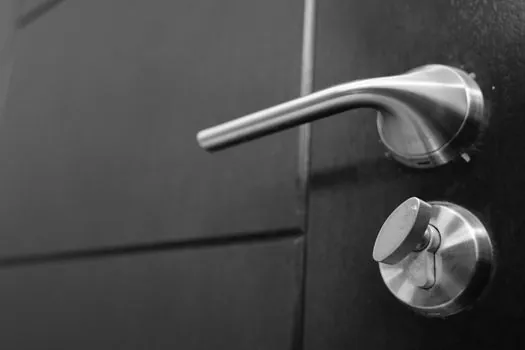
Stainless steel and brass are the two base materials called out in the research as preferred for commercial hardware, on the strength of corrosion resistance and durability, and they form the substrate under any architectural finish [S1]. For exterior openings, coastal or pool-adjacent exposures, and healthcare cleaning regimens (where quat- and bleach-based disinfectants attack plated finishes), stainless (typically 304 or 316 grade) is the safer pick because the base alloy itself resists corrosion rather than relying on a plated or painted surface.
Solid brass is the alternative where a heavier feel, a warmer tone, or a specific architectural finish (polished brass, antique brass, satin brass) is the design intent, and it machines cleanly into mortise locks and high-end levers [S1][S5]. Finishes popular on contemporary commercial work include brushed nickel, polished chrome, matte black, and bronze, but the specifier should confirm the finish is architectural-grade (e.g., BHMA A156.18 designation) and that the substrate beneath is stainless or brass rather than zinc or pot metal, which corrodes under the finish and is the most common field failure [S5][S6].
Door Closers, Hinges, and the Supporting Hardware Set
Door closers are not optional on most commercial openings: they are required on fire-rated assemblies, on accessibility routes (to control the closing speed and latch action), and on any door tied to an HVAC or smoke-control boundary [S3]. Closer selection is a function of door width, weight, and frequency of use: a standard surface-mounted closer (size 3 or 4) covers most 36" interior doors, while larger or high-traffic exterior doors need size 5 or 6 and may need a backcheck arm or heavy-duty track to handle abusive use.
Hinges are the most underestimated item on the hardware schedule. Commercial-grade ball-bearing or spring hinges are the baseline for doors over 36" wide or weighing more than standard, and continuous gear hinges are increasingly used on high-traffic exterior and corridor doors because they carry the door weight along the full frame height and eliminate the hinge-bound sag that drives callbacks [S1]. Door stops, kickplates, push/pull plates, and silencers round out the supporting set, and the full assembly typically flows through a single spec section that also includes building pipe hardware where the door frame interfaces with plumbing chases or fire-suppression risers in healthcare and lab work.
Sliding and Bi-Parting Hardware: Where It Fits, Where It Doesn't

Sliding door hardware and bi-parting door hardware make sense in commercial properties that manage high-traffic areas because they allow seamless entry and exit, reduce bottlenecks at the opening, and can be ordered with automatic closing to maintain the security boundary after each cycle [S5]. They are a strong fit for conference-room partitions, large healthcare corridor openings, and retail storefronts where a swinging door would either consume too much wall space or block merchandising.
They are a poor fit where fire-rated assemblies are required but the listed fire-door sliding hardware is not available for the needed rating, or where ADA accessible maneuvering clearances demand a swing door because the slide-in pocket geometry reduces the usable clear width at the strike jamb. Specifiers should also account for the fact that automatic sliding systems add an operator, a track, and a power supply to the hardware schedule, which is a different maintenance profile than a mechanical closer on a swing door [S5].
Selection Workflow and Common Failure Modes
A defensible commercial hardware specification follows this order: confirm the door's fire rating and required ADA status, pick the lock family (cylindrical, mortise, or electronic) and the ANSI/BHMA grade, select the matching closer size and arm type, list the hinge type and quantity, and only then pick the finish and trim [S1][S3]. The most common field failures we see are: Grade 2 hardware speced on a main entrance and worn out within five years, panic bars installed on fire-rated openings without the matching fire-label listing (voiding the door's fire rating), and closer timing set incorrectly in the field so the ADA 5-second traverse is not actually met on accessible routes.
The trackable signal to watch is local code adoption: jurisdictions that adopt the latest ICC A117.1 (accessible hardware) and NFPA 80 (fire-door inspection) editions typically tighten the enforcement on these same failure modes, and that is when retrofits on existing buildings start to drive replacement demand for Grade 1 hardware, ADA-timed closers, and listed fire-egress exit devices. For a deeper dive on how specification choices drive downstream cost and inspection risk, the industrial filter TCO framework applies the same lifecycle thinking to a different asset class, and the spec-engineer reading on nickel content vs low-temperature toughness translates the same material-substitution logic to stainless vs brass substrate choices under corrosive disinfectants.
Spec-level background on the components involved: pressure transmitter.