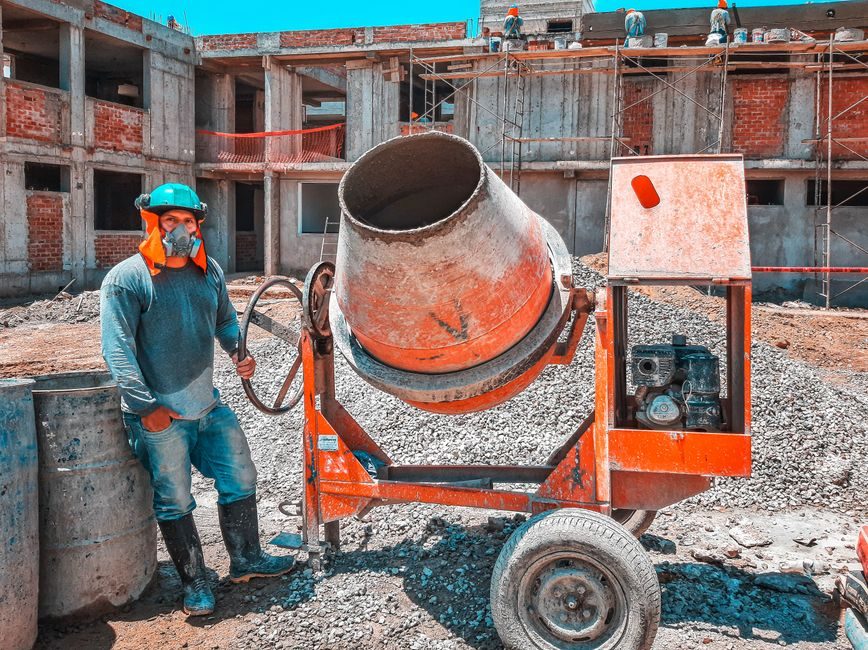
Admixture selection starts with the water-to-cement (w/c) ratio target and the ambient conditions at the pour, not with the brand name on the drum.
Concrete is the single most widely used structural material worldwide, and Sika and other major suppliers segment the chemistry into five functional families — water reducers, set-controllers, durability admixtures, specialty products, and mineral additions handled separately as supplementary cementitious materials (SCMs) [S1][S2]. The mistake most first-time specifiers make is treating the admixture as a single line item; in practice it is a stack of chemistry that must be sequenced and dose-matched to the cement, the aggregates, and the placement window.
For engineers sizing a new mix, the selection workflow runs: (1) lock the w/c and target slump or slump-flow, (2) set the ambient and placement temperature window, (3) choose the durability regime (freeze-thaw, sulphate, chloride, ASR), (4) pick the SCM package, and only then (5) match the admixture stack. The reference page on concrete admixtures frames the families in that order; downstream articles on related equipment such as concrete vibrators and batching plants handle placement and dosing hardware.
The five functional families and their typical dose windows
Set-controllers split cleanly: accelerators (calcium chloride, calcium nitrite, or non-chloride thiocyanate blends) cut set time by 30–60% in cold-weather pours and are typically dosed at 0.5–2.0% bwoc, while retarders (sugar acids, gluconates, and certain lignosulfonates) extend working time by 1–4 hours at 0.1–0.5% bwoc, used in hot-weather or long-haul conditions [S1]. Air-entraining agents (AEAs) — vinsol resin, synthetic surfactants, and fatty-acid soaps — are dosed at 0.02–0.10% bwoc to deliver 4–7% total air content in freeze-thaw-exposed concrete, with the exact target set by aggregate size and exposure class [S1].
Durability admixtures (corrosion inhibitors, shrinkage reducers, ASR suppressors) and specialty products (viscosity modifiers for SCC, anti-washout for underwater pours, pumping aids, integral waterproofers) round out the stack [S1][S2]. A sizing-side cross-reference that comes up at the same planning stage is concrete fibre for crack-width control — fibres and shrinkage-reducing admixtures are commonly specified together in slabs.
Selecting by performance criterion: w/c, slump, durability, climate
The first technical decision is the water-reduction target.
The second decision is the setting-time window. Cold-weather placement (≤10 °C ambient) typically needs an accelerator so initial set is reached before the next freeze-thaw cycle, while hot-weather pours (≥30 °C) and long-haul ready-mix commonly need a retarder to prevent cold-joint formation; the supplier data sheets call out the dose–temperature response curve explicitly because PCEs in particular lose effectiveness above ~35 °C unless blended with a retarder [S1][S2].
The third decision is the durability driver. The Sika documentation explicitly groups these under a “Construction Solutions” lifecycle that links the admixture to the structural element being poured, which is the framing a process engineer should keep on the drawing [S2].
The fourth decision is SCM compatibility. HRWR-PCE admixtures are sensitive to clay content in fines and to the specific surface of fly ash, silica fume, and slag; mixes with ≥30% slag or ≥8% silica fume often need a 20–40% HRWR dose uplift and sometimes a viscosity modifier to keep the mix cohesive [S1]. Trial batching is non-negotiable here — manufacturer dose charts give a starting point, not a final number.
Comparison across the main admixture types

Specifying engineers should be able to line the five families against four decision axes: water-reduction capability, dose range bwoc, primary function, and typical failure mode if overdosed. [S1]
Retarders (0.1–0.5% bwoc, 1–4 hours extension) are for hot-weather and long-haul, with the risk being 24-hour strength loss if overdosed. AEAs (0.02–0.10% bwoc, 4–7% air) are the freeze-thaw default, where overdosing collapses strength and finish quality [S1].
When two requirements collide — for example, SCC at 30 °C ambient that must be pumped 45 minutes — the stack is HRWR-PCE for fluidity plus a retarder/HRWR blend for slump retention plus a viscosity modifier for anti-segregation, with the dose of each tuned at the plant [S1][S2].
Use cases: ready-mix, precast, SCC, mass pour, repair
Precast plants push for early strength to strip forms in 6–10 hours, so accelerators and warm-water curing dominate; HRWRs are used to drop w/c and keep the mix cohesive at low water [S1].
Self-consolidating concrete (SCC) is HRWR-PCE-led, with a viscosity modifier (typically a high-molecular-weight polysaccharide) at 0.05–0.20% bwoc to keep the paste from segregating; SCC sits at slump-flow 550–750 mm and is the default for congested reinforcement and architectural finishes [S1]. Mass pours (large raft foundations, thick pile caps) need set retardation plus SCMs plus strict temperature-control admixtures, with the goal of holding the core temperature differential under 20 °C to avoid thermal cracking.
Repair and underwater concrete add anti-washout admixtures (cellulosic or flocculating polymer, 0.5–1.5% bwoc) so cement does not bleed into the water column. Tightly related is the equipment layer: dosing accuracy on the concrete batching plant and consolidation with the concrete vibrator — the wrong AEA dose or inadequate vibration produces the same honeycomb outcome. For guidance on adjacent equipment sizing such as industrial pumps used in admixture handling, the article on industrial pump suppliers covers the dosing-pump and transfer-pump map.
Limitations, failure modes, and compatibility traps
Admixtures are not independent of cement chemistry. ASTM C150 / EN 197-1 cements with high C3A drive PCE demand upward; supplementary cementitious materials with high surface area (silica fume) do the same. Calcium-chloride accelerators are banned in reinforced concrete in many jurisdictions because they promote rebar corrosion, and non-chloride accelerators (calcium nitrite, thiocyanate) are required where chloride limits apply [S1].
Two common failure modes to brief the QC team on: first, “false set” from overdosed accelerators — concrete appears to set early then re-fluidifies with continued mixing; second, slump loss in transit caused by a PCE that is not slump-retention-modified, fixed by either a retarder addition at plant or by switching to a slow-release PCE blend. Air content in fresh concrete must be checked with a pressure-type air meter (ASTM C231) before placement — the AEA dose and the mixer residence time together determine the air-void system, and a 1% drift in air content changes freeze-thaw durability more than any other admixture parameter [S1].
Storage and handling are spec items, not housekeeping. Most admixtures ship as liquids at 1.0–1.2 g/cm³ and must be kept above 0 °C and below 40 °C; PCEs in particular degrade with prolonged high-temperature storage. Solid admixtures such as welan gum (a high-viscosity biopolymer used in oil-well cement and grout, CAS 96949-22-3) are typically supplied in 25 kg bags at commercial quantities of 1,000 kg minimum with 10,000 kg/month supply capability from Chinese exporters [S3]. Shelf life ranges 6–24 months — date codes belong on the QC checklist, not just on the procurement order.
Sourcing, standards, and the 2026 supplier landscape
The supplier base is structurally a four-tier market: global majors (Sika, BASF Master Builders Solutions, GCP Applied Technologies / now part of Saint-Gobain, Mapei), regional formulators, local blenders who buy base chemistries and re-dilute, and direct-to-job-site specialty suppliers. Sika, the most-cited single reference in this article, positions its admixture line as part of a broader construction-solutions package that includes waterproofing, sealing, bonding, and refurbishment systems [S1][S2].
Standards that should appear on every submittal: ASTM C494 (chemical admixtures) for the Americas, EN 934-2 (admixtures for concrete, mortar and grout) for Europe, and ISO 10144 where international projects are tendered. For specialist work, ACI 212.3R covers chemical admixtures for concrete, ACI 318 specifies chloride limits for reinforced concrete, and ACI 301 covers the placement-side responsibilities. Air-entrained concrete for freeze-thaw exposure is checked against ASTM C457 (hardened air-void analysis) when the exposure class warrants it.
Pricing in 2026 is being driven by two forces: the cost of PCE monomers tied to ethylene-oxide supply, and freight on liquid admixtures that ship at ~1.1 g/cm³. Bulk liquid delivery is the lowest-cost route for any project consuming more than about 200 m³/month; below that, totes (1,000 L IBCs) and drums dominate. Trial batches at the plant and a 90-day field audit of air content, slump retention, and 7/28-day compressive strength should be part of any new-supplier onboarding — a submittal that does not include field performance data from a comparable project is incomplete.
Related equipment on the same procurement line

Admixtures are dosed by the batching plant, so the concrete batching plant specification has to match the admixture count — typically 3 to 6 liquid admixture tanks per plant, each with its own flow meter and on-board water dilution. Placement is handled with a concrete vibrator, and crack-width control at the slab level is increasingly specified with concrete fibre — fibres and shrinkage-reducing admixtures are the two tools that buy you the most against restrained-shrinkage cracking. [S2]
For a wider view of mid-2026 industrial sourcing decisions and how the same spec-first logic applies to adjacent equipment, the gear selection article on gear selection 2026 and the buyer guide on industrial gear buying walk through the same decision tree for a different component class — useful for procurement teams that want a consistent spec-first workflow across asset categories.
Both signals are public and visible on the CEN and Sika documentation channels.