Ready-mix concrete is a batched mixture of cement, water, sand, coarse aggregate, and typically chemical concrete admixtures, proportioned at a plant and delivered in a rotating-drum truck for fresh placement [S1]. A workable default for residential slabs and footings is a 3,000 psi (≈20.7 MPa) mix with a ¾-inch (19 mm) nominal max aggregate and a 4-inch (100 mm) slump, but the actual specification must be driven by the structural engineer's call-out, not the supplier's house blend.
Specifying wrong is the single most expensive error on a pour: undersized aggregate blocks pump lines, a slump that is too low kills workability, and a strength that is too low fails the structural engineer. This guide walks through the spec-first logic an experienced contractor uses to lock the right ready-mix concrete order before the truck is dispatched.
Anchor the Order on Strength, Slump, and Aggregate Size
Three numbers sit at the top of every ready-mix order: the 28-day compressive strength class (e.g., 2,500 / 3,000 / 4,000 / 5,000 psi, or roughly 17 / 21 / 28 / 35 MPa), the target slump in inches or millimetres, and the nominal maximum aggregate size (NMSA) [S9].
Slump is not a wish-list number — it is tied to placement method. Direct chute pours tolerate 3–4 in (75–100 mm); pump placement usually demands 4–5 in (100–125 mm); tremie or deep foundation placements often need 6–8 in (150–200 mm) and almost always a superplasticiser. Holding the water-cement ratio near 0.45–0.50 keeps 28-day strength on the call-out while the higher slump is delivered by a Type F/F-Type HRWR admixture rather than by adding water on site.
Match the Mix to Placement Method and Haul Distance
Haul time, ambient temperature, and placement method interact more than most buyers realise. ASTM C94 sets a 90-minute discharge limit from the moment water hits the cement unless the mix is designed for extended-life retardation or the supplier can demonstrate slump retention with retarders [S9]. Beyond that window the mix starts losing air content and workability, and re-tempering with water at the chute is one of the most common causes of weak, dusting slabs.
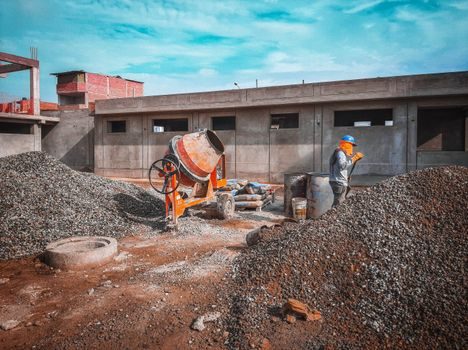
Choose placement method first, then derive the mix. Wheelbarrow or buggy pours on small residential jobs are happy with a 3,000 psi / 4 in slump / ¾ in NMSA mix and a standard set. Pump placement pushes NMSA down to ½ in and slump up to 5 in, and adds a mid-range water reducer. Crank the same 3,000 psi requirement up to 4,000 psi for any pour exposed to de-icing salts, freeze-thaw cycling, or sulphate-bearing soils, and budget for air-entrainment at 5–7% if the region falls in a freeze-thaw zone [S1].
Exposure Class, Air Content, and Durability Levers
Strength gets the slab through inspection; durability decides whether it survives the next 20 winters. Exposure class drives four downstream choices: water-cement ratio ceiling, air content, supplementary cementitious materials (SCMs), and admixture package. For a severe freeze-thaw exposure the w/c cap drops to 0.45 with 5–7% entrained air, often delivered with a Type S or Type F concrete admixture package. For sulphate exposure (soil or groundwater with >0.10% sulphate) Type V cement or a ≥35% slag or ≥25% Class F fly-ash replacement is the standard response, with a 0.45 w/c cap. [S1]
For structural slabs that will receive a hard-trowelled finish, use a ¾ in NMSA mix with a water reducer to keep the surface tight; for slabs to be polished or shake-on hardener topped, ask for a "fiber-reinforced" or a macrosynthetic-concrete fiber dosage to control plastic-shrinkage cracking. Marine or de-icing-salt exposures push specifiers toward a lower w/c, microsilica additions, and a documented 28-day strength of at least 4,500–5,000 psi.
Ordering Logistics: Volume, Short-Loads, and Pump Time
Calculate volume in cubic yards (or cubic metres) using length × width × depth plus 10% waste, not the neat volume. Most plants carry 9–11 yd³ (7–8.4 m³) standard trucks; short-load fees of $60–$150 per yd³ kick in for orders under 4–5 yd³, and Saturday or small-load surcharges can double that. Breedon Minimix in the UK explicitly offers flexible small-load deliveries for the under-4 yd³ jobs that most plants decline [S5].
Schedule the pump for a 5–7 yd³-per-hour placement rate, the chute pour for 2–3 yd³ per truck, and lock the batch-ticket delivery window so the trucks are not stacking on site. Most plants can sequence a 30–40 yd³ pour on a 10–15 minute head start, which is what keeps a vibrator operator's concrete vibrator running at consolidation pace rather than racing a setting slab. Hold the driver at chute until internal temperature is checked if the pour is in summer; >90 °F ambient demands an ice-water or chilled-aggregate mix and a retarder.
Compare the Common Mix Designs Side by Side
Most contractors order from a small library of mixes. The decision matrix below lines up the four mixes a US supplier will typically offer against four decision criteria — use this as a quick pre-order check before you call dispatch. [S2]
Residential slab (3,000 psi, ¾ in NMSA, 4 in slump, w/c 0.55) — cheapest, easiest to finish, but not for freeze-thaw exposure or structural footings. Commercial slab-on-grade (4,000 psi, 1 in NMSA, 4 in slump, w/c 0.45) — hard-trowel finish, salt resistance, 5% air-entrainment option. Pump mix (4,000 psi, ½ in NMSA, 5 in slump, w/c 0.45) — required when line placement exceeds ~60 ft horizontal or 2 stories vertical. High-strength or durability mix (5,000 psi, ½ in NMSA, 5 in slump, w/c 0.38) — for structural columns, post-tension slabs, marine exposure, or any pour with >0.40 w/c cap from the engineer.
Three pre-order guardrails keep a project out of trouble. First, confirm whether the mix design is a "house" blend (faster, cheaper, less paperwork) or a "mix code" submittal (slower, more expensive, full QC and mill certs) [S9]. Second, specify the slump at the point of placement, not at the plant — a 4 in plant slump becomes a 3 in placement slump after a 30-minute haul in summer. Third, ask for a batch ticket at delivery and verify the mix code, water dose, and time of batching match the order; ASTM C94 and the supplier's own QA program give you the right to refuse a load that is out of spec.
Verify Supplier, Plant, and QA Capability
Not all ready-mix concrete is equal in QA, and the difference shows up at the cylinder break. A credible plant posts its most recent NRMCA or DOT plant certification, has a quality manager on staff, and supplies mill certs and 7- and 28-day break histories on request [S9]. Smaller regional suppliers are often perfectly capable for residential work; large aggregate producers such as Vulcan or Silvi Materials back the same spec on infrastructure pours because they control the aggregate source and the cement supply [S7].
Two red flags kill a supplier shortlist: no published mix-design library, and no written procedure for hot- or cold-weather pours. A "shotcrete now available" line in the supplier's product list is also a useful indicator that the plant can deliver small-volume, high-slump specialty mixes, which often translates to a more flexible QC process overall [S6].
Cost, Sustainability, and Low-Carbon Mixes in 2026

Ex-works ready-mix pricing in 2026 tracks the regional cement and aggregate market, but two levers consistently move the number: SCM content and short-load size. A 30% slag replacement typically costs $4–$8/yd³ more than a straight-cement mix; a 20% Class F fly-ash mix runs neutral to slightly cheaper and gains workability; a ternary blend with microsilica pushes the cost up $10–$15/yd³ and is reserved for high-durability or high-strength applications [S9]. For a deeper look at the chemistry behind the price, see our concrete admixture pricing guide for 2026.
A useful pattern is to read the mix's EPD file (if available) and require that CO₂e per yd³ is below ~200 kg for a 3,000 psi slab; this is roughly the threshold where the climate benefit and the cost premium start to balance against the engineer's durability risk.
Pre-Pour Checklist and Trackable Signals
Confirm formwork release agent compatibility with the specified air-entraining admixture, especially on freeze-thaw pours, and book a concrete vibrator sized for the bar spacing. A 1.5 hp electric internal vibrator handles standard residential work, but structural pours with #5 rebar at 6 in centres need a 2.5 hp high-cycle vibrator and a spare on site. Test the slump on the first truck before the rest of the fleet is released; if the test fails, reject the load and re-batch rather than pour a marginal mix. [S3]
Two trackable signals to watch in the next ordering cycle: (1) the local plant's published low-carbon mix line (most major US and UK operators rolled out 30%+ SCM standard mixes in 2025–2026) [S5][S9], and (2) the regional price delta between a 3,000 psi "house" blend and an EPD-documented 30% slag blend — that delta is the real number to budget against, not the headline mix price. If the gap closes below $5/yd³ in your region by year-end 2026, the low-carbon mix becomes the default, not the premium option. For a complementary cost reference on dry-mix and mortar systems that often get confused with ready-mix, our dry-mix mortar vs cement spec guide is a useful cross-check.