
Concrete admixtures are batched into the mix at 0.1–5% by cement weight to alter rheology, set time, air content and durability; concrete release agents are applied at 0.01–0.05 L/m² to the form face to prevent bond to the hardened concrete [S1][S4]. One is a chemistry problem inside the paste, the other is a surface-interface problem at the steel, plywood or rubber mould.
Admixtures are dosed by weight of binder, while release agents are dosed by area of formwork, which is why their pricing units, lead times and quality-control tests do not overlap at all [S2][S5]. Specifying one when the other is required is one of the most common line-item errors on precast and decorative-concrete submittals.
What Each Product Actually Does at the Molecular Level
Polycarboxylic-acid (PCE) superplasticizers, the dominant high-range water reducer family, work by steric repulsion: side-chain polyethylene-oxide grafts push cement grains apart and let the same workability ride on 25–40% less mixing water, with 40% solid-content PCE liquids shipped in 200 L drums or 1000 L IBCs as the typical commercial form [S5]. The result is a lower w/c paste, higher 28-day strength, and tighter capillary porosity; that porosity shift is what drives chloride and freeze-thaw resistance on bridge decks and marine substructures.
Release agents, by contrast, sit on the formwork face and present a low-surface-energy barrier. A mould-release agent rated for steel forms on the same Okorder catalogue ships at 50,000 kg minimum-order quantity with 100,000 kg/month supply capability, and is typically a saponified fatty-acid emulsion or a solvent-borne wax dispersion [S4]. On decorative stamped work the same job is done by a pigmented powder release (33 lb / ~15 kg pails are a standard pack size, retailing around US $106.75 on the secondary US market as of late 2025), which both lubricates the stamp and colours the surface [S3].
Selection Criteria: Drive the Spec by the Failure Mode, Not the Brand
For admixtures, the binding decision is the performance gate: required slump or slump-flow, target water reduction, set-time window for the placement method, air content for freeze-thaw exposure, and chloride limit for reinforced work. ASTM C494 covers Type A (water-reducer), Type B (set-retarder), Type C (accelerator), Type D (water-reducer + retarder), Type E (water-reducer + accelerator), Type F (high-range) and Type G (high-range + retarder), and the submittal should declare the type explicitly on the mill sheet, not just call it a "superplasticizer" [S2].
For release agents, the binding decision is the form-face material and the desired surface finish: bare steel calls for a thin film of a chemically active release agent to prevent rust staining; plywood and timber want a wax-based barrier to limit grain pickup; rubber stamps and textured mats want a powder release to keep fine detail from filling in; plastic forms often need a silicone emulsion because solvent carriers attack the liner [S3][S4]. A spec line that says "release agent" without naming the form substrate is, in practice, a non-spec.
Who Each Product Is For — and Who It Is Not For

Admixtures are for any ready-mix, precast, self-consolidating, shotcrete, mass-concrete or high-performance pour where one of the standard C494 properties is specified; they are not for compensating a bad mix design, a contaminated aggregate, or a too-dry sand, and they will not fix a mix where the cement content itself is wrong [S1][S2]. They are mandatory on most structural concrete with a w/c ceiling, on any pour exposed to de-icing salt, and on virtually all self-consolidating concrete (SCC), where PCE-based superplasticizers at 0.8–1.5% solids-on-cement are what make the 600–750 mm slump-flow achievable without segregation.
Release agents are for any formwork that will later be stripped — steel, plywood, plastic, rubber, GFRC, stamped mats — and for any process where a clean release and a defect-free surface are part of the deliverable; they are not for permanent formwork left in place, not for slip-form pavers running with the same mould 24/7, and not for the top trowelled face, which is cured with a curing compound, not released [S3][S4]. Poured-in-place walls that will receive plaster or tile do not need a release agent because there is no form to release; the form-release decision tracks the formwork decision, not the concrete decision.
Comparison: Admixtures vs Release Agents Across the Four Decision Criteria That Matter on a Submittal
Dosage basis: admixtures are dosed at 0.1–5% by mass of cementitious material and re-dosed by mix-design weight, while release agents are dosed at 0.01–0.05 L/m² of form face and re-dosed by formwork area — different units, different scales, different QA forms [S1][S4]. Performance test method: admixtures are qualified to ASTM C494 (and C1017 for SCC) on mortar/concrete cubes, while release agents are typically qualified to a manufacturer panel test or a project mock-up because there is no equivalent single US standard governing all form-face combinations. Failure mode addressed: admixtures target strength, durability, workability and set, while release agents target bug-holes, surface staining, grain pickup and mould wear. Supply chain: admixtures are liquid chemicals shipped in drums, totes or bulk tankers from a regional chemical distributor, while release agents are sold in 15–33 lb pails, 200 L drums or 50,000 kg bulk lots depending on whether the application is decorative, precast or marine [S3][S4][S5].
Real Use Cases Where the Two Show Up on the Same Pour
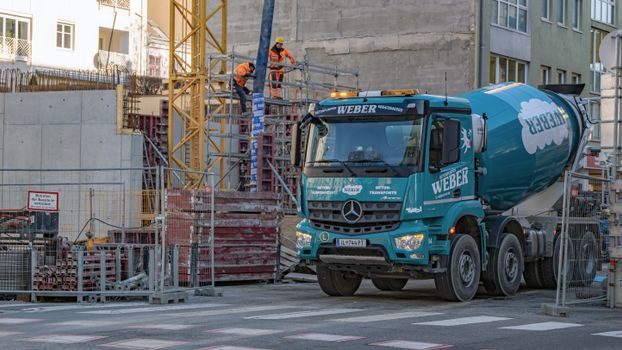
A typical highway-bridge deck will specify a Type F or G PCE superplasticizer to hold a 0.40 w/c while the mix rides a 90-minute haul, plus a form-release agent on the pier-cap side-forms to keep the architectural concrete surface free of bug-holes and rust bleed — two different products, two different spec sections, two different suppliers on the same pour [S1][S4]. The ready-mix submittal covers the admixture; the forming submittal covers the release agent; the QC inspector audits both, but rarely checks whether they are chemically compatible, which is fine here because the two never touch.
A stamped-concrete patio is the other end of the spectrum: integrally coloured concrete with a PCE superplasticizer for placement workability, plus a pigmented powder release agent broadcast across the surface before the stamp mat drops [S3]. The release in this case is doing decorative duty, not just bond-breaking — it lays down a secondary colourant in the shallows of the stamp texture and then gets pressure-washed off, which is why powder releases are sold by the pail, not the drum. For related context on how different reinforcement and concrete-system layers stack on a single pour, see Ready-Mix Concrete vs Concrete Fiber: Two Different Layers of the Same Pour, and for a deeper walk through the admixture family tree, see Concrete Admixture Selection: 5 Gates, 4 Families, 1 Compliance Check. For a complementary read on how concrete-fibre selection sits next to this question, see Steel Fiber vs Steel Section: Reinforcement Role and Load-Path Function.
Limitations, Failure Modes and Common Mis-Specs
Admixtures fail in three recurring ways: overdosing PCE past the saturation point causes segregation and bleed; chloride-bearing accelerators corrode embedded rebar unless the mix carries a documented Cl⁻ ceiling; and set-retarders in cold-weather pours push the bleed-water window into a finishability problem. None of these failure modes is fixed by switching to a release agent, and vice versa [S1][S2].
Release agents fail in their own set of ways: too little film gives bug-holes and form pick-up; too much gives a soft, dusty surface that rejects paint and sealer; the wrong chemistry stains the concrete (petroleum oil is a known AAR/ASR trigger in some alkali-reactive aggregate regions); and a wax-based release applied to a rubber stamp mat will fill in the texture in two or three impressions. The two product classes do not substitute for each other; they sit at different interfaces of the same pour and have to be specified against the right substrate and the right performance gate. For a reference primer on the admixture side, see the concrete admixture encyclopedia entry; for the release-agent side, see concrete release agent.
Sourcing, Standards and a Trackable Signal

Procurement for admixtures is dominated by regional chemical distributors carrying the major PCE and lignosulfonate lines, with 40%-solid PCE in 200 L drums or 1000 L IBCs as the standard commercial pack [S5]. Release-agent procurement splits cleanly: decorative powder releases move through building-supply retail and e-commerce channels in 15–33 lb pails [S3], while bulk mould-release emulsions for precast yards are quoted by the metric tonne with 50–100 tonne/month supply capability from China-mainland and US Gulf origins [S4]. The two streams rarely share a vendor, and they should not be co-specified on one purchase order.
The trackable signal for the next quarter is the divergence between the two categories: admixture pricing is tracking PCE feedstock (acrylic acid, MPEG monomers) and will move with petrochemical swings, while release-agent pricing is tracking fatty-acid and paraffin-wax feedstocks and will move with vegetable-oil and base-oil swings. If both move together in the same direction for two consecutive months, it usually signals a freight or solvent-supply shock, not a demand surge in construction chemicals.