
A concrete-rated circular saw is defined by a diamond or abrasive disc of 12-14 inches paired to a motor in the 1500-1800W class, with most 2026 factory listings offering wet-feed water-supply for dust suppression [S1][S6].
Standard 185mm wood-cutting units ship in the 1400W range at 5,500 r/min no-load speed for soft materials, while concrete cutting raises the spec to larger diameters, higher torque, and water-cooled operation [S3][S4][S6].
Concrete-Cutting Circular Saw Power Class
Factory listings on Made-in-China catalogue a 14-inch (≈355mm) hydraulic concrete cutter with metal disc cutting path at US$1,250-1,350 per set with a 10-set MOQ, reflecting the heavier frame, water pump, and reinforced arbor typical of masonry-rated units [S9]. Mid-tier retail 14-inch wet/dry concrete saws with water pump ship at US$169.99 per unit [S10]. eBay 120V SKILSAW SPT77WML-01-FS refurb units list at $479.99 for 7-1/4-inch framing work, while Evolution S210CCS 8-1/4-inch mild-steel cutters sit near C$408.28 [S5]. The gap between a 7-1/4-inch wood/steel trim saw and a 14-inch concrete cutter is roughly 2-8× in price and reflects motor output, blade diameter, and water-feed hardware rather than brand premium [S5][S9][S10].
For masonry, contractor-tier 14-inch (355mm) saws draw 220-240V at 50/60Hz from the same mains the lighter 185mm wood units use, but the motor and gearbox are sized for continuous-load diamond-blade work, not intermittent crosscuts in timber [S3][S4][S10].
Diamond vs Abrasive Blades for Concrete
Concrete-grade circular saws run either diamond-segmented or abrasive wheels, and the choice is set by aggregate hardness, rebar presence, and wet/dry duty cycle rather than by the saw chassis itself [S6][S8]. Diamond blades in the Made-in-China concrete-saw category cluster around the 14-inch format paired to a hydraulic or hand-held cutoff frame, with the segment bond and rim height sized to the abrasive expected [S8][S9].
Wet-feed operation is the default for reinforced concrete because it cools the segment bond, suppresses silica dust, and extends blade life; dry cutting is reserved for short intermittent cuts where water management is impractical [S6][S10]. Operators specifying a unit for masonry should confirm water-pump delivery rate and tank capacity before quoting the job, since the same 14-inch saw can be sold wet-only, dry-only, or convertible [S10].
Corded Mains vs Cordless 18V Class

For continuous concrete cutting, corded 220-240V saws dominate the spec sheet because battery current draw of 18V cordless platforms (Milwaukee M18 FUEL 6-1/2-inch brushless at C$219.19 bare tool, M18 2630-20 at C$140.82) cannot sustain 14-inch diamond-blade torque [S7]. 18V cordless platforms are practical for trim and formwork cuts up to ~165mm depth, not for masonry sectioning [S7][S6].
Contractors running rebar-heavy demolition should stay on corded mains with a 1500-1800W motor and 220-240V supply, sized so the no-load speed sits in the diamond-blade manufacturer’s published band—typically 3,500-4,500 r/min for 14-inch wet diamond, not the 5,500 r/min a wood blade demands [S3][S4][S6].
Selection Criteria: Match the Saw to the Cut
Five decision points govern a concrete circular-saw purchase: blade diameter (cut depth plus 5-10mm clearance), motor wattage (1500W+ for rebar-adjacent work), wet/dry capability, voltage platform (220-240V corded for site mains, 18V only for shallow trim cuts), and dust-suppression interface for silica compliance [S1][S6][S10].
A simple comparison lines the three main options against the four criteria a buyer actually filters on:
7-1/4-inch corded wood/steel trim saws (SKILSAW SPT77WML-01-FS class, 120V/15A, ~$480 refurb) deliver shallow cuts at low cost, but lack the torque and blade size for masonry [S5]. 14-inch corded wet/dry concrete saws (US$169-1,350 factory-direct, 220-240V, 1500-1800W) cover rebar and reinforced sections when paired with a diamond wheel and water feed [S8][S9][S10]. 18V cordless brushless saws (Milwaukee M18 6-1/2-inch class, C$140-220 bare tool) are restricted to light formwork, not structural concrete [S7].
Operating Limits and Failure Modes
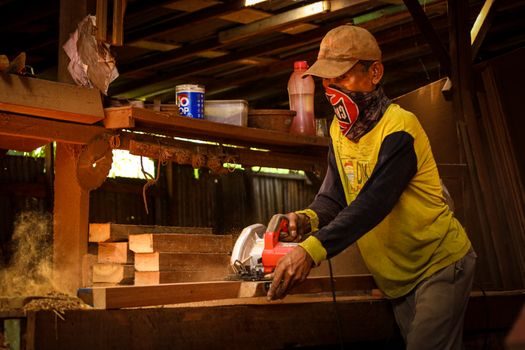
Concrete circular saws fail in three predictable ways: segment loss from dry-cutting diamond blades past their thermal limit, armature burn-out on under-rated motors driven into rebar, and water-pump failure on wet units left to run dry [S6][S8][S10]. Operators should never exceed the blade manufacturer’s published maximum r/min—mismatch between a 5,500 r/min wood-rated arbor and a 4,000 r/min diamond blade is a documented failure path [S3][S6].
For crews running concrete saws alongside rotary hammers or chipping tools, a portable impact drill is a common companion on the same site supply, so the 220-240V mains and 16A circuit rating should be planned across the tool fleet, not per-tool [S1][S4].
Standards, Sourcing Channels, and What to Verify
No single IEC or ISO standard governs a circular saw as a whole tool; instead, blade segments are typically rated against manufacturer-published r/min, segment height, and bond hardness, and the saw chassis is CE-marked for low-voltage directive compliance in the EU and UK [S9]. Buyers should request the CE certificate validity date and the diamond-blade test certificate rather than relying on catalogue copy [S9].
On 2026-08-02 sourcing, the three live channels are Made-in-China factory listings (US$1,250-1,350/set hydraulic concrete cutter, 10-set MOQ, CE since 2025-09-10), eBay retail (US$169.99 for 14-inch wet/dry kits, $479.99 for 7-1/4-inch refurb corded), and Alibaba general listings for 1800W and 1500W wood/light-metal units which are not concrete-rated [S2][S3][S9][S10]. For crews cross-equipping for material-handling or landscaping on the same site, an impact drill selection reference running in parallel helps align voltage, duty cycle, and dust-suppression spec across the kit.
The underlying component specifications are covered under aerial work platform, and aerial work truck.