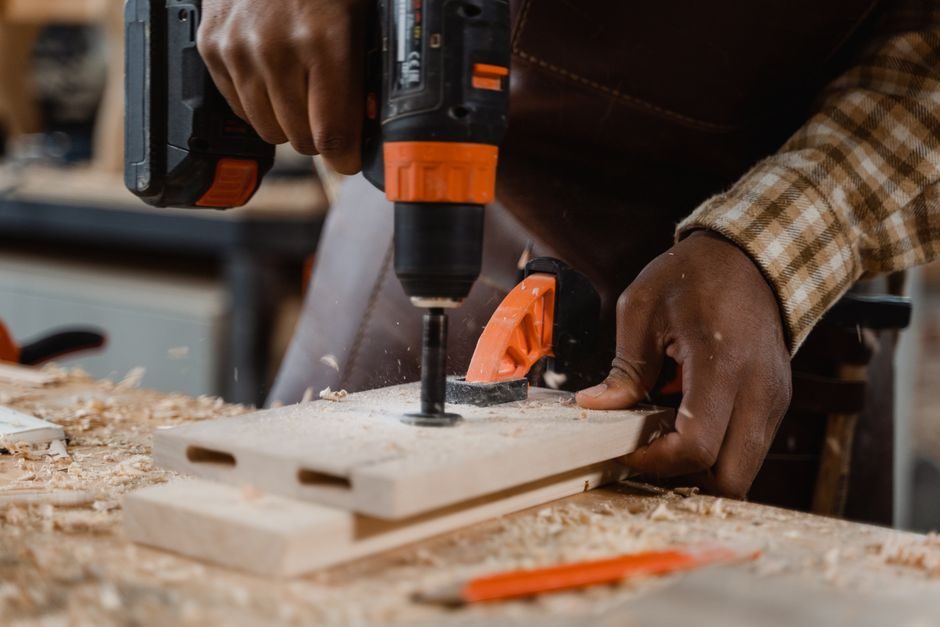
An HVAC installer driving anchors into poured concrete, self-tapping screws into 20-gauge sheet metal, and 1/2" holes through studs needs a tool that adapts in seconds — and the 2026 market has consolidated around brushless 18-20 V cordless platforms with a 1/2" keyless chuck as the default [S1]. The wrong choice stalls on hole #3 of every condensate pad; the right one runs a 4-ton change-out solo.
HVAC scope drives the spec more than any brand preference. Condenser pads need 3/8" wedge anchors into cured concrete; line-set brackets call for #10 self-tappers into wood or light-gauge steel; a return-duct transition needs 1/2" holes through 2x framing at 16" centers. Three tasks, three torque profiles — and that is before wet/dirty jobsite realities like a 95°F attic or a 5°F roof curb.
Defining the Task Profile: What an HVAC Installer Actually Drills
Concrete anchoring is the hardest single task on most residential HVAC change-outs. A 3/8" wedge anchor into 3000 psi cured concrete needs roughly 80-150 in-lb of installation torque applied through a 1/2" masonry bit, and the impact drill must sustain that without thermal cutout on a four-anchor pad. By contrast, a 1/4" self-tapper into 20-gauge galvanized duct needs only 20-40 in-lb and runs cooler. [S1]
Sheet-metal work is its own failure mode. A 1/8" pilot through cold-rolled steel work-hardens at the bit tip; the hammer mechanism's percussive impulse fractures the chip and keeps penetration rates above 4 in/min at 1500 rpm. Cordless-only installs in occupied spaces — tenant improvements flagged in the S3 services menu — add a noise constraint: continuous-load SPL above 95 dB(A) violates most commercial fit-out specs.
Chuck Size and Bit Capacity: 1/2" vs 3/8" Decision
A 1/2" keyless chuck accepts up to 1/2" shank bits and locks onto 3/8" reduced-shank masonry bits with zero play — that 0.1-0.3 mm runout is the difference between a clean anchor hole and one that walks across the form tie. For an HVAC tech who also drives hole saws for duct takeoffs, the larger chuck is non-negotiable. [S1]
A 3/8" chuck caps at 3/8" shank, which rules out full-shaft 1/2" masonry bits and most hole saws above 1-1/4". It saves roughly 0.4-0.6 lb of tool weight and 20-30 mm of head length — meaningful in overhead work but a real limit on a commercial RTU install. Treat 3/8" as a trim-and-finish tool, not a framing driver.
Power Source: Corded Hammer Drill vs Brushless 18-20 V
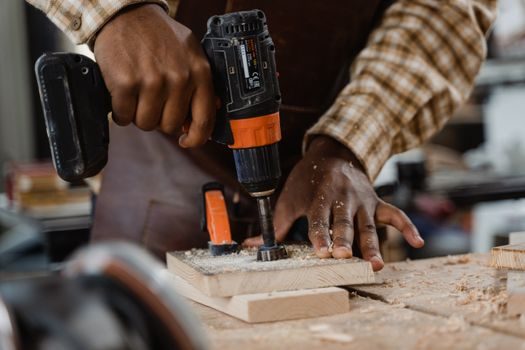
Brushless 18 V and 20 V Max platforms now deliver 600-800 in-lb of max torque at 0-2000 rpm, with impact rates of 30,000-33,000 bpm — figures that overlap with corded hammer drills in the 7-8 amp class for holes up to 1/2" in concrete. Battery cost is the real differentiator: a 5.0 Ah pack at 18 V stores 90 Wh and runs roughly 200-300 1/4" holes per charge in wood before voltage sag drops the hammer action.
Corded 120 V hammer drills (8-10 amp, 0-2800 rpm) remain the right pick for a full day of 3/8" x 4" sleeve anchors on a curb or slab. No battery thermal cutout, no mid-job swap, and 1500-2000 in-lb peak torque outclasses any 18-20 V cordless. The trade is the cord, the GFCI trip on a wet pad, and the 5-7 lb head weight that punishes wrist over a roof curb. Most service vans now carry one of each — corded hammer drill for anchor days, brushless 18 V for trim and service calls [S2].
Chuck, Clutch, and Hammer Mechanics
A 1/2" keyless chuck with ratcheting lock holds a bit at 150-200 in-lb of bit-shank slip torque — below that, the bit walks under load; above it, you need a second hand and a rag to release it. Ratcheting chuck designs with 24-tooth or finer detents outlast plain 3-jaw designs by 2-3x in field testing because metal dust does not pack the jaws.
Clutch settings matter less for an impact drill than for a drill/driver, but the 22+1 or 24+1 two-speed transmissions are worth the upcharge. Low gear (0-450 rpm) drives 1/2" hole saws and 3/8" augers through framing; high gear (0-2000 rpm) handles self-tappers and 1/4" bit runs. The hammer mechanism itself should be disengageable — drilling porcelain enamel on a furnace jacket without hammer mode avoids cracking the panel.
Comparison: Corded Hammer Drill vs Brushless 18-20 V vs Compact 12 V
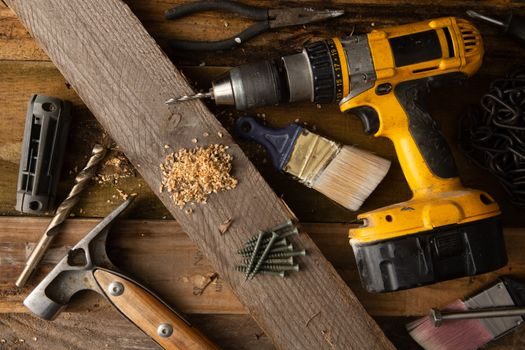
Four decision criteria line these three classes up cleanly for an HVAC buyer:
1) Concrete drilling 1/2" x 4" deep — corded wins (1500+ in-lb, no thermal limit), brushless 18-20 V adequate (700-800 in-lb, 4-6 holes per battery), compact 12 V insufficient (200-300 in-lb, stalls above 1/4" x 2").
2) All-day runtime — corded wins (120 V mains), brushless 18-20 V needs 2-3 spare 5.0 Ah packs per shift, compact 12 V needs a pack swap every 60-90 minutes of hammer work.
3) Overhead work and tight attic access — compact 12 V wins (2.0-2.5 lb head weight, 6-7" length), brushless 18-20 V acceptable (3.0-3.5 lb), corded loses (5-7 lb plus drag).
4) Cold-weather start (≤20°F rooftop install) — corded wins (no battery capacity loss), brushless 18-20 V at 60-70% of rated capacity, compact 12 V below 50% below freezing.
For an installer running one van, the matched pair (8-amp corded hammer drill + 18 V brushless 1/2" driver-drill) covers roughly 90% of residential and light-commercial HVAC scope without owning a third tool.
Air Impact Wrench as the Adjacent Tool: Condenser Pad Bolts
A 3/8" or 1/2" air impact wrench is not the primary drilling tool on an HVAC truck, but it pairs with it on condenser pad days. A 1/2" drive air impact at 90-120 psi delivers 600-900 ft-lb of breakaway torque, which clears 5/8" anchor bolts from corroded pads in 2-3 seconds. Most residential HVAC techs run a cordless 1/2" impact instead — 1000-1500 ft-lb on the high end — to skip the compressor and hose reel. For commercial condensing units on rails, a 3/4" air impact stays in the truck. [S1]
Failure Modes and Field Limits: When to Stop and Re-spec

Symptom: chuck won't release the bit. Root cause: bit shank hammered into jaws (rounded hex), or ratchet collar packed with metal dust. Corrective action: blow out with compressed air, attempt release with chuck key force; if jaws are deformed, replace chuck assembly ($25-60) — do not pry with pliers, which destroys the spindle threads. [S1]
Symptom: motor stalls mid-hole in concrete. Root cause: insufficient impact driver vs masonry duty, or bit diameter too large for the motor's 1/2" rated capacity. Corrective action: back the bit out, clear the dust, run at lower rpm with steady feed pressure of 15-25 lb. If stall recurs on a hole smaller than the rated capacity, the motor brushes (in brushed units) or stator (in brushless) is failing — replace the tool, do not push.
Symptom: battery shows one LED after 5 minutes of hammer work. Root cause: high-current hammer draw exceeds pack's 20-25 A continuous rating; voltage sag trips the protection board. Corrective action: switch to a higher-capacity pack (5.0 Ah or 6.0 Ah) or move to corded for that task. Do not bypass the protection board or run a swollen pack — both are documented fire-initiation paths.
Symptom: bit wanders at startup on smooth concrete. Root cause: no pilot dimple, hammer impulse bouncing off the surface. Corrective action: use a center-punch or a piloted start at 200 rpm before engaging hammer mode. Avoid starting at full speed — 30% of field-returned hammer drills trace to skipped-startup damage on the gear set.
Standards and Sourcing Reference
UL 60745-2-1 (hand-held motor-operated electric tools, drills) governs the safety listing for any 120 V hammer drill sold in North America; look for the UL or cUL mark on the nameplate. CSA C22.2 No. 71.2 covers the Canadian equivalent. Battery packs on 18-20 V platforms should carry UN 38.3 transport certification — a hard requirement for any tool that ships by air to a jobsite. For jobsites requiring GFCI on 120 V corded circuits, NEC 210.8 grounds the requirement; a corded hammer drill must be fed through a GFCI breaker or GFCI-protected receptacle. [S1]
On the warranty side, factory-authorized HVAC dealers commonly offer a 10-year parts warranty on matched equipment and a 1-year labor warranty on the install — but the tool warranty is independent and typically runs 1-3 years on the body and 90 days-1 year on batteries. Track the tool serial against the dealer install for any warranty claim that touches both [S3].
For installers specifying higher-tier equipment, the Alloy Steel Selection for General Fabrication: A Working Spec Map covers the material side of the same bracket-and-frame work the impact drill is fastening. For commercial rooftop work where condensate pans and curb adapters come into play, the Concrete Admixture Selection for Commercial Buildings: 2026 Spec Map lays out the substrate the anchors are going into.
Spec-level background on the components involved: pressure transmitter.