
For tunnel crews, the impact drill decision is driven by three numbers: chuck system, blows per minute (BPM) at working load, and single-stroke impact energy in joules — the spec block that separates a steel-on-steel anchor installer from a rotary hammer that stalls on a 20 mm rebar hole [S2].
Handheld drilling in tunnel work covers bolt installation for rock bolts (typically 20-25 mm), Swellex/Split-set bolts, mesh fixing, utility hangers, and survey plug drilling — none of which is interchangeable with a pneumatic air impact wrench duty cycle or a rotary hammer spec sheet borrowed from a job-site drill-driver brochure [S1][S2].
Chuck System and Bit Interface: SDS-Plus, SDS-Max, Spline, and 1-1/8 in Hex
SDS-Plus (10 mm shank, 4-groove) is the default for sub-16 mm bit diameters and 90% of handheld bolting roles on tunnel jumbos and man-baskets; the slip-clutch rotation stop engages around 15-25 Nm of torque, which matches M16 expansion-shell rock bolts without twisting the operator's wrist [S2].
SDS-Max (18 mm shank, 5-groove) starts at 16-18 mm bit diameters and runs up to roughly 45 mm in standard rotary-hammer bodies; impact energy climbs into the 7-19 J band, and the larger bearing stack gives a duty cycle of 2-3 hours continuous before bearing service, against roughly 45 minutes for a hand-held SDS-Plus in granite [S2].
Spline-drive and 1-1/8 in hex (28 mm) shanks are specified for 32-150 mm concrete-core bits and demolition work where the chuck must transmit full hammering without slip — spline shanks remain common on legacy compressed-air rotary hammers used in older tunnel inventories, but new procurement in 2026 trends away from them because replacement chuck assemblies are single-source [S2].
Power Source: Cordless 18-54 V, Corded 220 V, and Pneumatic
Cordless 18 V brushless rotary hammers now deliver 2.0-2.5 J impact energy with a 5.0 Ah pack, covering M10-M16 anchor and bolt drilling in headings; 36-54 V platforms push impact energy into the 4-8 J band, closing the cordless/corded gap on SDS-Plus work up to 16 mm bit diameter [S2].
Corded 220 V rotary hammers still hold the SDS-Max 18-45 mm role because continuous draw does not throttle impact energy the way a depleted battery pack does; typical draw sits at 1,000-1,500 W with 8-20 J impact energy, and crews carry 2.5 mm² H07RN-F cable on tunnel reels rather than 1.5 mm² jacketed cable because of abrasion against shotcrete ribs [S2].
Pneumatic rotary hammers (piston-type, 4-7 bar) survive in tunnel environments where diesel particulate and methane call for air-driven tools; they deliver 8-15 J at 6 bar and weigh 20-30% more than the corded electric equivalent, but the only moving seal is a rotary valve, so MTBF in wet headings is two to three times that of an equivalent electric motor housing [S2].
Selection Criteria Matrix: Bit Diameter vs Tool Class
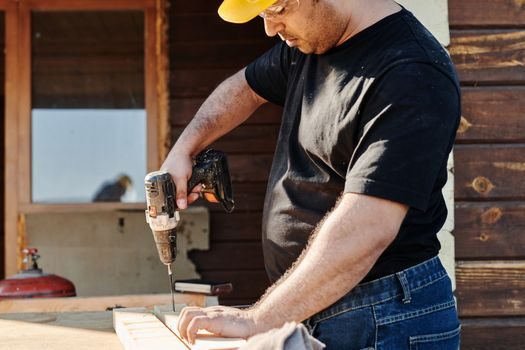
For 6-10 mm holes (light anchors, signal-cable hangers, mesh fixing), specify an 18 V cordless SDS-Plus with 1.5-2.0 J impact energy and a 13 mm keyless chuck or dedicated SDS-Plus holder; weight should sit at 2.0-2.5 kg with battery to limit operator-arm vibration dose under ISO 5349 [S2].
For 12-16 mm holes (M16 rock bolts, resin anchors, drainage pex), step up to a 36 V cordless or 220 V corded SDS-Plus at 2.5-4.0 J, with vibration tri-axial below 12 m/s² and a decoupled main handle; this is the most common size class in NATM/SEM heading drill patterns, and undersizing here is the most frequent cause of burned-out armature windings [S2].
For 18-32 mm holes (rock-bolt resin cartridges 25 mm, probe-hole drilling 32-42 mm, dewatering-line anchors) specify an SDS-Max or 1-1/8 in hex at 8-15 J; this class adds a D-handle or side-handle because one-handed use at this energy is a vibration-injury vector and violates most EU operator-vibration directives [S2].
For 35-45 mm holes (larger resin bolts, utility-line penetrations, ground-sample holes) stay on SDS-Max; above 45 mm, the impact-drill class is wrong and the job moves to a pneumatic rock drill or a rotary-percussive jumbo, not a larger impact drill [S1][S2].
Duty Cycle, Vibration, and Dust in Tunnel Air
Tunnel air carries granite and basalt particulate that migrates into motor housings; an impact drill specified for tunnel work needs an IP5X dust rating on the motor housing and a sealed switch boot, otherwise bearing failure shows up at 200-300 hours instead of the 800-1,200 hours expected in surface construction [S2].
Tri-axial vibration (ahv) at the handle should be quoted per EN 60745-2-6; SDS-Plus hammer drills typically post 10-15 m/s², SDS-Max sits at 8-12 m/s², and pneumatic units come in at 18-25 m/s² — the higher pneumatic figure is offset by the lower total hours of exposure on heading crews [S2].
Dust extraction is no longer optional on European tunnel jobs: M-class extraction shrouds with auto-start and a HEPA H13 afterfilter hold the operator's respirable crystalline silica dose below the EU OEL of 0.1 mg/m³; shroud-only retrofits on older drills are a frequent audit finding [S2].
Matching to the Tunnel Method: NATM, TBM, and Cut-and-Cover
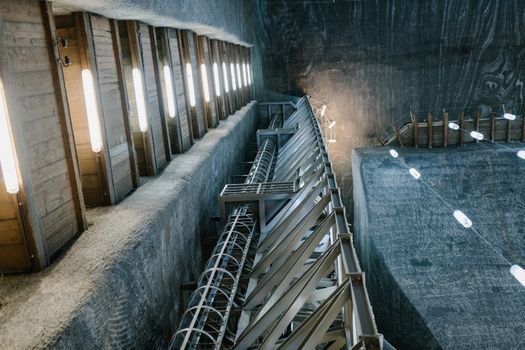
In NATM/SEM sequences, the impact drill lives on the jumbo and on a separate bolting platform; SDS-Max is the workhorse because rock-bolt patterns land in the 20-25 mm range, and resin cartridges run 25-32 mm, so the 8-15 J class is matched to the actual hole geometry rather than upsized for the rare 45 mm probe hole [S1].
On TBM projects, the impact-drill role shrinks to rib-and-lagging bolt installation, utility hangers, and survey-plug work inside the segmental lining; cordless 18 V SDS-Plus dominates because the 1,200 V DC trailing cable on TBMs is not a safe source for hand-held 220 V tools, and crews carry 5.0 Ah packs on the segment-erector basket [S1].
Cut-and-cover and station caverns revert to corded 220 V SDS-Max because the heading is dry, ventilation is good, and the long cable runs do not hit a battery limit; specifiers in 2026 are still issuing corded-only rules for shafts deeper than 80 m because of cable-voltage-drop and trip-coordination problems at the heading distribution board [S1].
Limits, Failure Modes, and What Not to Buy
Impact drills are not a substitute for rotary rock drills: at bit diameters above 45 mm, an SDS-Max hammer runs at the wrong penetration rate, overheats the clutch, and the operator compensates by leaning into the hole — which fails in either a clutch slip or a wrist injury before the hole completes [S1][S2].
Battery cold-soak is a recurring failure mode in deep-tunnel headings at 8-14 °C; spec a cold-rated pack (low-impedance cell chemistry) below 12 °C because standard Li-ion packs lose 25-35% of impact energy below 10 °C, and the operator reads the symptom as "drill is weak" rather than a battery issue [S2].
Cheap consumer SDS-Plus units (sub-1.5 J impact energy, no slip clutch, no vibration-decoupled handle) fail within a single heading shift on granite; the symptom is a stripped gear or a chuck that will not seat the bit, and the cost of downtime usually exceeds the price difference inside one shift on a tunnel jumbo [S2].
For a related view on equipment matching in tunneling environments, see wheel loader selection for tunneling: 2026 spec map, which covers the heading-side loading class that often shares the same heading power and ventilation constraints as a drill fleet.
Trackable signal: SDS-Plus cordless platforms above 54 V are entering 2026 tender documents for European rail-tunnel lots, while legacy 220 V corded SDS-Max retains its share of shaft work above 80 m depth — two trends worth watching as tunnel boring schedules extend through 2027 and 2028 [S1][S2].
Spec-level background on the components involved: pressure transmitter.