Bosch's UniversalImpact 18V cordless combi drill ships with a 1.5 Ah battery, a 10 mm keyless chuck, 20+2 torque settings, 34 Nm max hard-joint torque, and 21,750 bpm max impact rate at 1.30 kg machine weight [S1].
Landscaping work spans soft timber (sleepers, raised beds), masonry (brick planters, pier blocks), and 4-6 mm gauge metal (irrigation brackets, fence wire), so a combi drill with both rotation-only and impact modes covers the broadest range without forcing a tool swap.
What "impact drill" actually means in a landscaping context
An impact drill — more precisely a combi or hammer drill — adds an axial hammering action to rotation so masonry bits can break out dust while spinning, with Bosch's UniversalImpact 18V delivering 21,750 bpm in the impact setting [S1]. A dedicated impact driver (1/4 in hex collet, higher bpm) is designed for fastening, not hole-starting, and pairs with a different bit range. Hitachi's DV16V manual uses "change lever" markings to switch between "Rotation" and "Impact" modes, with separate high/low speed gearing, confirming the dual-mode architecture is the established mechanical pattern [S7]. For landscapers, the combi drill — not the impact driver — is the primary hole-making tool because it accepts 10 mm round-shank masonry and wood bits that the hex collet cannot.
Selection criteria: chuck, torque, voltage, weight
Four specs decide the right tool. First, chuck capacity: the UniversalImpact 18V uses a 10 mm single-sleeve keyless chuck and rates 10 mm in masonry, 10 mm in steel, and 30 mm in wood [S1]; the upper bound is governed by the chuck's clamping bore, not by the motor. Second, torque: Bosch publishes 23 Nm soft / 34 Nm hard, with 20 click-stops plus drill and impact positions on the preselection ring [S1]. Third, battery platform: 18 V Li-ion is the mainstream cordless class, and Bosch advertises the POWER FOR ALL ALLIANCE with 150+ products across 10+ brands on a shared 18 V pack [S1]. Fourth, weight with battery: 1.30 kg for the 1.5 Ah Bosch kit [S1] — relevant for overhead work on pergola beams, where heavier 5 Ah-equipped rigs tip the scales past 1.6 kg. For landscape crews cutting dozens of anchor holes a day, the 2-speed gearbox matters: Bosch quotes 0-440 rpm in 1st gear and 0-1,450 rpm in 2nd [S1], and the Hitachi DV16V separates the same two ranges with a mechanical change lever [S7].
Where a landscaping combi drill earns its place — and where it does not
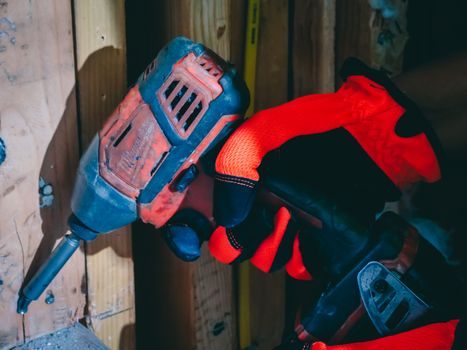
It IS for: 6-10 mm holes in clay brick and concrete block for fence post brackets, timber decking pilot holes up to 30 mm in softwood, 6-8 mm holes in sheet steel for irrigation clips, and occasional 8 mm masonry anchors on patio covers. The Bosch unit's 30 mm wood capacity and 10 mm masonry capacity bracket this workload cleanly [S1]. It is NOT for: repeated 13 mm+ holes in reinforced concrete, sustained chipping, or SDS-Plus demolition work — those want a rotary hammer, where the bit interface and piston mechanism differ. Landscaping also involves dirt, rain, and dust; cordless models without IP ratings (the UniversalImpact 18V spec sheet does not list one [S1]) are not intended for direct jet spray, so crew leaders should plan storage and dry-handling discipline around that.
Comparing the available options on the 2026 market
On the buyer-side platforms tracked in 2026, mass-market Chinese cordless impact drills cluster around 16-21 V with 6-13 mm chuck capacity. The Populus 16.8 V unit lists US$ 0.9-99/piece, 10 mm spec, ball-type impact structure, and a 1-piece MOQ [S2]. AWLOP's 20 V brushless hammer drill lists US$ 31.2/piece, 13 mm spec, MOQ 10 [S2]. Feihu's 21 V model lists US$ 30/piece, 32 mm spec, MOQ 50, with an "impact mechanism" classification [S2]. Golden Found's brushless press-style impact driver lists US$ 7.96-15.7/piece, 10 mm spec, MOQ 50 [S2]. Liangye's 18 V brushless hex-chuck impact driver (note: 1/4 in hex, not a keyless chuck) lists US$ 38-39.5/piece, 6 mm spec, MOQ 500 [S2]. Against the Bosch 18 V, 10 mm keyless chuck, 34 Nm, 21,750 bpm, 1.30 kg baseline [S1], the Chinese OEM units are an order of magnitude cheaper in unit cost but ship with no published torque, bpm, or weight figures on the listing page — that gap is the real spec decision point.
Bits, batteries, and the workflow around the tool
Bit choice is half the job: Alibaba's impact drill bit category groups masonry, SDS, wood auger, and step-cone families, with shank formats sized to match the chuck [S4]. A 10 mm chuck takes 10 mm round-shank masonry bits cleanly; larger bits need a 13 mm chuck or an SDS-Plus tool. Landscapers who already own a string trimmer or leaf blower on the POWER FOR ALL ALLIANCE 18 V platform can share cells across 150+ tools per Bosch's 2026 framing [S1], which materially lowers the per-tool battery cost. For crews working at distance from mains, the 1.5 Ah pack keeps the drill under 1.5 kg, but a 2.5-4.0 Ah pack of the same 18 V form factor will roughly double weight and triple continuous-drill cycle count between charges — pick by daily hole count, not by spec-sheet peak torque.
Standards, safety, and what the manual actually says
Operator manuals in this class require reading before use; the Hitachi DV16V manual opens with "Read through carefully and understand these instructions before use" and documents the side handle, depth gauge, and R/L rotation marking alongside the impact/rotation change lever [S7]. Bosch ships a downloadable manual for the UniversalImpact 18V and points users to the warnings document rather than printing them on the product page [S1]. In practice, landscapers should treat the depth gauge as a mandatory control when setting anchor bolts in masonry, and confirm the chuck is locked before each pull on the trigger — the 21,750 bpm impact rate will loosen an under-torqued single-sleeve chuck in seconds [S1]. For crew procurement, the documented tolerance on 18 V battery minimum capacity is 1.5 Ah per Bosch's own recommendation line [S1], which doubles as the lower spec boundary for any 18 V replacement pack a buyer might substitute.
Related reading for spec-mapped comparisons: impact drill vs rotary hammer for masonry anchoring, impact drill spec map for road maintenance crews, and wheel loader selection for quarrying if the landscaping job scales to earthmoving.
Two trackable signals to watch through late 2026: (1) whether 18 V cordless combi drills begin publishing ingress-protection ratings on retailer spec sheets, since the current UniversalImpact 18V listing omits one [S1]; (2) the price trajectory of brushless 18 V kits as Chinese OEM capacity from suppliers like AWLOP and Liangye continues listing 20-21 V brushless units in the US$ 30-40/piece band at 10-500 piece MOQs [S2].
For the relevant spec sheets and selection criteria, see impact drill, air impact wrench, and pressure transmitter.