Specifying a curing compound is a three-variable decision — resin/solvent vs water-based carrier, Type I (non-pigmented) vs Type II (white-pigmented, ASTM C309), and application rate against substrate water demand — and getting any of them wrong costs 7-15% surface strength on a hot-weather pour [S1][S3].
The product category sits inside a wider concrete-chemicals stack that also includes concrete admixtures and concrete fibers; a curing compound is the *external* moisture-retention layer, not an internal set-modifier, and that distinction drives every selection rule below [S1].
Chemistry Options: Resin/Solvent, Wax, Acrylic, Sodium Silicate
Four carrier-chemistry families cover roughly 95% of projects specified by concrete-curing specialists — solvent-borne resin, water-based wax emulsion, water-based acrylic emulsion, and sodium-silicate densifier hybrids — and the choice is governed by slab orientation, traffic use, and downstream floor finishes [S1][S2][S3].
Solvent-borne resin systems (typically 25-30% solids in mineral spirits or similar carrier) deliver 150-200 m²/L coverage and form a 0.05-0.10 mm moisture barrier that is widely specified on bridge decks, canal linings, and airport pavements where fuel and abrasion resistance are required [S1]. Acrylic emulsions sit between the two on price and performance and add a polish-friendly surface film favoured by polished-concrete and dyed-slab finishes [S3]. Sodium-silicate hybrids — often sold as "densify and cure" combinations — penetrate 2-5 mm into the cap and are chosen when the same product is being used to densify a slab for retail or logistics floors, not pure moisture retention [S3].
Type I vs Type II: Pigmentation Drives Heat Load
ASTM C309 splits field-applied curing compounds into Type I (clear or translucent) and Type II (white-pigmented), and the difference is functional, not cosmetic: a Type II TiO₂-pigmented film reflects 60-80% of incident solar radiation and holds the slab surface 5-11 °C cooler than a Type I film on a 32 °C ambient pour [S1][S3].
For hot-weather concrete (ACI 305R conditions: air > 30 °C, wind > 8 km/h, humidity < 50%), Type II white-pigmented wax or acrylic is the default — a 0.20 mm wet film delivers reflectance above 65% and keeps the surface below the 35 °C thermal-stress threshold that triggers plastic-shrinkage cracking [S1]. For cold-weather concrete (ACI 306R, air < 10 °C), Type I clear is preferred because pigmented films can slow early hydration in cool, shaded pours; the dominant failure mode shifts from evaporation to freezing, and the membrane's job is purely moisture retention, not solar reflectance [S1][S2].
A frequent spec error: ordering Type II for indoor or shaded pours where the reflectance premium is wasted and the white residue complicates subsequent floor-covering adhesion — Type I is the right call for enclosed warehouses, basements, and tunnels [S1][S3].
Substrate and Application Rate Logic
Application rate is set by the membrane's moisture-retention target, not by m²/L printed on the drum — the contractor's number is a maximum, not an optimum, and over-application can starve the slab of internal moisture needed for 28-day strength gain [S1].
For horizontal slabs in moderate climates, 4-5 m²/L (≈ 200-250 g/m² wet) is the standard wax-emulsion rate, climbing to 150-180 g/m² for solvent-resin systems with higher solids [S1][S3]. Vertical surfaces (tilt-up panels, formed walls) take 6-7 m²/L because the same wet film thins under gravity and bond is the limiting factor.
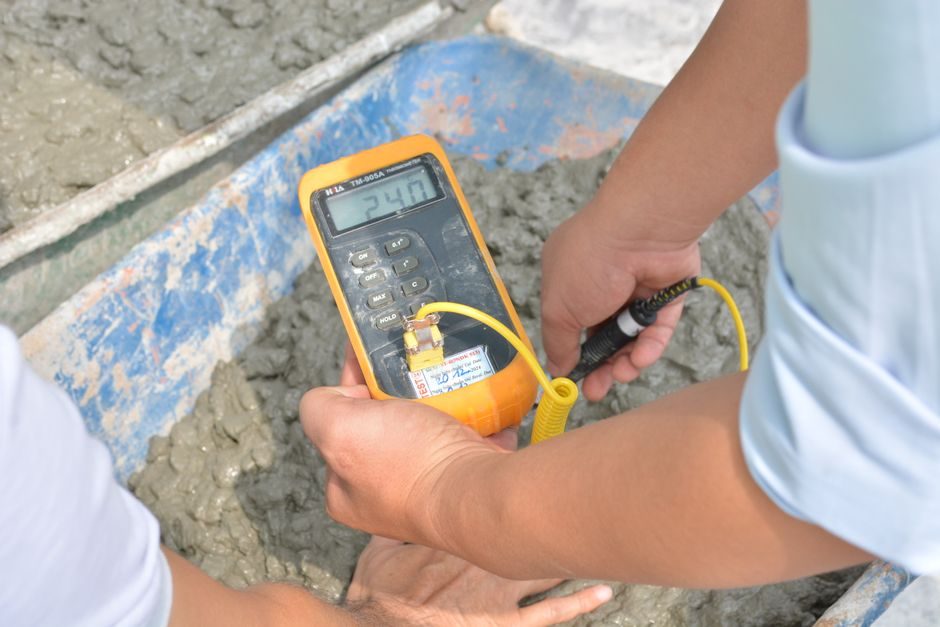
Substrate temperature, not ambient, is the gating variable: cure compounds should be applied when the slab is between 5 °C and 40 °C, and the membrane must form a continuous film before the surface dries out — practically, that means a 30-90 minute window after final trowelling on a 25 °C day [S1].
Compatibility with Admixtures, Fibres and Toppings
A cure membrane is a bond-breaker by design, and the engineer must decide at spec time which *subsequent* layer will be placed on top — densifier, topping, tile adhesive, epoxy — because the wrong film choice means that layer is debonded in 3-12 months [S3].
For slabs receiving a polished or dyed finish, an acrylic or sodium-silicate cure is selected so the hardener/dye can bond directly to the cap after a 14-28 day cure window and a mechanical grind (typically 100-200 grit metal-bond) [S3]. For slabs receiving a cementitious topping or self-levelling underlayment, the membrane is mechanically removed by shot-blasting or grinding to a CSP 3-5 profile before the topping is placed — wax-based products are easier to remove than solvent-resin films in this case [S1][S3].
The relation to the rest of the concrete chemical stack is strictly sequential: the concrete admixture is dosed in the mix to manage slump and set, the concrete fiber is added for shrinkage and impact control, and the curing compound is the *last* chemical decision — applied after final finishing, before the surface dries out.
Quality Control and Failure Modes
Three failure modes dominate field call-backs on cure-compound work: plastic-shrinkage cracking, dusting/soft cap, and delamination of the subsequent topping — and each maps to a different spec or application error [S1][S3].
Plastic-shrinkage cracking almost always traces to late or under-applied membrane on a hot, windy day: 200 m²/L of Type II wax placed within 30 minutes of final trowel, monitored with a 0.20 mm wet-film comb, is the field control point [S1]. Dusting and soft cap are usually over-applied wax emulsions starving the surface of water and leaving a 1-2 mm under-hydrated skin — the cure is mechanical removal and re-curing with a penetrating silane rather than another film-former [S3]. Topping delamination is the bond-breaker effect doing its job, and the fix is process: spec a strippable or water-emulsifiable cure, or spec mechanical removal of the membrane, before topping placement [S1].
Field QC kit: a wet-film thickness gauge (0.10-0.50 mm range), a reflectance spot-meter for Type II verification, and a simple evaporation-rate check (ACI 305R nomograph) at the pour start — three tools, one operator, and the membrane failure rate drops below 2% on a typical 5,000 m² slab [S1][S3].
Procurement and Sourcing Bands
Procurement usually locks in on drum-level pricing, and the spread between water-based and solvent-based systems is wide enough to swing the project budget — typical 2026 ex-works bands put water-based wax/acrylic at 1.80-3.50 USD/L and solvent-resin systems at 4.20-7.50 USD/L, with 200 L drums and IBC totes (1,000 L) carrying 8-15% volume discounts [S4].
Freight is the second lever: solvent-resin systems are classified as Class 3 flammable liquids, and the hazmat surcharge on a 200 L drum can add 12-25% to delivered cost in regions without back-haul — pushing the buy toward local water-based manufacture when the spec allows [S1][S4]. Lead time is typically 5-10 working days for stocked SKUs and 3-4 weeks for custom Type II batches, with most domestic supply concentrated in industrial-chemistry distributors and direct from the manufacturer (NATA-certified local suppliers in Australia, AASHTO-tested North American plants) [S1][S2][S3].
A pragmatic pre-pour checklist: confirm substrate temperature, confirm ambient humidity and wind, lock the application rate in the QC plan, confirm compatibility with the next-layer finish, and document the drum batch number against the pour record — five steps that decide whether the concrete curing compound delivers the 7-15% surface strength the spec assumes.
Related reads on adjacent concrete-chemistry decisions: Release Agent vs Admixture: Distinct Functions, Separate Specs clarifies the form-release side of the slab ecosystem, and Concrete Admixture Buying Guide 2026 covers the internal set-modifiers that interact with — but do not replace — the external cure membrane.