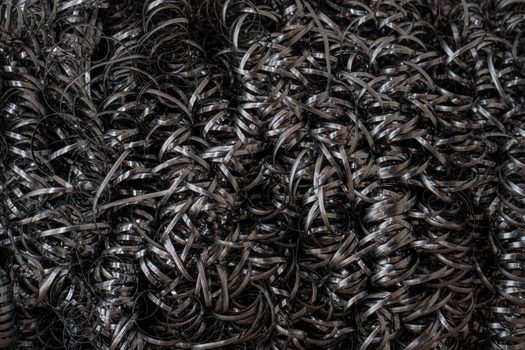
Steel fiber for concrete reinforcement is moving in a band of roughly USD 800–1,500 per metric ton on an FOB-China basis as of June 2026, with end-hooked and cold-drawn wavy grades sitting at the lower end and brass-coated or stainless melt-extract grades reaching the top of that range [S5][S6].
Polypropylene macro-synthetic fiber — sold both as concrete reinforcement and as a plastic-shrinkage crack-control admixture — typically lists in the USD 2.5–6.5/kg range on the same Okorder-style export channels, with the per-ton equivalent of USD 2,500–6,500 [S6]. Glass and carbon fiber reinforced polymer (GFRP/CFRP) recyclate grades remain a specialty, higher-cost line item. The bigger cost lever is almost never the per-kilo sticker: it is dosage (kg of fiber per m³ of concrete), aspect ratio (length ÷ diameter), and whether the mix is slab-on-grade, shotcrete or precast.
Fiber type lineup and the price each one carries in 2026
Four families dominate the procurement screens of a US/EU ready-mix buyer in 2026: hooked-end steel fiber, cold-drawn wavy steel fiber, polypropylene macro-synthetic fiber, and a growing glass/carbon recycled-polymer segment for non-structural pervious and decorative concrete [S1][S2][S5][S6].
Hooked-end steel (CFS 100-2, Bekaert Dramix-style 3D/4D/5D, ArcelorMittal Tabix) anchors the structural-replacement market: extended-joint slab-on-grade pours, industrial floors, tunnel segments, and shotcrete linings. Cold-drawn wavy fiber, often melt-extract stainless on specialty lines, lists at similar per-ton pricing on Chinese export portals and is the workhorse for general concrete reinforcement [S1][S5]. Polypropylene fiber splits into two procurement categories: micro-fiber (10–20 mm, 6–13 denier) sold as a shrinkage-control admixture near USD 2.5–4.5/kg, and macro-synthetic structural fiber (40–54 mm) that competes with steel at the upper USD 4–6.5/kg band [S6]. The glass-and-carbon recyclate pervious-concrete line studied by Singh et al. (2022) is still a research and demonstration segment rather than a commodity line item, with cost dominated by waste-stream sorting and resin content rather than fiber per se [S2].
Dosage, aspect ratio and the math that drives installed cost
Steel fiber dosage typically lands in the 20–40 kg/m³ window for slab-on-grade replacement of mesh or rebar, and 30–60 kg/m³ for shotcrete and tunnel linings; the per-cubic-meter fiber cost at USD 1,000/t and 30 kg/m³ is therefore USD 30 — a fraction of the USD 120–160/m³ ready-mix concrete line item on most 2026 US plant-price lists [S1].
Aspect ratio is the second lever. Most codes and supplier datasheets treat l/d = 50–80 as the structural sweet spot for hooked-end steel; pushing to l/d 80–100 buys higher post-crack residual strength but raises pumping risk and balling. For polypropylene macro fiber, aspect ratio runs 70–100 with 40–54 mm length. A 1,000 m² slab at 150 mm thickness is 150 m³ of concrete; a 25 kg/m³ steel-fiber design adds 3.75 t of fiber, or roughly USD 4,700–5,600 at mid-band pricing. A 4 kg/m³ PP macro design on the same slab is 600 kg of fiber, or USD 1,500–3,900 [S1][S6]. For cost context, ready-mix concrete typically prices out 15–25% lower when fibers are added versus equivalent rebar/mesh designs because joint spacing extends and placing labor drops — the trade-off is unit material spend going up.
Comparison: steel vs PP macro vs glass/carbon recyclate on four buyer criteria
On raw price per kg, PP macro at USD 2.5–6.5/kg undercuts steel at USD 0.8–1.5/kg only when the dosage is dramatically lower (3–6 kg/m³ vs 20–40 kg/m³); on a per-cubic-meter basis the two end up in the same USD 25–60 envelope for most structural applications [S5][S6].
On temperature and corrosion performance, steel wins for fire/high-heat exposure and for any carbonation-sensitive structural element, while PP macro wins for chemical plants, marine decks and pools where stray-current or chloride-induced corrosion of steel would shorten service life. On sustainability/LEED, the CFS 100-2 and similar hooked-end grades now publish the lowest industry EPDs among steel fibers per the manufacturer's own declaration [S1]. On handling and pump-ability, PP macro is lighter, safer for hand-spray shotcrete, and needs no Rust-on-pallet storage, but it cannot be used where the structural design relies on post-crack residual strength above ~1.5 MPa. GFRP/CFRP recyclate pervious concrete sits outside the structural procurement line — it is a niche, sustainability-driven buy, not a cost-optimized one [S2].
Who concrete fiber is FOR (and who it is NOT for)
Concrete fiber is the right buy for slab-on-grade industrial floors, jointed pavements, tunnel and mining shotcrete, precast elements with thin sections, and any pour where labor to place mesh or rebar is the schedule-killer on a tight crew [S1].
It is NOT the right buy for: heavily loaded structural beams and columns where the design relies on continuous rebar continuity at splices; elements requiring precise crack-width control below 0.2 mm; or any project where a non-fiber-ready mix design or a pump with insufficient vibration is going to ball the fiber into "hedgehogs" at the hose. PP macro is not appropriate where fire-resistance ratings demand a non-melting fiber. GFRP/CFRP recyclate fiber is not appropriate for primary structural reinforcement — it is a pervious, decorative, and sustainability credit line [S2].
Standards, sourcing rules and common failure modes

Steel fiber for concrete typically ships against ASTM A820 (steel fibers for fiber-reinforced concrete), with EN 14889-1 governing the European market and ACI 544 series covering design. PP macro fiber generally ships to ASTM C1116 Type III and EN 14889-2, with dosage and performance declarations carried on the mill datasheet rather than the bag [S1][S6].
The most common 2026 specification pitfalls on a buying desk: (1) ordering fiber by the bag instead of by kg/m³ of concrete — the two diverge once supplier bag weights vary; (2) accepting "hooked-end" as a generic when the actual l/d and tensile strength differ by 30–50% between the cheap melt-extract line and the cold-drawn 3D/4D product; (3) mixing fibers in the wrong sequence at the plant — fiber must go in after the mix has wetted out, or it balls; (4) ignoring the concrete admixture interaction when the project also needs a superplasticizer or air-entrainer, because dosage and slump retention both shift; (5) under-specifying the concrete vibrator cycle — fiber-reinforced mixes need shorter, multiple insertions rather than one long immersion, or the fiber migrates to the bottom of the slab. For chemical-plant and pool builds, the more general concrete fiber reference page is the starting point for grade selection, while the crossed-roller guide and linear-guide entries sit further down the spec chain for the production lines feeding those slabs.
Sourcing channels, MOQ and freight impact on landed cost
Chinese export portals (Okorder) list steel fiber with Loading Port: Tianjin, Min Order Qty: 2,000 kg, and a 250,000 kg/month supply capability [S5].
PP macro fiber lists on the same portals at MOQ in the 1,000–5,000 kg range, often with free-sample programs for new buyers. Landed cost in the US Midwest and EU North-Sea ports for either fiber type in June 2026 sits 25–40% above FOB once 2026 container rates, EU Steel Import Carbon Border Adjustment, and US Section 301 line items on Chinese steel are layered in. For projects in the 200–500 m³ range, the freight and duty math almost always favors the domestic mill; above 2,000 m³ the import channel starts to win.
The next data points worth tracking are the 2026 H2 Section 232 derivative-steel review outcome (which would re-stack duty on Chinese steel fiber) and any revision of ACI 544.4R on fiber dosage design tolerances; both move the 2027 procurement math on slab-on-grade jobs by mid-single-digit percent.