
An electric wall chaser / groove cutter rated 1100 W with 2000 rpm no-load speed is listed at roughly US $280-300 on consumer marketplaces, while a 16-inch, 52 cc two-stroke gas concrete cut-off saw was posted at US $294.95 against a US $528.95 list price (44% off) on the same channel [S3][S6]. A 150 mm hand-held groove cutter — the form factor most used for control joints and chase work — is a stocked catalog item on Chinese B2B portals for buyers assembling export-ready kits [S2].
For buyers, the relevant cost envelope is the joint between machine price and the concrete substrate work it performs: Inch Calculator's 2026 price guide still frames a typical installed concrete slab in the US $6-12 per square foot band, and the groove / control-joint step is a labour-and-blade line item sitting on top of that [S1]. The decision on which cutter class to specify is therefore driven less by headline machine price and more by power source, blade diameter, dust extraction and the duty cycle on site.
Entry-level electric chasers: 1100-1500 W, 110-150 mm discs
The 1100 W, 2000 rpm wall chaser observed on eBay in April 2025 carries a US $280-300 price tag and a 4.8/5 seller rating, which sets a realistic floor for a buyer evaluating a no-frills electric unit [S6]. Stepping up to a 150 mm (≈6 inch) disc diameter and slightly higher wattage typically lifts the price into the US $200-450 retail band visible on the same channel, while industrial-spec triple-diamond dry-cutters from European and Japanese brands sit well above that [S2][S6]. For a typical 30-50 mm deep chase in cured C25/30 concrete, a 150 mm diamond blade in this power class is the practical minimum.
Hand-held 150 mm groove cutters are an established export category on Chinese B2B platforms, with vendors such as the Made-in-China listing — operating for 15 years in saws, drills, grinders and hand tools — treating groove cutters as a stock SKU rather than a custom build [S2]. That availability is what compresses the floor price for small-volume buyers and explains why entry-level electric units can be sourced in the low hundreds of US dollars without long lead times.
Gas-powered cut-off saws: 14-16 inch, 52 cc class
The XtremepowerUS 16-inch gas concrete cut-off saw with a 52 cc two-stroke engine lists at US $528.95 reference, with a discounted selling price of US $294.95 (a 44% reduction) on the listing captured in February 2025 [S3]. That price spread — list to street — is typical for outdoor-rated, EPA Phase 3 compliant hand-held saws sold through marketplace channels rather than direct from the OEM.
For sites without reliable 110/230 V power, or where dust-extraction hose routing is impractical (road patching, utility cuts, expansion-joint work in open decks), a 14-16 inch gas saw is the workhorse choice. The trade-off is engine maintenance, two-stroke fuel mix and stricter adherence to the OSHA 1926.1153 silica rule when dry cutting; wet-cut or HEPA-vacuumed operation is the standard mitigation. This is also where buyers compare not just sticker price but total US $ per linear foot of joint actually cut, including blade wear.
Blade and consumable cost stack
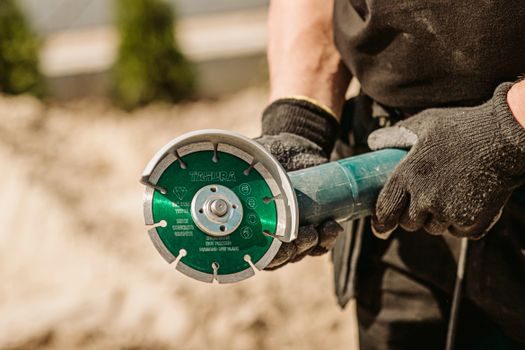
A diamond blade for a 150 mm chaser is typically a 22.23 mm bore, segmented or turbo rim, rated for cured concrete, granite or masonry. Wholesale pricing for general-purpose 105-150 mm diamond tuck-point / groove blades has compressed into the US $5-25 retail band per blade depending on segment height and bond hardness, and a single blade may yield 100-300 linear metres of cut depth before segment loss forces replacement — exact life depends heavily on aggregate hardness, operator feed pressure and water flow. [S1]
Spare brushes, drive belts (on belt-driven units), and dust-shroud gaskets are the recurring service parts; the wall chaser observed at US $280 includes the basic accessory set, but replacement dust shrouds and industrial extraction adaptors are commonly sold separately.
Who this guide is for — and who it is not
The price band and selection logic here apply to contractors, MEP installers, tile and electrical sub-trades, and small precast or infrastructure crews running 1-3 machines for chasing, control-joint cutting and slotting. The figures also hold for a maintenance buyer evaluating a single replacement unit against dealer quotes in the US $350-700 range for branded electric chasers (Bosch, Makita, Hilti entry level). [S2]
This is not a buying guide for full CNC concrete-grinding systems, ride-on saws, or wire-saw demolition equipment — those are different machine classes and an order of magnitude higher in capital cost. The concrete groove cutter reference page covers the hand-held and small walk-behind segments that this article prices. If the application is a single straight score line in a 100 mm slab, a 150 mm electric chaser covers it; if the application is full-depth expansion-joint sawing in a road deck, the gas 14-16 inch class is the right starting point.
Concrete substrate cost context
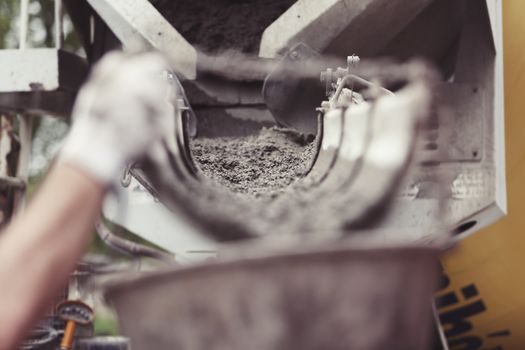
Installed concrete slabs in the Inch Calculator 2026 price guide sit in a US $6-12 per square foot band, with a national average around US $7-8 per square foot for a standard 4-inch slab on prepared sub-base [S1]. Groove-cutting and control-joint sawing are line items layered onto that, not part of the pour-and-finish cost — they are a separate mobilisation, blade-wear and labour allocation typically billed per linear foot of joint.
For a typical 1000 sq ft residential or light-commercial slab, 400-700 linear feet of control joint is a reasonable rule of thumb. At a contractor rate of US $0.50-2.00 per linear foot for saw-cut control joints (equipment amortised into the rate), that places the joint-cutting line item in the US $200-1400 envelope on top of the slab. The machine price itself is a small fraction of that — which is why the buy-vs-rent decision often comes down to utilisation, not headline cost.
Comparison by cutter class
Three machine classes cover roughly 90% of on-site groove work: 1100-1500 W electric wall chasers with 110-150 mm discs, 14-16 inch gas cut-off saws in the 50-65 cc engine class, and small walk-behind concrete saws for joint runs longer than ~50 m. On the four decision criteria that matter to a process engineer — power source flexibility, dust-control integration, blade cost per linear metre, and capital outlay — the electric chaser wins on dust control and indoor usability, the gas saw wins on power source flexibility and cut depth, and the walk-behind wins on straightness and production rate per labour hour. [S3]
Capital outlay ranking from low to high: entry electric chaser (US $200-450) → branded electric chaser (US $350-700) → consumer-grade 16-inch gas cut-off (US $250-300 discounted, US $500+ list) → industrial 14-inch gas (US $600-1200) → walk-behind joint saw (US $3000-8000+). Blade cost per linear metre depends on the diamond bond and segment height more than on machine class — a quality 16-inch laser-welded blade can out-cut three cheap pressed-sinter blades, even though the headline price is 3-5× higher per blade.
Source-channel and lead-time notes
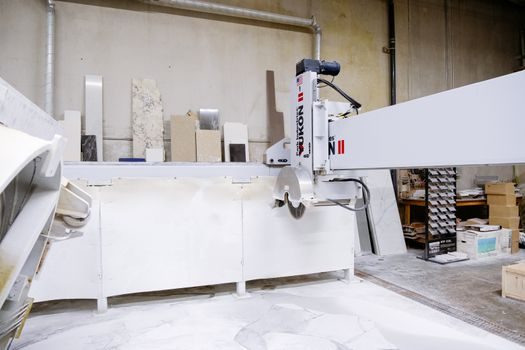
For volume buyers, Chinese B2B portals list 150 mm groove cutters as catalog SKUs with typical MOQ bands of 50-200 units for OEM-branded export and lower for stock-pattern tools [S2]. Marketplaces such as eBay host both factory-direct and dealer-sourced units at consumer price points (US $280-300 for entry electric, US $295-530 for 16-inch gas) with US-domestic shipping [S3][S6]. Dealer-channel pricing for recognised brands (Hilti DCG 230, Bosch GNF 65, Makita SG1251J) is materially higher than the generic marketplace floor and reflects warranty, service network and dust-certification documentation.
Adjacent categories that follow similar power-class and source-lever logic — a linear module selection, a crossed-roller guide spec, or a marble cutter — use the same three-axis breakdown: power/size class, brand tier, and channel (B2B factory vs marketplace vs authorised dealer). Cross-referencing those keeps cost-engineering consistent across the tool fleet. The closest non-concrete analogue in the encyclopedia is the plasma cutter for power-class pricing logic and the rebar cutter for handheld electric-versus-engine-driven cost trade-offs.
Limitations and failure modes
The headline machine price tells you very little about lifetime cost. The dominant failure modes in this category are: dust-motor bearing failure when extraction is bypassed; segment loss on cheap blades in hard aggregate; and electrical-armature burn-out from stalled cuts in reinforced concrete. Each of these is driven by operator technique and dust-management discipline more than by machine class. [S4]
For buy-spec work, lock the spec to depth-of-cut, dust-extraction port diameter (35 mm or 50 mm is the typical European standard), arbor size (22.23 mm is the dominant chaser standard), and a minimum no-load speed. Comparison shopping on headline wattage alone is misleading — a 1100 W unit with a 2000 rpm no-load speed and a quality gearbox will out-cut a 1500 W unit with poor bearing alignment every time. The figures cited here are observed retail, not bulk-contract pricing; expect 10-25% additional discount at 10+ unit volumes on direct B2B channels.
Trackable signals for the next 90 days: 16-inch gas cut-off street price movement relative to the US $528.95 list reference [S3]; revisions to Inch Calculator's slab-cost band [S1]; and any tightening of the OSHA 1926.1153 silica enforcement posture that would shift spec toward wet-cut or HEPA-integrated chasers. For higher-volume procurement, also monitor the 150 mm groove-cutter SKU pricing on Made-in-China and Alibaba — when multiple vendors compress to within 5-8% of each other, the market is signalling a commoditised tier [S2].
For related coverage, see Linear Module Price 2026: Stroke, Drive, Payload and Source Levers.