Interior finishing work runs on two distinct groove-cutting tools: walk-behind hand groovers for control joints in fresh slabs and dual-blade wall chasers for channels cut into cured masonry before electrical and plumbing rough-in [S1][S2].
Specifying the right tool for each operation drives joint spacing, edge radius accuracy, channel depth control, and dust load on occupied interior sites, so the selection criteria below tie machine class to slab age, joint function, and dust extraction requirements.
Two Tool Families, Two Operating Windows
Hand groovers and edgers cut joints into plastic concrete within minutes of placement, while wall chasers remove cured material to install concealed services [S1][S2]. A 1/4" radius edger is the standard for interior slabs, 3/8" is used for sidewalks, 1/2" for driveways, and 3/4" for heavy-traffic commercial pads, so radius size alone places the slab in a category before machine selection starts [S2]. Wall chasers carry two parallel diamond or abrasive blades and cut both edges of a channel in a single pass, after which the rib between them is knocked out with a chisel to leave a uniform slot for conduit or pipe [S1].
Joint depth on a green-cut groover is typically 1/4 to 1/3 of the slab thickness, set by the tool's depth fin, and the channel width is fixed by the groove bit (commonly 1/4" to 3/8") [S2]. For cured masonry, a wall chaser's cutting depth is adjustable on the machine, with most electric single-phase units covering 0-30 mm and three-phase or hydraulic rigs reaching 40-50 mm for deeper service runs [S1]. The two families therefore complement each other: the groover defines where the slab will crack; the chaser defines where the wall will be opened.
Slab Joint Tools: Trowel, Groover, Edger Spec Bands
Margin trowels sized 4"x6" to 5"x8" fit inside forms and along edges where 18" finishing trowels cannot operate, while pool trowels use 10" to 16" rounded-nose blades in blue steel or stainless for cove and curved surface work [S2]. Walking edgers cover 100+ linear feet per hour without the operator kneeling on fresh concrete, which is the productivity benchmark for commercial interior slabs finished by machine rather than by hand [S2].
Hand floats in the standard 16"x3-1/8" configuration open the surface for finishing, and wood floats produce an open-textured surface ready for broom finish, while magnesium and resin variants close it for trowel work [S2]. Groover bits are matched to slab depth: a 100 mm slab takes a 25 mm deep joint, a 150 mm slab takes a 38-50 mm joint, and ACI 302-class recommendations for interior flatwork call for joint spacing in feet of 2 to 2.5 times the slab thickness in inches (a 6" slab gets joints at 12-15 ft, an 8" slab at 16-20 ft), a rule of thumb reinforced by the concrete groove cutter operating envelope in the reference catalogue. Step trowels at 6"x6" to 6"x8" form clean 90-degree inside edges on stairs and landings, and coping trowels shape radius edges on walls and caps with convex blade geometry [S2].
Wall Chaser Spec Bands: Power, Blade Count, Dust
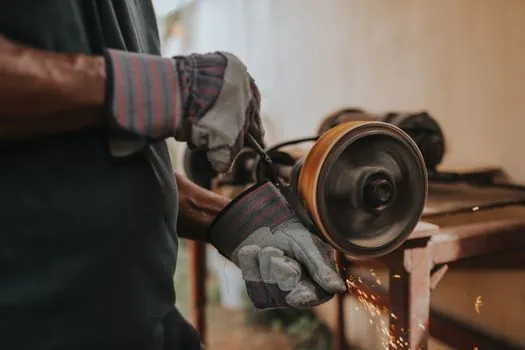
Single-phase 110-120 V or 220-240 V wall chasers in the 1.4-2.0 kW band cover most interior renovation work, while three-phase 380-415 V units at 2.5-3.0 kW are specified for continuous commercial cutting of cured concrete and reinforced masonry [S1]. Most machines run two parallel 110-125 mm diameter blades with a fixed or adjustable spacer that sets channel width between roughly 20 mm and 35 mm, and some heavy-duty chasers accept a third central blade to cut a wider slot in a single pass [S1].
Dust extraction is non-negotiable on interior sites: chasers must connect to an M-class or H-class vacuum that meets the EN 60335-2-69 dust extractor standard common in European fit-outs, because silica-bearing concrete dust drives the operator's respiratory exposure profile [S1]. A related comparison, marble cutter selection for stone trim versus plasma cutter for steel framing, illustrates that abrasive dry cutting is the common thread for masonry while thermal cutting takes over at the steel-to-concrete transition in mixed-material interior packages.
Who the Walk-Behind Groover Is For, and Who Should Use a Wall Chaser
Concrete contractors, concrete finishers, and concrete flatwork crews doing interior slabs, curb and gutter, and pool decks are the primary users of groovers, edgers, and the supporting trowel family [S2]. Landscapers and hardscapers use the same tools for patios, walkways, retaining-wall caps, and decorative stamping, while farm and ranch operators apply them to barn floors, feed pads, and silage bunker floors [S2]. On every site, joint cutting must happen while the concrete is still plastic, so the groover belongs with the placement crew, not the framing or MEP subcontractor.
Wall chasers belong with electricians, plumbers, HVAC installers, and renovation contractors who open cured walls and floors to run concealed services [S1]. Electrical conduit, water supply and drainage pipe, HVAC lines, and communication cable are the four service classes that justify a wall chaser, and the channel is then closed with plaster or a cement-based patching compound before final surface finish [S1]. The chaser is the wrong tool for green concrete and the groover is the wrong tool for retrofit MEP; matching tool to material state is the first selection gate. For utility-grade cuts on rebar, plate, or pipe stub-outs inside the same interior, an oxy-fuel cutter or rebar cutter is the right sister tool, while a finishing material specification governs the patch that closes the channel.
Selection Criteria: Comparing the Three Main Options

For interior finishing, the decision tree is: (1) is the concrete still plastic, (2) is the goal a control joint or an edge profile, and (3) is the substrate cured masonry that needs a service channel [S1][S2]. A criteria-based comparison of the three tool classes:
Hand groover and edger (1/4" radius): cost is low (USD 20-60 for a bronze or stainless bit), operating window is the first 2-4 hours after placement, joint function is crack control and edge rounding, dust load is negligible, and operator skill is finish-craft trained [S2]. Walk-behind groover / walking edger: cost is mid (USD 200-600 for the tool, USD 1500-4000 for powered riding edgers), output is 100+ linear ft/hr, joint function is control joints in commercial slabs, dust load is low, and operator skill is finish-craft trained [S2]. Dual-blade wall chaser: cost is mid-to-high (USD 250-1200 for a 1.4-2.0 kW single-phase unit, USD 1500-3500 for three-phase rigs), operating window is after full cure (typically 28 days), joint function is conduit, pipe, and cable channel, dust load is high without M-class extraction, and operator skill is electrical or plumbing trade [S1]. The "right" tool is the one that matches the concrete's age and the joint's function; mixing them leads either to late joint cuts that do not crack where intended or to dry-cutting cured concrete with the wrong bit geometry.
Limitations, Failure Modes, and Standards Touchpoints
Hand groovers fail when the concrete has stiffened past the point where the bit can press a clean shoulder; this is the classic "late joint cut" failure mode that lets random cracks form between sawn joints [S2]. Wall chasers fail when blades are run dry without extraction, when the operator forces feed past the rated amps, or when the depth is set deeper than the machine's plunge allows, producing a channel that is wider at the surface than at the base and that traps the patch material [S1]. A chaser's two-blade geometry also requires a matched spacer to keep the channel parallel; mismatched blades of different diameters cut a tapered slot that will not seat standard conduit clips or pipe clips [S1].
Standards touchpoints: interior flatwork joint geometry is typically set against ACI 302 (floor slabs) and ACI 360 (slabs on ground) recommendations in the U.S., and against BS 8204 in the UK; dust extraction for silica-bearing dust is governed by EN 60335-2-69 for the vacuum and by OSHA 29 CFR 1926.1153 for permissible exposure limits in occupied interior spaces [S1]. For comparison context, the tunnel laser screed selection spec map covers the placement side of interior slab work, while the concrete groove cutter spec map for steel construction covers structural interface cuts, so the two together frame the slab-and-joint workflow end to end. Trackable signals through the rest of 2026 include updated M-class extractor adoption on interior fit-out sites, wider use of 3-blade chasers for 40-50 mm channel widths in commercial electrical rough-in, and tighter edger radius standards (1/4" vs 3/8") being written into interior architectural finish specifications.