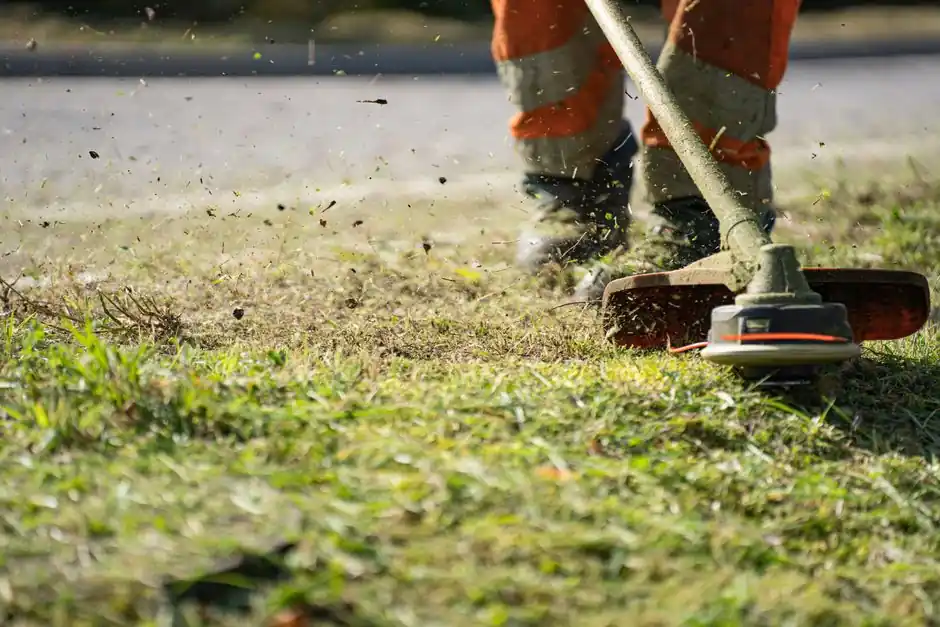
Landscape hardscape crews usually pick from three machine classes: handheld 2-stroke or 1,400-1,800 W electric groovers for control joints under 50 mm deep, 3-9 kW petrol walk-behind saws for 100-180 mm expansion cuts in cured pavement, and dedicated wall chasers with twin parallel diamond blades when edging or channeling decorative concrete [S1].
The matching cut width and depth is set by diamond-blade diameter, not motor power: a 350 mm blade cuts roughly 110 mm deep per pass, while a 450 mm blade reaches 165-180 mm in standard cured concrete, so landscaping work over 100 mm deep almost always needs a 400 mm or larger blade on a walk-behind saw [S1].
Match the Cutter Class to the Landscape Task
Handheld 2-stroke concrete groovers weighing 8-12 kg with 300-350 mm diamond blades are the standard pick for control joints in freshly poured patio slabs, broom-finished walkways, and stamped-concrete edging where cut depth stays at 25-50 mm [S1]. Their twin-handle anti-vibration design and 80-100 cc 2-stroke engines deliver 9,000-10,000 rpm blade speed, which is enough to keep a continuous segment rim cutting cleanly through green concrete (typically within 4-24 hours of the pour, depending on ambient temperature and mix design).
For trenches that hold landscape lighting low-voltage cable, 16-25 mm drip-irrigation laterals, or paver-edge restraints, a wall chaser fitted with two 125-150 mm diamond blades set 20-30 mm apart is faster than a single-blade saw because the channel is opened in one pass instead of two parallel saw cuts plus a chisel-out [S1]. Cutting depth on these machines is normally adjustable from 10-40 mm via a plunge roller or screw feed, which keeps the operator from over-cutting into sub-base.
Power Source and Drive: Electric vs Petrol vs 2-Stroke
Electric 1,400-1,800 W groove cutters running on 110-120 V / 60 Hz or 220-240 V / 50 Hz site power are common on indoor or covered-landscape jobs because they avoid exhaust fumes and keep noise at 90-100 dB(A), versus 105-115 dB(A) for an equivalent petrol unit [S1]. The trade-off is cable drag and the need for an RCD-protected outlet on outdoor pours.
Petrol 2-stroke 80-100 cc cutters at 3-5 kW and 4-stroke 200-390 cc cutters at 4.5-9 kW dominate open-site landscape work where no power is available, and they accept 300-450 mm diamond blades for the deeper expansion-joint cuts used in driveways, vehicle-rated pavements, and large-format slab hardscape [S1]. For tasks beyond paving, the marble cutter class overlaps on blade geometry but is not a substitute when abrasive green-concrete cutting is the goal.
Blade Specification Bands for Hardscape Joints
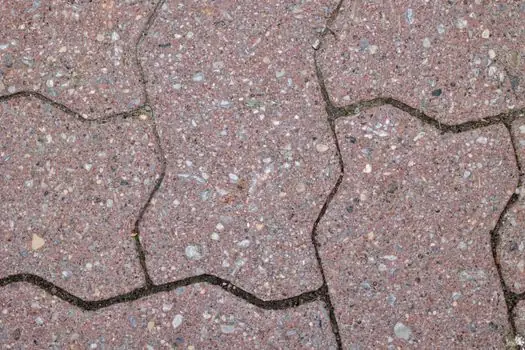
Three blade families cover the bulk of landscape concrete cutting: continuous-rim turbo blades for cured decorative concrete and paver overlays, segmented laser-welded blades for cured structural slabs with rebar, and early-entry dry-cut blades for control joints in green concrete within 2-6 hours of the pour [S1].
Bond hardness has to track the aggregate: hard-bond segments for soft, abrasive limestone and sandstone aggregate common in decorative landscape mixes, soft-bond segments for hard flint and granite aggregate where a hard rim will glaze and refuse to cut. Standard operating line speed sits at 60-100 m/s rim speed; under-speeding a 350 mm blade below roughly 3,600 rpm starves the diamond exposure and burns the steel core.
Walk-Behind Saw Selection for Joint Runs Over 30 m
Once a landscape project needs continuous control or expansion joints longer than 30 m/day, the productivity math flips to a walk-behind power cutter with a 350-450 mm blade, 4.5-9 kW petrol engine, and a water-bottle or pump-fed dust suppression kit [S1]. Typical daily output is 30-100 m of joint for 50-100 mm depth, against 8-15 m for a handheld on the same depth, so on a 200 m² patio the walk-behind finishes jointing in a single shift.
Water feed at 8-15 L/min keeps dust below visible nuisance levels and extends blade life by 30-50% versus dry cutting on cured concrete, but on green concrete early-entry blades are designed to run dry to avoid washing cement fines into the joint. Wheel kit, depth screw, and pointer are standard; a third-wheel flatness indicator matters on slabs being scored for stamped overlays where joint straightness drives the pattern alignment.
Comparison: Handheld vs Wall Chaser vs Walk-Behind
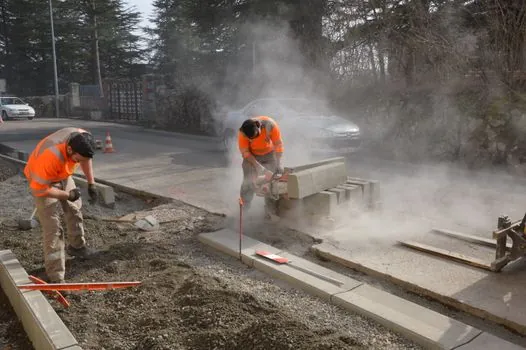
Lining the three options against the four criteria that drive a landscape purchase decision: maximum cut depth, daily productivity, surface finish tolerance, and capital cost. Handheld 2-stroke: 50 mm depth, 8-15 m/day, +/-3 mm finish, USD 350-700. Wall chaser: 40 mm depth, 12-25 m/day of channeled trench, +/-1.5 mm finish on channel width, USD 250-600 plus blades. Walk-behind 4-stroke: 165-180 mm depth, 30-100 m/day, +/-5 mm finish (joints are usually hidden by sealant), USD 2,000-5,500 [S1].
Selection rules: pick a handheld for under 50 mm control joints on small patios, a wall chaser for narrow 20-30 mm irrigation or lighting trenches, and a walk-behind for any expansion joint over 100 mm deep or any project over 200 m² of hardscape. For a separate paving detail, the cement concrete encyclopedia page lays out the strength classes and curing windows that set when joints can be cut.
Joint Spacing, Depth, and Timing for Landscape Slabs
The rule landscape contractors follow on unreinforced poured-concrete patios and walkways: space control joints at 24-30 times the slab thickness in inches (so 1.8-2.5 m for a 75 mm slab, 2.4-3.0 m for a 100 mm slab), and cut depth at one-quarter to one-third of slab thickness (so 19-25 mm deep on a 75 mm slab) [S1]. Deeper cuts let thermal movement localize at the joint and stop random cracking across the field.
Timing on green concrete is the most common spec error: cutting too early ravelsthe joint edge, cutting too late invites shrinkage cracks before the saw arrives. Target window is when the slab supports the saw's weight without rutting, usually 4-8 hours after the bull float in warm weather and 6-24 hours in cool weather, verified with a scratch test that leaves a faint mark rather than powder.
On-Site Safety and Standards Anchors
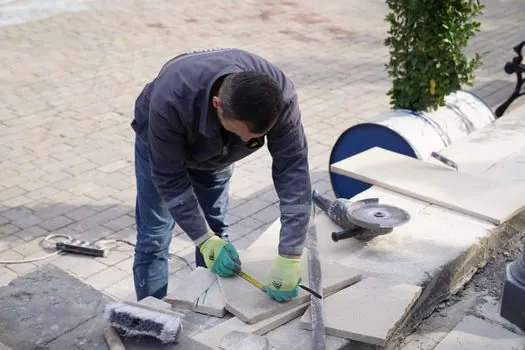
Handheld and walk-behind concrete cutters in landscape use should be specified to EN 60745-2-22 for hand-held machines and ISO 19432 for portable cut-off machines, with a diamond blade rated to EN 13236 for the bonded-abrasive product family, per the 2026 OEM guidance [S1]. Dry-cutting on cured concrete also needs an integrated dust extraction port tested to the local dust-control class (Class M in EU jurisdictions for silica-bearing dust).
Operator-side requirements: 100 dB-rated hearing protection, FFP2/FFP3 or P100 respiratory protection during dry cutting, and a face shield plus safety glasses because segment loss at 60-100 m/s rim speed projects fragments several meters. Water-fed wet cutting cuts visible dust by roughly 80-90% and is the lower-exposure option for residential landscape work where neighbors and finished planting are close to the saw.
Limits and Failure Modes to Plan Around
Three failure modes dominate landscaping groove-cutting call-backs: raveled joint edges from cutting too early, random cracking from joints spaced too far apart, and glazing of a hard-bond blade on soft aggregate that then burns the steel core [S1]. Each is preventable with a 30-second check: scratch test for timing, measuring tape plus slab-thickness math for spacing, and matching bond hardness to aggregate before the first cut.
Cutter choice also matters for the rebar cutter and plasma cutter cross-over cases: landscape crews occasionally need to trim rebar in a slab before jointing, or to cut steel landscape edging, and these are different machines with different spec bands, so do not substitute a concrete saw for rebar work or vice versa.
For demolition and re-use of broken landscape concrete, an excavator-mounted crushing bucket is the alternative path: 55,000-100,000 lb excavator class, 4,600 psi max hydraulic pressure, 90-105 gpm oil flow, and roughly 5,500 lb bucket weight handle rubble up to 300 mm with rebar in the feed and run at up to 110 US t/h in the right material [S3]. That is the recycling endpoint of the same hardscape that a groove cutter first jointed on pour day.
For related coverage, see Static Pressure Molding Machine Selection for Automotive Castings.