
Automotive foundries specifying medium-to-large castings such as engine blocks, valve bodies, and complex structural parts should anchor selection on multi-piston static pressure molding lines that consistently hit 85-90 B-scale mold hardness across the entire flask, paired with throughput targets of 50-120 molds per hour [S1].
Static pressure molding in this segment is not a single SKU but a class of equipment, and the spec-first forks that matter are flask versus flaskless architecture, compaction method, PLC control depth, and the upstream sand-handling footprint that the line forces on the foundry floor [S1].
What Counts as a Static Pressure Molding Line
Air-flow static pressure molding lines and multi-piston (multi-touch) presses are the two equipment categories engineers mean when they say "static pressure" for green-sand automotive work, and both rely on uniform compaction pressure across the pattern face rather than jolt kinetic energy [S1]. Multi-piston machines use dozens of independently actuated hydraulic heads that auto-adjust to local sand-layer thickness, so a pattern with high vertical steps still produces a mold whose hardness stays inside the 85-90 B-scale band on both flats and sidewalls [S1].
For higher-volume brackets, hubs, and small suspension parts, a top-and-bottom shoot-squeeze dual-station automatic press sits in the same family and pre-compacts the sand with compressed air before the final squeeze, lifting cycle rate without sacrificing hardness uniformity [S1]. Within the broader foundry taxonomy this sits alongside shell molding machine and low-pressure die casting machine routes, which solve different problems: shell molding for thinner-wall, higher-surface-finish cores and housings, low-pressure die casting for non-ferrous structural nodes.
Spec Bands That Drive a Buy Decision
Three numeric bands separate a working automotive spec from a guess. First, throughput: 50-120 molds per hour is the multi-piston and top-and-bottom shoot-squeeze envelope; below that, a jolt-squeeze Z1410-class machine is the lower-cost alternative for small, simple parts [S1]. Second, hardness uniformity: the 85-90 B-scale figure is the published target, and the underlying mechanism is multi-piston internal-force compaction where the press frame carries no reactive load, so all force transfers into the sand [S1]. Third, electrical and control load: representative flaskless top-and-bottom shoot-squeeze units such as the Z5161 sit near 15 kW absorbed power with an 11.5-ton machine mass and a landed cost band of roughly 50,000-75,000 USD, useful as a sanity check on budgetary quotes [S1].
For comparison, the broader static pressure molding machine category in our reference index documents the same compaction principle applied to larger flask sizes, while molding covers the upstream sand-mix and blow-plate decisions that feed any of these presses.
Flask vs. Flaskless: The Layout Fork
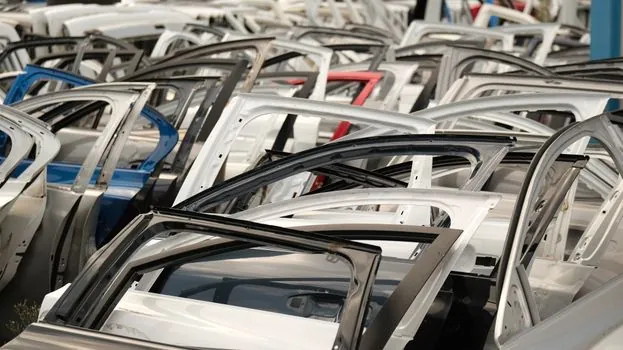
Flask molding keeps the flask married to the mold through pour and shakeout, which is the right call for medium-to-large castings where the pattern mass and cope/drag balance rule out boxless handling; most multi-piston automotive lines are flask-type for exactly this reason [S1]. Flaskless (boxless) molding strips the flask immediately after compaction and recirculates it, which makes sense for high-volume, smaller castings such as counterweights and park-bench legs, and combines molding and closing in a single machine cycle [S1].
For a Tier-1 automotive program running mixed part sizes, the practical answer is usually a flask-type multi-piston line as the primary asset with a separate flaskless top-and-bottom shoot-squeeze cell for the small high-runner brackets, so the foundry avoids forcing one machine family to cover both ends of the part-size spectrum [S1].
Controls, Safety, and Daily-Operation Specs
PLC control, motion interlock protection, built-in fault diagnostics, and remote monitoring are no longer optional on a static pressure line; modern multi-piston and shoot-squeeze machines are specified with all four, and a new operator should be able to run the line after a short familiarization rather than a multi-week apprenticeship [S1]. PLC I/O count, safety-circuit category (typically Category 3 / PL d under ISO 13849-1 for the moving-flask and squeeze zones), and Ethernet/IP or PROFINET uplink for plant-level SCADA are the next-tier questions to put on the RFQ.
For foundries already standardising on the anti-static equipment and static var generator side of plant power quality, the molding-line PLC panel should share the same grounding and surge-protection philosophy so a single trip event does not propagate from the sand plant into the molding cell.
Adjacent Decision: When Injection Molding Wins Instead
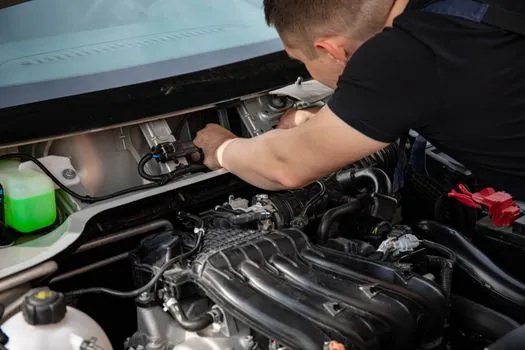
For plastic automotive exterior parts, including bumper fascias, integrated grilles, and light-bar enclosures, large-tonnage injection molding is the right process, not sand casting; 1600-ton machines with closed-loop microprocessor control of cavity pressure, hold pressure, and clamp tonnage are the current benchmark for that segment [S3]. The decision split is straightforward: if the part is ferrous or high-temperature aluminum and must survive a poured-metal thermal cycle, specify a static pressure green-sand line; if the part is modified PP with EPDM and mineral filler, or another engineered thermoplastic, specify injection molding [S3].
Within injection molding for these parts, a fully integrated tool-build, molding, and painting supplier reduces dimensional stack-up and paint-adhesion risk, which matters because modified PP has low surface free energy and tolerates very little surface contamination between molding and coating [S3].
Limitations and Failure Modes to Spec Against
Low or uneven mold hardness is the dominant failure mode: it produces casting swell, excessive flash, and dimensional drift that downstream machining cannot fully recover [S1]. The spec-time mitigation is to require the 85-90 B-scale band as a measured value on a flat test block, not as a marketing line, and to require the press builder to demonstrate uniformity data on a stepped pattern [S1].
A second failure mode is sand-system mismatch: a static pressure line is only as uniform as the incoming moisture, bentonite activation, and grain-size distribution, so any selection decision that ignores the sand plant is incomplete and typically surfaces as hardness drift after the first 200 operating hours. A third risk is throughput optimism: vendors sometimes quote peak mold rate under ideal conditions, so the buy-spec should pin a sustained 50-120 molds-per-hour figure over an 8-hour shift with the actual part mix, not a single-cycle best case [S1].
Standards, Sourcing, and a Trackable Signal
There is no single ISO or SAE number that fully governs a static pressure molding line; the relevant benchmarks are process-side, namely the published B-scale mold hardness target, the 50-120 molds-per-hour envelope, and the ISO 13849-1 performance level on the safety circuits, with PLC and fieldbus conformance (IEC 61131-3, PROFINET or Ethernet/IP) called out separately [S1]. For any insert or sub-assembly that ends up overmolded into a sensor or connector housing, the precision insert-molding reference notes that micron-level insert positioning, controlled thermal management, and validated insert surface preparation are the engineering controls, with materials aligned to SAE AMS family specifications for the automotive use case [S2].
Trackable signals to watch through the rest of 2026: how many Chinese-built multi-piston lines land at European Tier-1 automotive foundries under the same 50,000-75,000 USD-equivalent price band that defines the smaller flaskless shoot-squeeze segment [S1], and whether major press builders release PLC firmware updates that expose real-time B-scale hardness telemetry to plant SCADA, since that is the next data flow that will change how these lines are procured and accepted on site.
Related analysis: Safety Interlock Switch Selection for Warehouse Operations: A Spec-First Map.