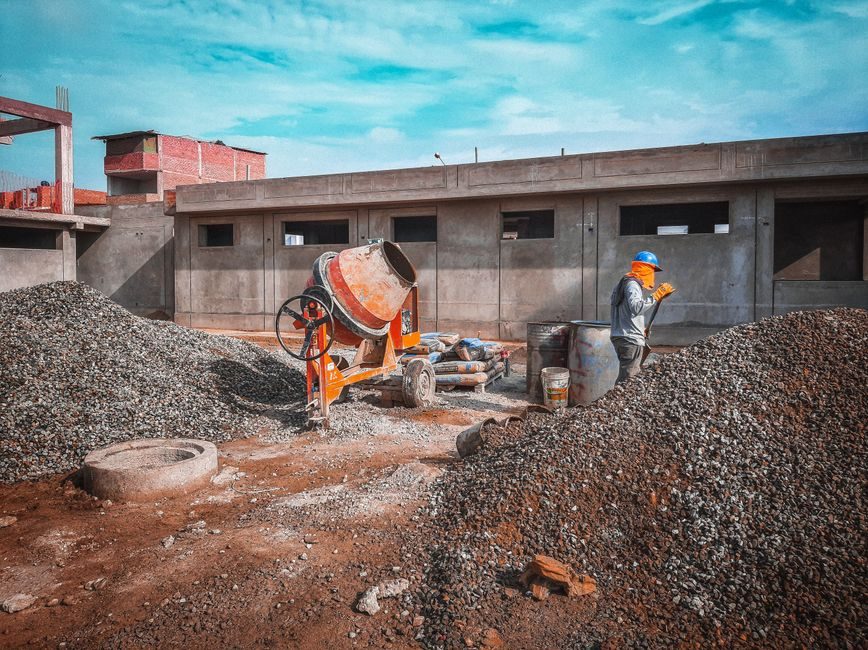
A 2026 concrete mixer truck purchase boils down to three mechanical decisions — drum volume class, drive system (hydraulic or hydraulic-lightweight), and chassis configuration — because those three gates fix payload, manoeuvrability, and unit cost simultaneously.
Current production mixers span 7-15 m³ drum capacity, with the CIFA HD series topping out at 15 m³ (529.72 ft³) and the Semix SM9 lightweight model covering 7-12 m³ (247.2-423.78 ft³) [S1][S2]. Chinese-built 6×4 chassis units (HOWO 375 class) list at US$7,000-15,000 per piece FOB, while self-loading 4 m³ diesel mini-mixers run US$12,000-43,000 per piece [S6][S5]. Fleet buyers on tight European tender rates are still specifying the upper drum class; African and Southeast Asian road-build fleets are migrating down to 7-9 m³ to preserve axle loads on marginal pavements [S1][S2].
Drum Capacity Bands and the 7-15 m³ Working Envelope
The 7-15 m³ bracket is the production envelope across hydraulic and lightweight hydraulic drives [S1][S2]. Below 7 m³ you cross into the concrete mixer truck self-loading / mini-mixer category — the Hamac 4 m³ mobile self-loading unit sits in that pocket at US$12,000-43,000 per piece [S5].
Drum volume dictates residue rate. Okorder publishes a vendor spec of ≤0.5% discharge residue rate for production hydraulic mixers, paired with discharge throughput of ≥2 m³/min [S6]. That residue threshold is the difference between a drum geometry that cleans out and one that builds up a hardened cake after 200 loads. Jidong's mixer spec sheet adds a structural gate — every weld point is handled by an automatic welding arm to keep fatigue initiation under control [S5] (2022-03). Both are useful baselines when reading Chinese supplier quotes that quote drum volume but skip geometry.
For buyers running one drum on multiple sites, the spec to push for is the geometric volume AND the mixing (not agitating) volume, because Chinese suppliers frequently quote nominal drum size rather than usable volume. The CIFA HD's 560 l/min hydraulic output is the kind of flow figure that tells you whether the drum can unload the rated volume inside an hour [S1].
Hydraulic vs Lightweight-Hydraulic Drive: Where the Weight Goes
Standard hydraulic drum drives remain the default on CIFA HD, with single or double rollers, sling bar off-road support, and bolted maintenance access [S1]. The Semix SM9 sells a "lightweight" hydraulic configuration aimed at payload recovery on axle-limited chassis [S2].
The practical delta is unsprung weight at the rear axle. Lightweight drum systems trade blade geometry and liner thickness for empty-vehicle mass, returning 300-800 kg of payload per load depending on the OEM. On a 6×4 chassis with a 9 m³ drum that is a 4-9% payload uplift before any legal axle limit is touched. The trade-off is wear life — lighter blades and liners on abrasive mixes (silica-rich aggregate, low-slump paving concrete) can halve the drum-relining interval.
For a fleet running structural concrete and ready-mix on paved urban routes, lightweight-hydraulic is the better spec gate. For quarry, dam, or mine site pours with high-aggregate-impact loading, stay with the standard hydraulic heavy-duty build [S1][S2]. The engine-driven hydraulic pump is the same architecture in both — what changes is the drum mass and the blade wear package.
Chassis Configuration: 4×2, 6×4, 8×4 and the 375 hp Class
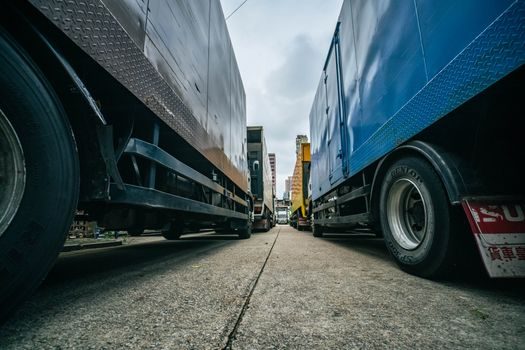
Chinese-built 6×4 HOWO 375-class chassis dominate the lower-cost segment at US$7,000-15,000 per piece FOB [S6]. The 375 designation refers to the engine horsepower band (around 375 hp / 280 kW) which is the working point for a fully loaded 9-12 m³ drum on highway gradients.
Chassis selection is governed by gross vehicle weight (GVW) and local bridge-formula rules. A 4×2 chassis with a 7 m³ drum suits urban ready-mix where total laden mass stays inside a 25 t GVW window. 6×4 is the workhorse for 9-12 m³ drums. 8×4 only earns its keep above 14 m³ or on routes with low per-axle limits [S6]. A useful sanity check: chassis manufacturer and drum OEM should be specced together — a 15 m³ CIFA HD drum on a thin-wall Chinese chassis is a torsion-fatigue problem waiting to happen [S1].
Engineered chassis also feed the discharge plumbing. If a fleet already runs a truck-mounted concrete pump on the same chassis spec, standardising the wheelbase, PTO interface, and hydraulic reservoir simplifies spares and training. That cross-equipment logic is why some buyers anchor the chassis decision first and let the drum OEM follow.
Self-Loading Mixers: The 4 m³ Class and When It Pays
Self-loading concrete mixers (SLMs) bundle the drum, loading shovel, water tank, and operator cabin onto a single 4×4 chassis. Hamac's 4 m³ diesel SLM lists at US$12,000-43,000 per piece, with a 1-piece MOQ and Diamond-member audited supplier status [S5].
The SLM buying case is site mobility, not per-cubic-metre cost. On remote rural pours, dam access roads, or islands where a concrete pump truck cannot reach, a single SLM replaces a loader, a weigh batcher, a transit mixer, and a water bowser. At 4 m³ per batch and 4-6 batches per shift, an SLM produces 16-24 m³/day which is roughly one pour cycle for a small foundation.
The spec to demand is the diesel engine emission tier (Stage V / Tier 4 final for EU/US; equivalent for other regions) and the weighing-system accuracy — published Chinese SLM spec sheets list a "truck weighting" module that governs cement, aggregate, and water dosing [S5]. Buyer beware: cheaper SLMs with a single load-cell under the drum have ±3-5% batch accuracy. Water-cement ratio variance of that magnitude will show up as strength scatter on the break tests.
Pricing Bands 2026 and the FOB Cost Stack
FOB China pricing for 2026 spans three rough bands, all per piece MOQ. (1) Bare chassis-cab 6×4 HOWO 375 with a 4-6 m³ drum: US$7,000-15,000 [S6]. (2) Self-loading 4 m³ diesel SLM: US$12,000-43,000, depending on weighing system and emission tier [S5]. (3) Heavy hydraulic 12-15 m³ transit mixer on a 6×4 or 8×4 chassis: typically US$30,000-60,000 per piece once OEM brand (CIFA-class) is included [S1][S6].
MOQ is almost universally 1 piece on the Chinese B2B platforms, with a supply capability of around 1000 units/month on Okorder listings and 500 sets/year on Jidong [S6][S5]. Payment terms default to T/T (telegraphic transfer) and L/C (letter of credit), with the Chinese port of loading being the standard FOB point [S6][S5].
Reading the published supply capability figures is its own sanity check — a vendor quoting 1000 units/month has genuine production line capacity; a vendor quoting 5 units/month with no factory audit is trading stock, not building mixers. The Made-in-China platform distinguishes Diamond-member audited suppliers from basic listings; treat that as a baseline filter rather than a guarantee [S5]. For a wider framework on concrete mixer truck selection and the chassis-drum-drive triad, the related article walks through the same gates at fleet scale.
Residue, Discharge, and the After-Sale Spec Gates
Three after-sale numbers should sit in any 2026 purchase order. (1) Discharge residue rate ≤0.5% by mass [S6]. (2) Discharge throughput ≥2 m³/min for 9-12 m³ drums [S6]. (3) Hydraulic pump output in the 400-600 l/min band for heavy hydraulic 12-15 m³ class [S1].
Warranty terms on Chinese-built units typically run 12 months from shipment, with the Jidong-published guarantee covering structural and hydraulic assembly [S5] (2022-03). Spare-parts support is where the cheaper units fail — confirm that drum liners, blade wear strips, and hydraulic pump rebuild kits are stocked by the OEM and not imported on a 6-week lead time.
Buyers comparing 2026 quotes should lock the same drum volume, same chassis configuration, and same discharge-throughput spec across vendors before reading price. A US$7,000 mixer at 4 m³ is not a substitute for a US$15,000 unit at 6 m³ even if both carry the HOWO badge [S6]. Match spec-to-spec, then read the price delta against the warranty and parts clauses — that is where the real cost lives across a 10-year fleet life.
The trackable signals for late-2026 buyers to watch are: published emission-tier compliance on Chinese SLM spec sheets (currently inconsistent across platforms), and any new lightweight-hydraulic drum options entering the 9-12 m³ band as the Semix SM9 platform matures [S2][S5].