
Concrete mixer trucks break down into three decision-grade axes: drum capacity (2 to 15 m³), prime-mover type (diesel or hydraulic), and operating environment (surface, off-road heavy duty, or underground explosion-proof) [S3][S4]. Across the catalogued 47 products from 23 manufacturers, diesel models dominate with capacities clustered at 2, 5, 6, 8, 10, 11.6, and 12.97 m³ [S3].
The drivetrain split matters for specifiers: diesel-powered chassis drive SANY's SY306C-8(R) at 6 m³ with a 5 m³/min discharge rate [S1], while CIFA's hydraulic HD-series scales 7-15 m³ at a hydraulic output of 560 l/min [S4]. Underground mining variants such as the EMSUNTOUR WC6BJ add explosion-proof certification and a continuous-rotation drum to keep slump loss below the working threshold during vertical-shaft haulage [S2]. Engineers comparing a concrete mixer truck to a truck-mounted concrete pump should note that the former agitates and transports, while the latter pressurizes and places.
Drum-capacity tiers across current OEM line-ups
Small-class drum capacities sit at 2 m³ (SANY SY202C-6(R), 2 m³/min discharge) for tight urban pours and mini-batch work, per DirectIndustry's manufacturer index [S3]. Mid-class 6 m³ remains the volume sweet spot: SANY's SY306C-8(R) rates 6 m³ (211.89 ft³) at a 5 m³/min output, while EMSUNTOOR's WC6BJ matches the 6 m³ drum but trims discharge to 0.7 m³/min because underground haul cycles limit aggregate velocity [S1][S2].
Large-class drum capacities step to 8 m³ (G08K), 10 m³ (G10V with a documented slump change of ≤5% across all stages), 11.6 m³ (G06K high-strength wear-resistant drum), and 12.97 m³ (Putzmeister P 7 IMI) — all designed for high-volume infrastructure pours [S3]. CIFA's HD-series tops the catalogued range at 7-15 m³ with bolted single/double rollers and sling-bar off-road support, targeting mines and dam sites where reliability outweighs cycle speed [S4].
Diesel vs hydraulic prime-mover trade-offs
Diesel-powered concrete mixer trucks dominate the catalogued set, including 10 SANY units, 5 EMSUNTOUR units, 6 CIFA units, 3 Putzmeister units, and 4 Normet units [S3]. The trade-off is straightforward: diesel offers self-contained mobility and engine-brake integration — SANY's exhaust-valve braking technology cuts braking distance 15% and brake-lining wear 50% on the SY306C-8(R) [S1].
Hydraulic drum drive, as fitted to CIFA's HD-series, decouples drum speed from engine RPM and delivers a steady 560 l/min hydraulic output regardless of truck speed, which helps maintain slump consistency on long grades [S4]. For a power mixer comparison, the same logic applies: hydraulic drives give finer discharge control, while diesel direct-drive is cheaper and easier to field-service. Underground explosion-proof diesel models (EMSUNTOUR WC4BJ, WC5BJ, WC6BJ, SM5) add a front inlet/outlet, rear-mounted engine placement to keep heat sources away from concrete contamination, and a combined oil-gas + leaf-spring suspension [S2].
Operating-environment classifications
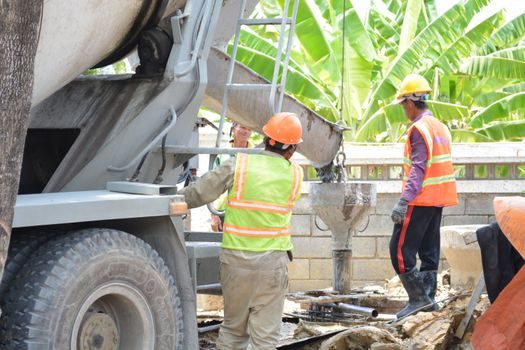
Surface road mixers (SANY, Putzmeister P 7 IMI, SINOTRUK HOWO 6×4) are built for highway-legal axle loads and prioritize fuel economy, panoramic-monitor cabs, and easy maintenance access [S1][S3][S5]. Off-road heavy-duty units (CIFA HD-series) add reinforced basic frames, wear-protected blades, and bolted rollers for jobsite abuse where discharge consistency under uneven load matters more than top speed [S4].
Underground and confined-space mixers (EMSUNTOOR WC-series, Normet UTIMEC LF 600 Agitator with 5.6 m³ capacity and 3.3 m tramming height, Putzmeister Mixkret 6 at 6 m³/211 ft³) target sprayed-concrete lines in mines and tunnels — engineering a concrete pump truck is the natural adjacent spec, since sprayed-concrete (shotcrete) workflows pair the agitator with a separate boom pump. The 200 l/min hydraulic output on Normet's Mixspray platform illustrates how underground chassis are downsized for tunnel profiles [S3].
Manufacturer concentration and sourcing landscape
The DirectIndustry index lists 23 manufacturers and 47 products (down from the m6 count of 22 companies/57 products, reflecting catalog curation rather than market shrinkage) [S3]. SANY leads the diesel segment with 10 listed units, followed by CIFA (6), EMSUNTOUR (5), Normet (4), Shandong Hengwang Group (4), Putzmeister (3+2), Semix (2), CLW GROUP (2), Hangzhou Truemax (2), and single-line entries from Bucher Municipal, HidroMak, Jaypee India, and M. LORENZANA [S3].
Bulk-cement and concrete-mixer supply through Chinese export channels lists MOQs as low as 1 piece and supply ability up to 200 pieces/month for SINOTRUK-branded chassis via Jinan Shanglong, while HOWO 375 6×4 diesel self-loading mixers on Made-in-China list at US$ 7,000-15,000 per unit — a price band that is roughly an order of magnitude below European OEM list price, although it excludes duties, homologation, and after-sales coverage [S5][S8]. Alibaba catalog pages for 10 m³ CBM units and Indonesian-market listings (Harga Concrete Mixer Truck) confirm a strong APAC secondary channel for 10 m³-class drums [S7][S9].
Selection criteria and spec limits by use case
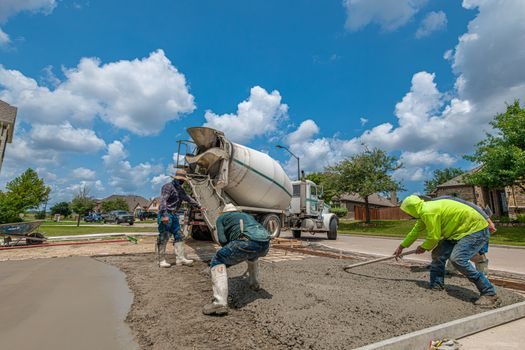
For urban ready-mix fleets operating on paved roads, the spec window is 6-10 m³ diesel drum at 4-5 m³/min discharge — SANY SY306C-8(R) at 6 m³ / 5 m³/min is the reference benchmark [S1]. For high-volume infrastructure and dam pours, the 10-15 m³ class applies: the G10V's documented ≤5% slump change across mixing, transport, and discharge is the concrete-quality anchor to verify on tender specs [S3].
For underground mining, the hard requirements are explosion-proof diesel certification, low-profile drum dimensions, and continuous-rotation agitation — EMSUNTOOR's WC6BJ (6 m³, 0.7 m³/min) and Normet UTIMEC LF 600 Agitator (5.6 m³, 3.3 m tramming height) bracket the working envelope [S2][S3]. A dump truck is NOT a substitute for any of these, because drum geometry, blade pitch, and continuous-rotation agitation govern slump retention that tipping-bed dump bodies cannot provide. For off-road heavy-duty sites, the CIFA HD-series hydraulic drive at 560 l/min output is the reference heavy-duty benchmark, with bolted rollers and sling-bar off-road support as the differentiators against road-spec rivals [S4].
Engineering constraints and known failure modes
Slump loss during transport is the controlling concrete-quality variable; the G10V spec sheet pins the all-stages slump change at ≤5%, which sets the practical upper limit on haul distance and ambient temperature for any given retarder dosing [S3].
Drum-blade wear on 11.6 m³ heavy-duty units (G06K) is mitigated by high-strength wear-resistant plate, but the bolted-roller design on the CIFA HD-series remains the easier field-maintenance architecture for remote sites [S3][S4]. Underground units face the additional constraint of contamination control: the EMSUNTOOR rear-engine layout deliberately separates heat sources from the concrete charge to protect mix water from overheating and to ease maintenance access [S2]. Buyers comparing mixer-truck line-ups to sand mixer configurations should note that the former handles plastic concrete (water + cement + aggregate), while foundry sand mixers handle bentonite-bonded aggregate with no hydration chemistry — the two equipment classes do not share wear profiles.
Trackable signals for the next sourcing cycle: monitor SANY's SY-series refresh for any >6 m³ diesel variant carrying the 5 m³/min discharge benchmark; watch CIFA's HD-series for hydraulic-output upgrades above the current 560 l/min; and verify whether EMSUNTOOR adds a >6 m³ explosion-proof model to its WC4BJ/WC5BJ/WC6BJ ladder.
See also our earlier report, Semiconductor Manufacturing Equipment Guide: SME Scope, Standards, and 2026 Sourcing Map.