
A standard 4–8 m³ European concrete mixer truck measures 2,491–2,542 mm across the body and 2,923–3,101 mm tip-to-tip with the mirrors deployed, with chassis length scaling from 7,168 mm (4 m³) to 9,760 mm (8 m³) per Holcim's published fleet data [S1]. The mirror envelope adds roughly 430–560 mm of sweep beyond the cab body, a figure that holds across Holcim's 4/6/8 m³ Minimix range and Moreton Cullimore's matching 4/6/8 m³ UK fleet [S1][S5].
On North American 10-yard chassis, the mirror-to-mirror figure jumps to 9 ft 7 in (2,921 mm) on a Kenworth 10-yard mixer and 9 ft 6 in (2,896 mm) on a 2003 Kenworth T800 dump, both with a wheelbase (body) width of 8 ft to 8 ft 7 in [S2]. A practical site-access rule of thumb is 9.5 ft (2.9 m) minimum entrance width for UK 3 m³ mixers and 10 ft (3.05 m) for 6–8 m³ rigs [S3].
Mirror-Inclusive vs Mirror-Exclusive Width by Drum Size
Holcim's 4 m³ Minimix measures 2,491 mm body / 2,923 mm with mirrors, a mirror sweep of 432 mm, while the 6 m³ and 8 m³ rigs both share a 2,542 mm body width and a 3,101 mm mirror-to-mirror figure, a 559 mm mirror sweep [S1]. Moreton Cullimore's UK fleet follows the same pattern: 2.5 m body width on every drum size, with the 4 m³ at 2.9 m and the 6/8 m³ at 2.85 m including mirrors [S5]. The volumetric (mobile) mixer is the outlier at 2.5 m body / 3.1 m with mirrors, the widest published figure in the Cullimore line because of its longer 11 m chassis and rear-mounted discharge boom [S5].
Across both UK fleets, body width holds within a tight 51 mm band (2,491–2,542 mm) regardless of drum volume, which means the mirror sweep, not the drum, drives the access envelope. The mirror arm geometry is set by the cab and mirror-mounting bracket, not the mixer barrel, so an 8 m³ truck does not need a wider lane than a 4 m³ truck once the mirrors are folded.
UK vs North American Width Benchmarks
UK mixers (3–8 m³, 2.85–3.10 m including mirrors) and North American 10-yard mixers (≈2.9 m / 9 ft 7 in including mirrors) converge on a near-identical mirror-to-mirror envelope, a useful planning constant for any specifier working transatlantic projects [S1][S2][S5]. The 2003 Kenworth T800 dump at 9 ft 6 in (2,896 mm) is a useful proxy for any tandem rear-axle construction chassis likely to be repowered with a mixer body [S2].
For comparison, Copes Readymix publishes three UK footprints: 3 m³ at 9.5 ft (2,896 mm) with mirrors, 6 m³ at 10 ft (3,048 mm), and 8 m³ at 10 ft (3,048 mm), all in feet rather than millimetres but tracking the same 3.0 m ceiling as the mainland European data [S3]. The 150 mm step between 3 m³ and 6 m³ at Copes is the widest published jump in the dataset and reflects a heavier chassis with larger mirrors rather than a wider drum barrel [S3].
Height, Length, and Chute Geometry That Drive Site Layout
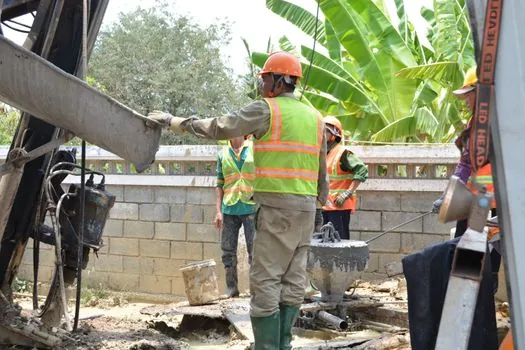
Height is the second access constraint: the Kenworth 10-yard mixer stands 12 ft 3 in (3.73 m) at the hopper, the T800 dump body 10 ft 4 in (3.15 m) in travel position and 18 ft 6 in (5.64 m) at full dump, and the Copes 6/8 m³ mixers 12.5 ft (3.81 m) loaded [S2][S3]. Cullimore's volumetric mixer rides at 4.0 m, the tallest of the published UK mixers, and needs overhead clearance for both the discharge boom and the truck cab [S5].
Length scales with drum: 7,168 mm (4 m³), 8,235 mm (6 m³), 9,760 mm (8 m³) per Holcim, and 7.1–8.7 m for the matching Cullimore drum sizes [S1][S5]. Chute reach is 1.83–2.74 m from the 1st pivot to the end of the 3rd chute across both fleets, which sets how far back of the truck's rear lights the pour can land without repositioning [S1][S5]. The 6 m³ Holcim configuration has a notably short 1,830 mm 3rd-chute reach, the tightest in the dataset, because the 2nd chute is extended to 2,440 mm instead [S1].
When Mirror-Inclusive Width Is and Is Not the Right Planning Number
For site entrance, gate posts, and street trees, the mirror-inclusive width is the only correct planning number, because UK operators quote 9.5 ft (2.9 m) for 3 m³ mixers and 10 ft (3.05 m) for 6–8 m³ as the live envelope they will not fold in transit [S3]. For yard layout, loading-bay design, and bin-pour positioning, the mirror-exclusive (body) width of 2.49–2.55 m is the relevant constant, because operators routinely fold mirrors to wash out, service, or park in tight depots [S1][S5].
Mirror-inclusive width is the wrong number when sizing a volumetric mixer's working footprint, because the 3.1 m figure includes both the cab mirrors and the rear discharge-boom swing radius, which Cullimore documents as a 3 m chute arc beyond the rear lights [S5]. For a rear-discharge-only site where the truck reverses in, body width (2.5 m) plus 3 m chute arc, not 3.1 m, sets the required clear corridor.
Selection Criteria: Matching Truck Width to Site Constraints
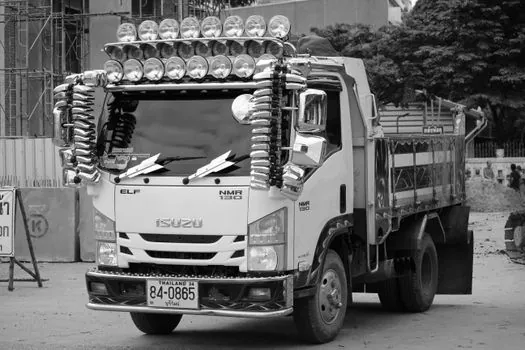
Use 3 m³ mixers (9.5 ft / 2,896 mm with mirrors) where site access is constrained to a single 9 ft 6 in gate, residential driveways, or weight-restricted urban streets, accepting a 21.5 ft (6.55 m) length and 8 ft 3rd-chute reach [S3]. Use 6 m³ mixers (10 ft / 3,048 mm) for typical residential and light-commercial pours where 9 ft body plus 1 ft mirror envelope is the working corridor; this is the most common UK spec [S1][S3].
Use 8 m³ mixers (10 ft / 3,048 mm) only when the pour volume justifies a 32-tonne GVW and the site can absorb 9.76 m length plus 2.69 m 3rd-chute reach [S1][S5]. For US projects, a Kenworth 10-yard at 9 ft 7 in (2,921 mm) mirrors / 35 ft 3 in (10.74 m) length / 72,000 lb (32.7 t) fully loaded is the standard reference, and the T800 tandem at 9 ft 6 in mirrors is the reference dump chassis if a truck-mounted concrete pump or auxiliary body is being specified [S2]. For mixed fleet planning that also includes a concrete pump truck or a dump truck on the same pour, hold site access at 10 ft (3.05 m) so the largest expected vehicle clears without re-mobilisation [S2][S3].
Common Failure Modes When Mirror Width Is Ignored
Mirror strikes on gate posts, overhead branches, and street signage are the most common site-access failure, with the mirror arm sitting roughly 200–280 mm proud of the cab body on every published UK spec [S1][S3][S5]. Folding the mirrors reduces width to 2.49–2.55 m, but UK operators do not fold in transit because the mirrors are required for road-legal operation, so a 2.5 m gate will not accept a 3 m³ mixer despite the body fitting [S3].
On US chassis, the T800 dump body at 8 ft (2.44 m) is the same width as a mixer body, but the mirror bracket extends another 1 ft 6 in (457 mm) past the body on each side, so any retrofit must keep the mirror geometry unchanged [S2]. For a related weight check on the same chassis, see the empty-mass baseline in How Much Does an Empty Concrete Mixer Truck Weigh?, which lists typical unladen kerb masses that gate access decisions on older streets.
Sourcing and Specification Discipline
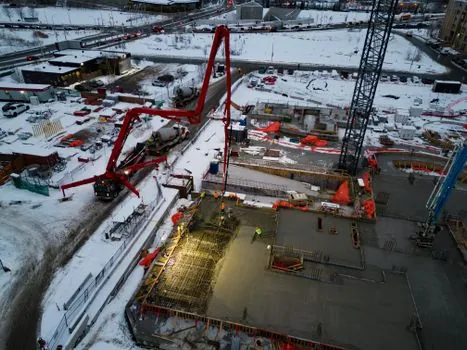
Manufacturer data, not regulator-issued tables, is the only reliable source for mirror-inclusive width, because the figure is a chassis-cab combination rather than a regulated dimension, and Holcim, Cullimore, Copes, and Salmon Bay each publish their own fleet-specific numbers [S1][S2][S3][S5]. Cross-checking at least two fleets in the same volume class is advisable: Holcim's 8 m³ at 3,101 mm and Cullimore's 8 m³ at 2,850 mm differ by 251 mm despite identical drum volume, which is a mirror-bracket difference, not a body difference [S1][S5].
For procurement, the practical spec language is "overall width including mirrors ≤ 3,100 mm for an 8 m³ drum, with mirror fold-in width ≤ 2,550 mm for depot access," a tolerance that both Holcim's 8 m³ (3,101 mm) and Cullimore's volumetric (3,100 mm) meet on the upper bound [S1][S5]. Confirmation that this envelope also holds when the same chassis is used to mount a power mixer or sand mixer for plant-side work should come from the body supplier, since the mirror geometry is set by the cab OEM and is independent of the rear-mounted equipment.
Track the next UK regulatory update on mixer-truck width tolerances (expected through the Department for Transport's Construction Plant movement guidance) and the next major North American chassis refresh from Kenworth, Peterbilt, or Mack, both of which historically reset mirror-bracket geometry by 50–100 mm per generation.