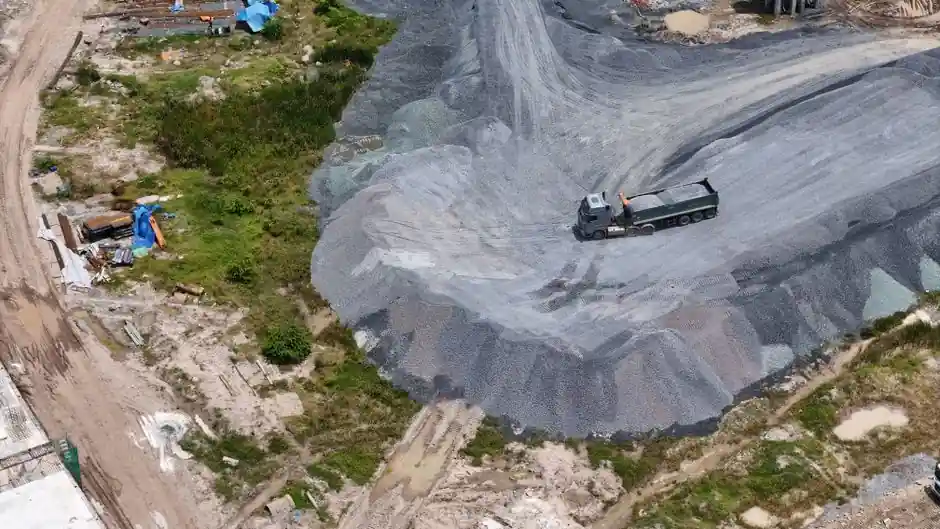
A standard on-road dump truck with the bed fully raised for unloading needs 15 to 18 feet of vertical clearance, while the same truck measures only 10 to 13 feet in normal travel configuration [S2][S8].
This 5 to 7 foot delta is not a marketing footnote, it dictates bridge approaches, overhead utility lines, batch-plant canopy heights, and indoor discharge bay clearances. Operators who plan for travel height alone routinely strike signage and low-hanging conductors during the first dump cycle on a new site.
Travel Height vs. Raised-Bed Height: Where the Numbers Come From
Standard on-road dump trucks measure between 10 and 13 feet tall in travel mode, with the tri-axle workhorse averaging 10.5 feet and quad-axle configurations pushing the upper end of that range [S2]. Forum and operator data triangulate this: 10 to 12 feet for typical on-highway units, with experienced operators citing 12 to 13 feet for many Class 8 makes and noting that a loaded chassis can sit a couple of inches lower than the empty spec [S4].
Raised-bed numbers are larger and more variable. A 2006 OSHA safety bulletin documented a 4,000 pound dump body being cycled up and down during chassis alignment, underscoring that the body in the air is not a static dimension but a kinematic one driven by hoist stroke and pivot geometry [S1]. Field fleet data puts the raised-bed envelope at roughly 15 feet for a light/medium single-rear-axle dump, around 16 feet for a medium tandem, and 15 to 18 feet as the broader standard-truck range, with off-road rigid haulers climbing well past 18 feet [S2][S3][S8]. For a baseline read on dump truck form factors and chassis classes, the dump truck reference page lays out the body-on-chassis architecture that produces these deltas.
Chassis Class and Body Length Drive the Delta
Body length is the single biggest lever on raised height. Class 3 chassis typically accept 9 to 18 foot steel dump bodies with 12 to 16 inch side walls and 2.5 to 6 cubic yard capacities, and longer bodies mean a longer lever arm rotating about the rear hinge, which lifts the front of the body higher off the chassis at full dump angle [S5]. A standard size chart for mid- and heavy-duty configurations lists body lengths of 9 to 10 m and 5.5 to 6.5 m with side heights of 1.4 to 1.6 m, the geometry that, once hoisted, sets the apex of the raised body [S7].
Operator fleet data confirms the chassis-class gradient. A 24,000 pound GVWR single-axle dump with a 7.5 foot travel height raises to about 15 feet; a 30,000 pound GVWR tandem with a 9 foot travel profile raises to roughly 16 feet; and the largest tandem in the same fleet, at a 25 foot overall length and 56,000 pound GVWR, sits correspondingly taller when dumped [S3]. The general rule of thumb in operator forums matches this: subtract the travel height from the raised height and you get a 5 to 8 foot swing, mostly a function of body length and hoist lift cylinder stroke rather than tire size or suspension type [S4].
Comparison of Standard Classes by Travel and Raised Height

Three configurations cover the bulk of fleet and contractor inquiries. Light/medium single-rear-axle units (Class 3 to 5, 9 to 14 foot bodies) travel at 10.0 to 10.5 feet and raise to roughly 15 feet. Heavy-duty on-road tri-axle and quad-axle dumps (Class 7 to 8, 14 to 18 foot bodies) travel at 10.5 to 12.0 feet and raise into the 16 to 18 foot band. Articulated and rigid-frame off-road haulers (mining and quarry duty) travel at 12.5 to 18.0 feet and, when bed-raised at a quarry bench, routinely exceed 20 feet of total rig height, which is why these machines are non-highway-legal and moved on lowboy trailers [S2].
The decision criteria line up cleanly against use case. For residential and landscape work, the 15 foot raised envelope is the binding constraint and matches a 14 foot utility-wire minimum, so any canopy, batch plant, or indoor bay must clear 16 feet minimum with margin [S2][S3]. For aggregate and hot-mix haul, the 16 to 18 foot raised envelope is more typical and rules out older 14 foot structures. For quarry and mine work, the off-road hauler class dominates and the travel-mode height itself is already past highway limits, so site planning centers on bench face clearance rather than roadside infrastructure [S2].
What Changes the Number On a Given Truck
Spec-sheet height is a baseline, not a fixed dimension. Three variables move the number on a single chassis. First, payload weight: a fully loaded chassis sits lower because suspension compression drops the frame, and a fully loaded truck will measure a couple of inches shorter in travel mode than the empty spec [S4]. Second, aftermarket chassis modifications: lift kits, taller tires, drop axles, and raised fifth-wheel positions all push the travel height, and that delta carries straight into the raised figure [S2]. Third, hoist geometry: longer lift cylinders, taller subframe mounts, and longer bodies all rotate the front of the body higher at full dump angle, so two trucks with identical travel heights can finish dumping at noticeably different apex heights [S5][S7].
The other live variable is the hoist itself. The OSHA investigation that produced SHIB 09-18-2006 was triggered when a 4,000 pound body fell during maintenance, and the resulting engineering program developed bed-brace brackets rated for over 47,000 pounds because standard body props cannot be relied on to hold the bed at any specific raised height without positive locking [S1]. For work near overhead lines, batch-plant structures, or indoor discharge bays, treat the raised-bed figure as a kinematic envelope, not a single number, and add 6 to 12 inches of margin to the spec value.
OSHA Rules and Field Safety for the Raised Position
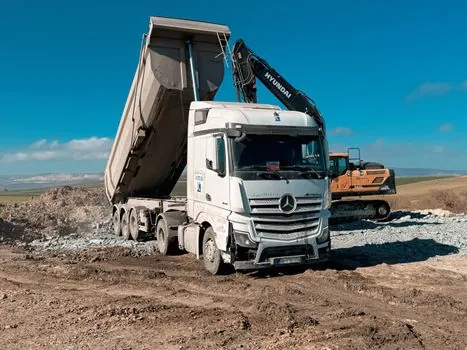
29 CFR 1926.600(a)(3)(i) requires that dump bodies be fully lowered or blocked when being repaired or when not in use, and 29 CFR 1926.601(b)(10) requires trucks with dump bodies in construction settings to be equipped with positive means of support, permanently attached and capable of being locked in position to prevent accidental lowering while maintenance or inspection is performed [S1]. These rules are written for the maintenance case, but they are the same mechanical reality operators face during a normal dump cycle: a body in the air is held only by the hoist until the operator pulls the dump valve.
For fleet planning, the practical rule is that 14 feet of overhead clearance, the typical utility-wire minimum, is below the raised-bed envelope of every standard on-road dump truck in the surveyed fleet, so any dump site with overhead infrastructure must be measured to the spec raised height, not to the travel height [S3]. For higher-volume aggregate work where a mining dump truck class is in play, the raised envelope is well past 18 feet and the site survey has to include bench face geometry, not just overhead wires.
How to Measure a Specific Truck Before Spec'ing the Site
Three measurements settle the question for any given chassis. First, the empty travel height, tire-flat to top of cab or top of folded-down dump body, taken on level ground with the chassis at cold ride height. Second, the empty raised height, measured from the same tire-flat reference to the highest point of the body at full dump angle, with the hoist held at the operator's normal full-up position. Third, the loaded raised height, taken with a representative payload in the body, because the chassis will sit lower and the body will also ride lower on the subframe, shifting the apex by a few inches [S2][S4][S8].
For body sizing in cubic yards, the standard field method multiplies inside body length by inside width by inside side height, all in feet, which gives a volumetric baseline independent of the raised-height question [S9]. Once the raised envelope is fixed, the site constraints follow: indoor discharge bays need at least the raised height plus 12 inches of margin, overhead batch-plant conveyors need the raised height plus 18 to 24 inches for belt sag and sway, and any utility-line crossing needs the raised height plus conductor sag plus a safety buffer that no North American operator should drop below.
Track two signals going into 2027: municipal low-clearance databases being updated to include raised-bed, not just travel-height, limits for known dump routes, and OEM body builders publishing per-body-length raised-height curves rather than single travel-mode numbers, since body length is the dominant driver of the raised envelope on a fixed chassis [S2][S5]. For adjacent spec work on the same fleet, the concrete mixer truck reference page covers a related chassis class where raised geometry, in that case the rotating drum apex, drives the same kind of overhead-clearance planning.
Background reading: Behind-cab crane front axle load: how to spec without overloading the steer.