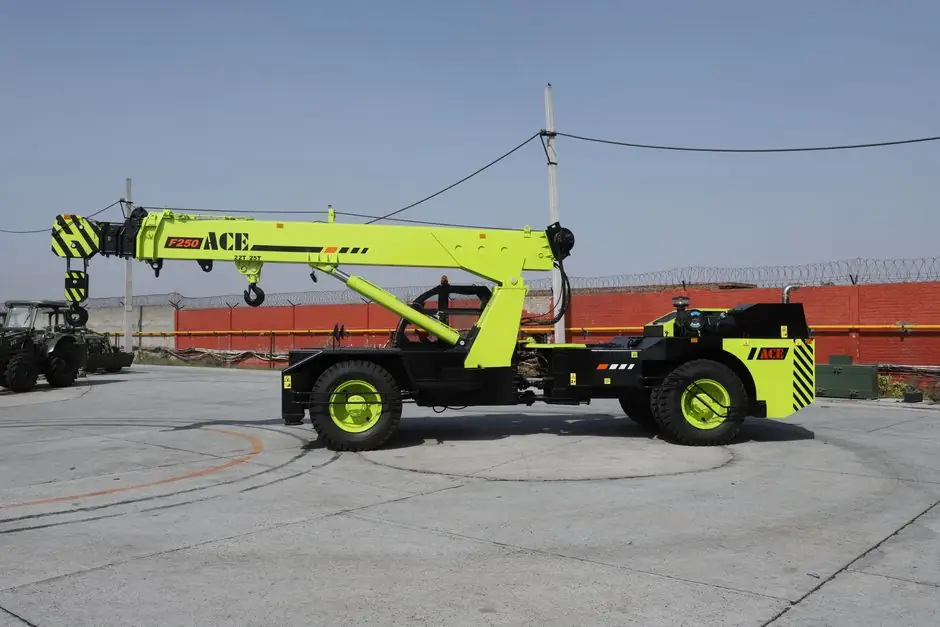
A loader crane's size is stated in metre-tonnes (mt) of lifting moment, the product of load and outreach, so a 15 mt crane can theoretically lift 15 t at 1 m, 5 t at 3 m, or 1.5 t at 10 m, with the binding figures living in the manufacturer's load chart rather than the brochure [S1].
Outreach on modern folding-knuckle units runs 6 m on light vans to over 30 m on five-axle heavy-duty chassis, while slew torque governs how the upper structure rotates under load and dictates how fast a load can be repositioned on a busy site [S1].
Lifting-moment classes and what each one actually does
The truck-loader market is sliced into four practical bands: up to 10 mt on 7.5-12 t chassis with 6-10 m reach for building materials and landscaping; 10-25 mt on 18-26 t chassis with 10-18 m reach for joinery, roofing, and precast work; 25-60 mt on 32 t four-axle or articulated combinations with 18-26 m reach, often fitted with a jib and auxiliary winch; and over 60 mt, climbing past 200 mt on five-axle chassis where the machine begins to blur into a mobile crane [S1]. Each step up the band adds both outreach and slewing inertia, so a buyer who only reads the headline mt number is comparing apples to caravans.
The relationship is linear in the simple case: a 72,000 ft-lb moment divided by a 10,000 lb rated load equals 7.2 ft of radius, which is exactly how load charts are built and why the chart, not the marketing leaflet, is the reference document [S4]. The same model designation can also change radically with the number of boom extensions, so a 2S versus a 5S configuration of one chassis is two different cranes for comparison purposes [S2].
Reading the load chart as load-plus-radius pairs
Every value in a load chart is a pair: a load and the outreach at which that load is rated, and a capacity without its outreach says very little [S2]. A real example from a marine-equivalent comparison shows an HLRM 440-4S lifting 55,000 kg at 5.71 m and 15,200 kg at 17.69 m, both correct, both describing the same machine, and only one of them useful for a given job [S2].
A buyer who only quotes "max 6.2 t at 4 m" without the rest of the curve is not comparing cranes, they are comparing brochures.
Slew torque and the slewing drive as a sizing axis

Lifting moment describes vertical capacity, but slew torque describes the rotational resistance the slewing bearing and drive motor must overcome: boom weight, load pendulum, wind on the load, and reaction forces as the load swings. Heavier booms and longer jibs multiply that torque requirement, which is why 25-60 mt cranes and above routinely use twin slewing motors with planetary reduction, while sub-10 mt units get away with a single compact slew drive. [S1]
Outrigger spread interacts directly with slew torque: the wider the spread, the lower the reaction moment per jack, which lets the slewing drive move the same load more controllably. Modern loader cranes monitor outrigger position electronically and de-rate capacity as the spread narrows, so two cranes with identical mt ratings can have very different usable envelopes over the front versus the side [S1].
Outrigger envelope, LMI calibration, and the safety stack
Full outrigger extension, stabilizer spread matching the load chart notes, and confirmation that the frame is level within tolerance are the non-negotiable pre-lift checks; pad sizing and soil type belong on the same checklist, because soft ground under one jack can swing the whole stability calculation [S3]. The LMI is then calibrated via digital interface and CAN bus data so it tracks boom length, outreach, and lifting capacity in real time, and any drift from the indicator's own test-load reference is grounds for a reset before the next pick [S3].
Anti-two-block and emergency-stop testing completes the stack, and the same pattern repeats every shift because sensor calibration drifts with hydraulic temperature and boom wear. Buyers comparing machines from different vendors should ask which LMI platform is fitted, whether the chart is auto-selected by outrigger position, and whether the unit logs the last 100 lifts for audit, since the answers drive through-life compliance cost more than any 5% difference in brochure capacity [S3].
Configuration matters: boom count, attachments, and chassis match

Two cranes with the same model code but a different number of boom extensions sit on different capacity curves, so an HLM 25-2S rated at 5,170 kg at 4.68 m and 2,820 kg at 8.62 m is not the same machine as an HLM 25-5S at 4,520 kg at 5.04 m and 1,200 kg at 14.72 m, even though the base model is shared [S2]. The 5S boom buys about 6 m of reach but costs roughly 12% of short-radius capacity, a trade that only makes sense if the job needs the reach.
Attachments change the load chart just as much: timber grabs, brick forks, vacuum lifters, and concrete skips each carry their own dead weight, which subtracts from the net capacity at every outreach, while a personnel-carrying work platform is only legal on a crane explicitly approved for it [S1]. Chassis match closes the loop: a 60 mt loader on a three-axle rigid will eat into payload harder than the same crane on a four-axle, which is part of why the 25-60 mt band is dominated by 32 t four-axle and articulated combinations [S1].
Comparison matrix for the four practical bands
On four decision criteria the bands line up roughly as follows. Light (up to 10 mt): chassis 7.5-12 t, reach 6-10 m, slew drive single, outriggers manual or single-stage hydraulic, typical fit on vans and building-materials trucks [S1]. Standard (10-25 mt): chassis 18-26 t, reach 10-18 m, slew drive single with planetary reduction, outriggers four-point hydraulic, the workhorse band for joinery, roofing, and precast [S1]. Heavy (25-60 mt): chassis 32 t four-axle or articulated, reach 18-26 m, slew drive often twin, jib and winch common, the band where loader and mobile-crane specifications start to overlap [S1]. Heavy-duty (over 60 mt, up to 200+ mt): five-axle chassis, reach over 30 m, twin or dual slewing motors, full electronic LMI with outrigger-position sensing, classed as a mobile crane in some jurisdictions rather than a loader [S1].
For a buyer cross-shopping machines, the most useful single filter is the required load at the worst-case radius: pick the smallest crane whose chart shows that pair with margin, then check slew torque at full load, then check outrigger spread on the actual jobsite footprint. That sequence prevents the most common over-spec, paying for slew capacity and outreach that the actual lift plan never uses. Related heavy-equipment selection logic in other mobile platforms, for example AMR ROI vs Forklift and Tugger Trains, follows the same "load-at-radius, then envelope, then duty cycle" pattern and is worth reading alongside any loader-crane evaluation.
Limits, failure modes, and what the chart does not tell you
Load charts assume level ground, full outrigger extension, and a specific slewing position; the moment the crane slews over the side with outriggers half-deployed, capacity falls faster than any linear estimate predicts, which is why electronic outrigger monitoring is no longer optional above the 25 mt band [S1]. Off-chart conditions, including personnel lifts, subsea or offshore duty, and operations in significant wave height, require a separate selector switch and a different rating, so a harbour-duty chart should never be quoted for offshore work [S2].
For buyers sourcing equipment at fleet scale, the next signal to track is the rollout of unified LMI platforms that log chart selection, outrigger position, and attachment weight together, since that data is what makes the difference between a 60 mt unit used as a 40 mt workhorse and the same 60 mt unit actually delivering 55 mt of usable lift on a real site. For background on how lifting vehicle classifications interact with chassis choice and payload, the related reference page is a useful cross-check.
Component reference pages worth checking: torque sensor, and torque wrench tester.