An empty concrete mixer truck typically weighs between 15,000 and 31,000 lbs (6,800 to 14,000 kg), and the heavier end of that range is the most common on US three-axle chassis running under federal limits [S1][S3].
Tare weight is dominated by the chassis, drum, engine, and rear-axle tag assembly, so the spread comes mostly from drum capacity (7 to 12 m³) and chassis material choice, not from optional equipment [S3]. A fleet planner who assumes "30,000 lbs empty" is usually within 10% of the real number for any modern rear-discharge unit [S2][S3].
Empty Weight Ranges by Model and Chassis Class
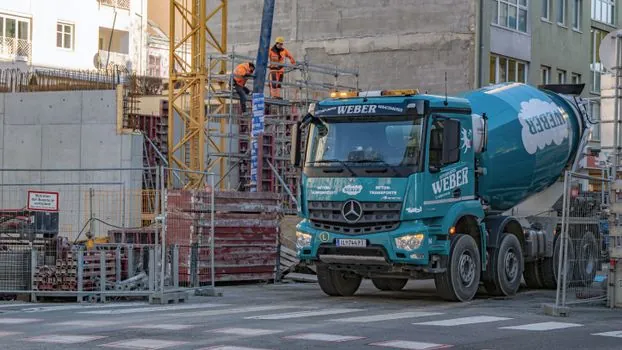
Mainstream rear-discharge mixers built on Mack Granite, Peterbilt 567, Kenworth T880, Volvo FMX, and Mercedes-Benz Arocs chassis land between 25,350 and 31,000 lbs (11,500 to 14,000 kg) empty, with the Liebherr HTM 905 drum package sitting at the lighter end of that band [S3]. A typical 10-yard Kenworth concrete mixer posts a fully-loaded weight of 72,000 lbs and measures 35 ft 3 in long, 9 ft 7 in wide at the mirrors, and 12 ft 3 in tall at the hopper [S4].
Drum material is a quiet but real lever: steel mixing drums contribute 4,400 to 11,000 lbs (2,000 to 5,000 kg) on their own, and switching to a carbon-steel drum or aluminum chassis trim can shave roughly 1,000 to 2,000 lbs off the chassis baseline [S3]. The chassis itself, with frame rails, axles, and suspension, accounts for 15,400 to 19,800 lbs on a standard steel build or 13,200 to 17,600 lbs on an aluminum-intensive chassis [S3].
Component Breakdown: Where the Tonnage Goes
The diesel engine, drum drive hydraulics, and rear tag axle push tare weight up regardless of drum size. Mid-range diesel engines weigh 1,100 to 2,650 lbs (500 to 1,200 kg), and heavy-duty ratings for 11 to 13 L diesels add 3,300 lbs (1,500 kg) or more on top of that [S3]. A 6x4 or 6x6 axle configuration adds another 4,000 to 6,000 lbs over a 4x2 day-cab tractor, which is why three-axle mixers with pusher or tag axles sit roughly 3,000 to 5,000 lbs heavier than a stripped two-axle chassis [S3].
Mixer drum geometry scales with capacity: a 9 m³ Liebherr HTM 905 drum on a lightweight chassis hits 25,350 lbs empty, while a 12 m³ Volvo FMX drum with reinforced cab adds about 4,400 lbs to land near 29,760 lbs empty [S3]. Most North American ready-mix operations standardize on the 10-yard (7.6 m³) drum because it is the largest size that keeps the empty vehicle under the 30,000 lbs mark on a three-axle chassis [S2][S3].
Federal Bridge Formula and Why Tare Eats the Payload
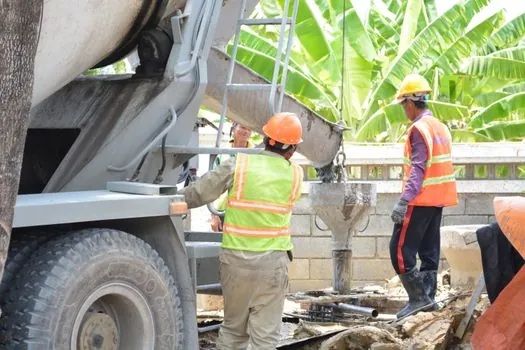
Under US federal weight law, a three-axle ready-mix truck may gross 48,000 lbs, and 30,000 lbs of that is the truck itself, leaving only 18,000 lbs for concrete, which is less than half of the 40,000 lbs the chassis could physically carry [S2]. The Federal Bridge Formula, written into the Federal Aid Highway Amendments of 1974, forces that gap by limiting how much weight can ride on a given axle spacing, and the heavy tag or pusher axle on a mixer chews through that envelope before any concrete is loaded [S2].
Fully loaded, a 10-yard mixer with 10 m³ of standard 4,000 lb/yd³ concrete tips the scale near 66,000 lbs (40,000 lbs of concrete plus 26,000 lbs of vehicle), which is 18,000 lbs over the Interstate-legal gross for a three-axle unit [S1]. That is why loaded ready-mix trucks in many US states default to state and county roads instead of Interstates, even when the jobsite is closer to a limited-access highway [S2].
Selection Criteria: Matching Truck Weight to Project and Site
Project scale should drive drum size, not the other way around: a 60 m³/day pour needs a minimum of 5 to 6 standard 10-yard mixers to stay inside drum-charge windows, and a useful sizing pass for that scale is laid out in this fleet sizing walk-through. For a single short pour, a 7 to 8 m³ truck on a lighter chassis often delivers a lower empty weight (around 11,500 to 12,500 kg) and better maneuverability on tight urban sites, even though per-yard freight cost is higher [S3].
Site constraints matter as much as drum size: a 35 ft 3 in length and 12 ft 3 in hopper height will not fit under a 12 ft overhead door or inside a 30 ft radius turning pad, and chute reach of 10 ft at 90° or 12 ft straight back from a Kenworth 10-yard unit sets the practical pour radius for slab work [S4]. Aggregate suppliers running older 30,000-lb-class trucks report overall empty weights around 33,500 lbs, lengths of 30 to 35 ft, and overall heights of 12 to 13 ft, which still meets most municipal bridge-clearance envelopes [S5].
Comparison: Common 10-Yard Chassis Options on Empty Weight

For a fleet buyer choosing between five popular three-axle chassis at the same 10 m³ drum capacity, empty weight spans roughly 25,350 to 31,000 lbs, or about a 5,650 lb (≈22%) spread between the lightest and heaviest configuration [S3]. The Liebherr HTM 905 on a lightweight chassis sits at 25,350 lbs, the Peterbilt 567 with aluminum components lands at 27,500 lbs, the Kenworth T880 with PACCAR power reaches 28,700 lbs, the Mercedes-Benz Arocs 3240 hits 28,200 to 31,000 lbs, and a steel-chassis Mack Granite with heavy-duty frame runs 26,500 to 31,000 lbs [S3].
On a value-for-payload basis, the 25,350-lb Liebherr config leaves the most headroom under the 48,000-lb federal gross (about 22,650 lbs of usable concrete, or roughly 5.7 yd³), while the 31,000-lb Arocs leaves only 17,000 lbs (about 4.25 yd³) [S2][S3]. Real fleet data from concrete logistics providers shows that an in-cab, on-the-fly scale and load-monitoring system is the most effective lever for keeping axle weights legal, because tare alone does not explain overruns, water added on site and chute residue routinely add 500 to 1,500 lbs of "phantom" payload [S6].
Limits, Failure Modes, and Common Mis-Specs
The most common field failure is axle overload on the tag or pusher axle, not on the drive axles, because a loaded 10-yard mixer puts 22,000 to 24,000 lbs on the tag when the chute is swung to one side for a slab pour [S2]. Operators who spec a heavier drum (12 m³) onto a 30,000-lb chassis find that even a half-loaded drum, 6 m³ at 4,000 lb/yd³ (about 31,700 lbs of wet concrete), grosses the truck at 61,700 lbs and pushes tag-axle weight past 24,000 lbs, which is the practical single-axle envelope for most US state routes [S1][S2].
Another common mis-spec is treating the concrete mixer truck weight envelope as interchangeable with a concrete pump truck: a boom pump adds 12,000 to 20,000 lbs of outrigger and boom mass and is typically mounted on a four- or five-axle chassis to keep any single axle under bridge-formula limits. A truck-mounted concrete pump boom in full outrigger deployment also concentrates up to 28,000 lbs per outrigger pad, so site soil bearing pressure, not vehicle tare, is the binding constraint for that equipment class. Buyers comparing a mixer to a dump truck on the same chassis should note that a 50,000-lb fully loaded Kenworth T800 dump runs 6,000 to 8,000 lbs lighter than a comparably sized 10-yard mixer, because there is no drum, no tag axle, and no hydraulic drive [S4].
Sourcing, Standards, and Trackable Signals
Two anchor references drive the US numbers in this article: the National Ready Mixed Concrete Association (NRMCA) federal-weight policy brief, which sets the 48,000-lb three-axle gross and 30,000-lb tare baseline, and the Federal Bridge Formula codified in the Federal Aid Highway Amendments of 1974 [S2]. For European and Asian fleets, the comparable figure is the 11,000 to 14,000 kg empty range from OEM published data on Mack, Peterbilt, Kenworth, Volvo, and Mercedes chassis [S3].
Trackable signals for fleet planners over the next 12 months: any movement on the NRMCA-backed federal-weight exemption that would raise the Interstate gross limit for ready-mix trucks above 48,000 lbs, and any OEM release of a sub-25,000-lb carbon-steel-drum mixer that would shift the empty-weight band downward by roughly 1,500 to 2,000 lbs [S1][S2]. Concrete density specs of 4,000 lb/yd³ for normal-weight and 3,000 lb/yd³ for lightweight mixes are the two payload-calculation anchors any fleet should pin in their dispatch software, and both are vendor- and product-line-independent [S1].