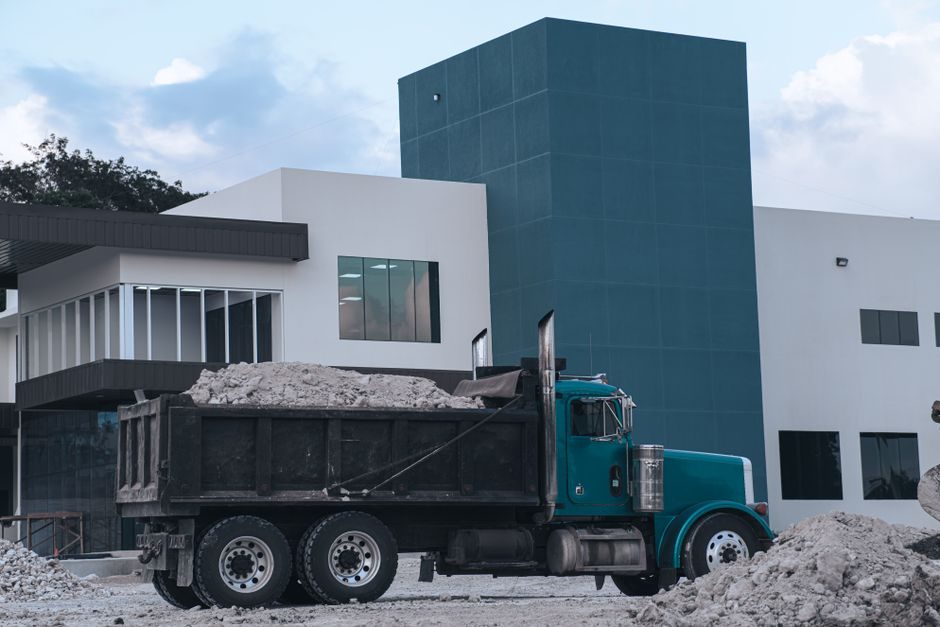
A truck-mounted concrete pump combines a multi-section articulating boom (commonly 38 m to 62 m class on five- and six-axle chassis [S2]) with a high-pressure hydraulic piston or open-circuit concrete pump, delivering 80 to 170 m³/h of structural-mix concrete at distances that wheelbarrows and cranes cannot match [S2][S5].
Versus a stationary trailer pump or a concrete mixer truck chain, a pump truck collapses placement time, crew size, and site congestion into a single unit, but only if the boom geometry, axle load, and concrete mix design are matched to the job. The trade-offs below frame that decision with the data points a process engineer actually needs to verify before sign-off.
Where a Concrete Pump Truck Wins on Job-Site Economics
Continuous boom placement removes the bottleneck of a concrete mixer truck cycle discharging into a hopper and re-pumping through hose runs, which is the dominant labour and time cost on vertical pours [S5]. A six-axle boom configured at the upper 56 m to 62 m class can serve floor plates that would otherwise require a placing boom on a tower or a separate crane-and-bucket operation, a setup that typically doubles crane time and crew head-count on decks above the fourth storey [S2].
On the supplier side, OEM custom engineering of the chassis is now standard practice: Autocar documents 4×2 through 12×6 axle layouts with single, tandem, or tridem front steer, allowing weight distribution to be optimised for the pump package rather than the other way around [S1]. That integration matters because regulatory axle limits, not pump capacity, are the binding constraint on European and U.S. highway moves. A 6-axle ACX-class truck reported by Autocar can make intersection turns that 3- and 4-axle configurations cannot, a concrete maneuverability gain for tight urban sites [S1]. Uptime economics are reinforced by 24/7 factory-direct service desks that handle warranty routing instead of multi-tier dealer hand-offs [S1].
Operating Envelope: Reach, Output, and the Pressure Side
Production-class booms from Sany and Zoomlion cluster in the 52 m, 56 m, and 62 m reach bands on Mercedes-Benz chassis, with the 2020-vintage 62 m Sany and 2023 Zoomlion 52 m now appearing as high-volume entries in the global used-pump market [S2]. The 62 m class translates to roughly 150–170 m³/h at 8.5 MPa hydraulic pressure; the 52 m class trades reach for mobility and typically lands in the 130–150 m³/h window [S2][S5].
Compared with a stationary line pump, the boom's value is measured in metres of horizontal reach plus vertical reach, not in peak pressure: a 47 m remanufactured Zoomlion boom, for example, was shipped from the Changsha remanufacturing base to the Middle East in March 2025 for desert infrastructure, where cooling-air intake dust separation and boom-section lubrication intervals are the real-life limiters [S2]. Hydraulic systems run on the order of 8–12 MPa at the concrete cylinder, with peak system pressures in the 30 MPa range for the prime mover circuit, so any mix design with high coarse-aggregate content (>32 mm) or low slump (<120 mm) will punish the pumping circuit and cause plug events the operator cannot recover from mid-pour [S5].
Concrete Pump Truck vs Trailer Pump vs Crane-and-Bucket
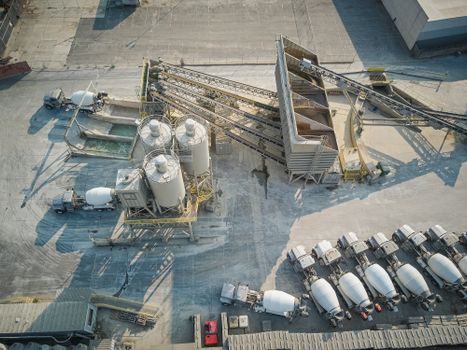
Three options dominate structural-pour logistics; each maps to a different site constraint rather than to a general best choice. A truck-mounted boom pump sets the benchmark for speed on pours under roughly 200 m³/h where a single setup point can serve the floor plate, but its weakness is the chassis footprint and the legal axle load. [S2]
A trailer-mounted line pump paired with a separate placing boom is cheaper to mobilise, fits through 3 m site gates, and serves long horizontal runs (over 100 m) where the boom cannot reach, but it needs an extra operator, hose-pull crew, and pipe-cleaning station. A crane-and-bucket rig handles mega-volume mass pours (dams, thick mat foundations) but at 1.5–2× the crane-hour cost and is uneconomical above the third storey. The decision table below distils the trade-off for a process engineer writing a method statement.
Criteria compared: (a) reach in metres vertical × horizontal, (b) typical output in m³/h, (c) crew size, (d) mobilisation cost relative to a 56 m boom truck set at 1.0×:
Bogie-driven reach, 56 m class: 56 m × ≈52 m horizontal, 130–150 m³/h, 3-person placing crew, 1.0× baseline mob cost [S2].
Trailer line pump + placing boom: typically 36–46 m vertical with manual hose extension, 60–90 m³/h, 4- to 5-person crew including hose handling, ~0.6× mob cost, but the labour delta eats the saving on pours over 500 m³ [S2][S5].
Crane and bucket: limited to the crane's free height (often 40–60 m tower), 40–80 m³/h, 5- to 6-person crew, 1.5–2.0× mob cost on boom-truck baseline, justified only when the boom truck cannot physically set up on the slab [S2].
Hard Limitations: Axle Load, Mix Sensitivity, and Site Set-Up
Fully loaded gross vehicle weight is the spec that kills most pump-truck bids: a 56 m six-axle package with water, fuel, and boom-deployed concrete in the hopper typically runs 38–44 tonnes, which is at or above the EU 40-tonne five-axle design limit and pushes operators toward six-axle configurations that still need route surveys on bridges and overpasses [S1]. Outrigger pad loading at full extension concentrates 25–30 tonnes per pad corner, so ground-bearing capacity of 150 kPa or better is the practical floor; below that, matting is mandatory and the set-up area must be excavated and back-filled, which can cancel the time saving on small pours [S1][S5].
Mix sensitivity is the second hard limit. Pump-spec concrete is not the same as structural-slab concrete: pumpable mixes are typically specified at 100–180 mm slump with 20 mm max aggregate and a fines content in the 350–400 kg/m³ cementitious range to keep the boom pipe wall in laminar flow [S5]. Deviations from those numbers cause pipe-line plug events, the single largest unplanned downtime mode reported in field service notes [S5]. Hot-weather pours above roughly 32 °C ambient further tighten the window because the mix loses slump in the boom, and the operator must slow the cycle or accept a cold joint.
Capital Cost, Resale, and the Used-Pump Channel
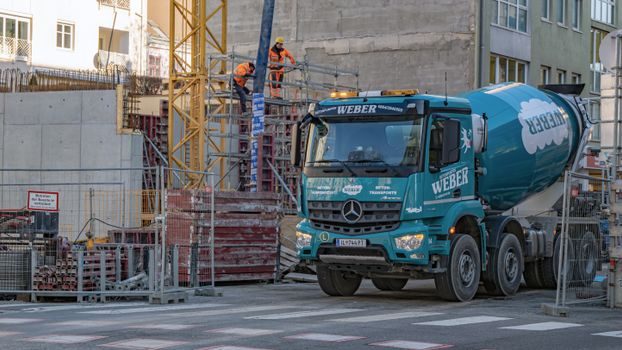
A new 56 m class six-axle pump truck lists in the high six figures USD, while 2020–2023-vintage 52–62 m units in the global used market are trading at a fraction of new price, supported by the Changsha-area remanufacturing base that issues traceability documentation and certification certificates under the National Construction and Urban Construction Machinery Quality Supervision and Inspection Center rules referenced in March 2025 [S2]. That channel matters because pump-truck structural fatigue is concentrated in the boom-section pivot pins, the S-tube wear plate, and the hopper agitator seals, and a properly remanufactured unit addresses those items before shipment.
Global demand for used pump trucks is rising alongside the broader used construction-machinery market, which the research material sizes at 136.8 billion USD in 2025 with a 2033 projection of 227.3 billion USD; this is the demand-side context the truck-mounted concrete pump segment is operating inside [S2]. For a contractor, that translates into a healthier resale market on 3- to 5-year-old units than for most other heavy-machinery classes.
Selection Map: When to Specify, When to Walk Away
Specify a concrete pump truck when the pour volume per shift exceeds 200 m³, the reach required is 30 m or more vertically, the site can provide 6-axle access and ground bearing of 150 kPa+, and the mix design is committed to a pumpable 100–180 mm slump with ≤20 mm aggregate [S1][S2][S5]. Do not specify one when the pour is below 80 m³ total, the site is on a bridge deck with weight restrictions, the ground is soft clay, or the mix is a no-fines structural lightweight that will segregate in the boom pipe.
Trackable signals worth watching in the next buying window: the EU position on 6-axle 44-tonne exemptions for ready-mix pump trucks, which currently varies by member state, and the rollout of the Changsha-area full-process traceability platform, which will tighten the documentation standard for used and remanufactured booms entering the Middle East, Africa, and Central Asia [S2]. Either signal will shift the cost calculus on new versus used procurement in the next two bidding cycles.
Background reading: AI Server Supply Chain 2026: EMS Footprint, Tariff Risk, and Software-Side Strain.