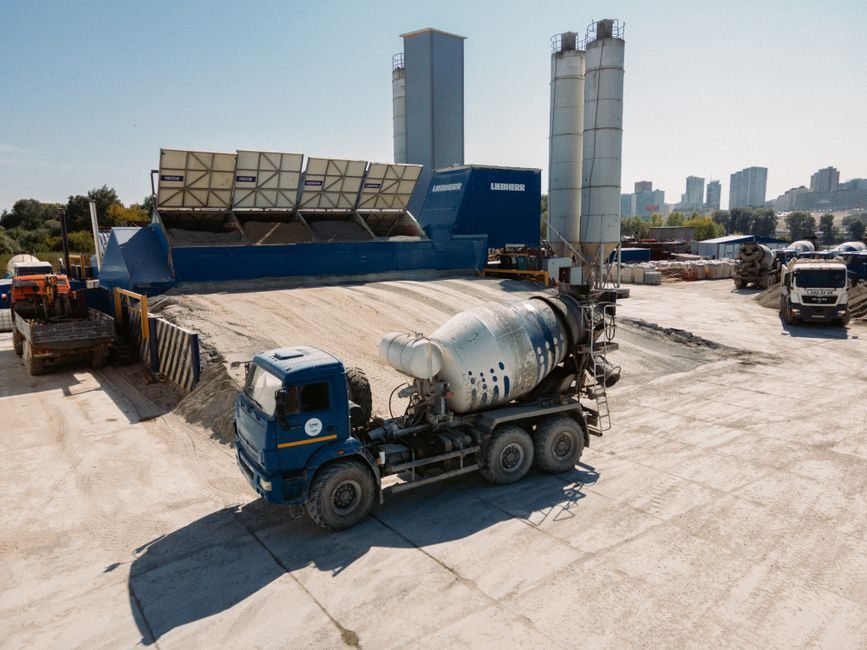
Truck-mounted concrete pumps split into three operating classes — boom (placing boom) pumps, line (trailer) pumps, and mixer-pump combinations — each sized by vertical reach, theoretical output, and concrete pressure. Current catalog offerings on 2026-07-30 show boom spans from 24 m to 62 m mounted on 3- to 8-axle chassis, with theoretical outputs between 90 m³/h and 180 m³/h at cylinder pressures of 8.5-13 MPa [S2][S5][S7].
Aggregate size, slump range, and placing-boom geometry drive the technical fit. Standard 40 mm aggregate capacity, 12-23 cm slump handling, and 51.5 m reach define the typical 47-tonne 6×4 class shown in the XCMG HB52 spec sheet, while longer 5- and 6-section booms push reach to 58 m on heavier 8-axle carriers [S2][S5].
Boom pumps: 24-58 m reach, 90-180 m³/h output
Boom pumps mount an articulated, multi-section placing boom on a heavy truck chassis, with current 2026 product lines spanning 24-58 m vertical reach and theoretical outputs of 90-180 m³/h at concrete pressures of 8.5-13 MPa [S1][S2][S5]. The SANY SYM5535THB 620C-8 lists dual-rated output of 125 m³/h and 180 m³/h at 8.3 MPa and 12 MPa respectively, with a one-button boom-position hold function for precision pours [S1]. The ZLJ5419THB 48X-6RZ platform reports a pumping-capacity index of 586 MPa·m³/h at 8.5 MPa, paired with a 700 L hopper and 1,400 mm feed height — values that match the typical 47-50 m boom class [S7].
For detailed operating principles, see the reference page on truck-mounted concrete pump architecture. Boom length dictates chassis class: 24-37 m units use 3- to 4-axle carriers around 18-25 tonnes, 39-48 m units use 5- to 6-axle carriers around 38-47 tonnes, and 52-62 m units require 7- to 8-axle chassis above 50 tonnes [S2][S5][S7].
Chassis, driveline, and pump-system spec bands
The 47-tonne HB52 reference unit uses a Volvo FM440 chassis with a D13 diesel rated at 324 kW at 1,400-1,800 rpm, 12.8 L displacement, a 410 L fuel tank, and 50 L/100 km consumption under working cycle [S2]. A separate 39 m/6×4 unit ships as a diesel-powered, ISO 9001:2000-certified, CE-marked configuration with hydraulic-machined process control [S8]. Across the 2026 catalog, theoretical outputs cluster into two operating points: low-pressure/high-volume at 8.7 MPa / 138 m³/h and high-pressure/low-volume at 13 MPa / 90 m³/h for the same S-valve pump head, switched by hydraulic circuit [S2].
Common pipeline diameter across the boom and delivery system is DN125 (5-inch), with wear bends available in 1000 mm radius (R1000) at 45° as a standard spare — both single- and double-layer elbow designs are listed for high-wear service [S3][S6]. Aggregate clearance is 40 mm in most 47-tonne 6×4 platforms, with pumping stroke counts of 18/min at high pressure and 27/min at low pressure on the S-valve circuit [S2].
Comparison: boom pump vs line pump vs mixer-pump
The three main concrete pump truck classes differ along four decision criteria. Boom pumps offer 24-62 m reach, 90-180 m³/h output, and 13 MPa max pressure on 3- to 8-axle chassis; they fit high-rise columns, decks, and large mat pours where reach and rate matter more than mobility. Line (trailer) pumps typically run 40-80 m³/h at higher pressures (16-20 MPa class for long horizontal runs) and pull behind a separate truck-mounted or site mixer; they suit tunnel, dam, and pipeline jobs where boom geometry is wasted. [S4]
Mixer-pump combinations — common in the 25-37 m Chinese export class — combine an onboard agitator drum with a 3- to 4-section boom, giving a single-vehicle pour-and-deliver unit; the 25 m and 28 m variants ship with integrated mixing and reach suitable for low-rise residential and rural infrastructure [S9]. Compared with a dedicated concrete mixer truck, a mixer-pump trades drum payload (typically 4-6 m³) for boom placing — you lose volume per cycle but skip the conveyor or crane step on site.
Component wear parts and service limits
Delivery-line wear concentrates at the boom elbow and bend transitions. The DN125 R1000 45° bend is the most reordered spare, with one supplier listing 10,000 pc/month capacity on DN125 elbows and a separate 290,000 pc/month capacity on 15D single/double elbows, indicating steady aftermarket demand on Chinese-built fleets [S3][S6]. Double-layer elbows — a hardened outer shell with an inner wear sleeve — are specified where placing rates exceed 90 m³/h and aggregate hardness is high; single-layer elbows fit lower-rate, lower-aggregate-duty service [S6].
Slewing geometry on a 47-tonne class boom is typically 364° continuous rotation with 47.5 m slewing radius and a 1.4 m feed height into the hopper, allowing placement around the truck footprint without repositioning [S2]. Outrigger spans in the 10-11 m class (front, rear, overall) and 270 mm minimum ground clearance define the pad-prep footprint and approach-grade envelope for jobsite setup [S2][S7].
Application boundaries and selection rules

Boom pumps are the right call when vertical reach exceeds 20 m, pour volume is above 30 m³/hour sustained, and the pour point moves within the boom's slewing envelope. They are the wrong call for tunnel work, long horizontal runs above 200 m, or sites with overhead obstructions, soft ground, or restricted outrigger footprints — line pumps or stationary trailer pumps handle those duty cycles more efficiently. For pours under 20 m height on slab, foundation, and rural road work, a 24-37 m boom on a 3- to 4-axle chassis is the cost floor; for high-rise decks above 40 m, the 48-58 m 6- to 8-axle class is the only practical option. [S4]
Aggregate selection is non-negotiable: any pump in this class expects 40 mm max aggregate and 12-23 cm slump; oversize aggregate blocks the S-valve, and low-slump mixes under 10 cm starve the suction stroke [S2]. A related industrial spec map covering wear-prone rotating and mating components is in the jaw coupling types and selection boundaries reference — useful when sizing hydraulic-drive couplings on the pump sub-assembly.
Standards, certification, and sourcing
Mainland-manufactured boom pumps in the 2026 catalog carry ISO 9001:2000 certification as the baseline quality-system reference, with CE marking on export-tier 39 m/6×4 units [S8]. Emission compliance for China-domestic 47-tonne chassis is rated to Nation III / GB III, and export units to Tier 3 / EU Stage IIIA equivalents depending on destination market [S2]. China-side production capacity from listed suppliers runs at 1,500 PCS/month for assembled boom-pump trucks and 10,000-290,000 PC/month for DN125 elbows and bends, giving 4- to 8-week lead times on stock configurations [S2][S3][S6].
For buyers comparing chassis-pump integration with adjacent construction-machinery categories, see the magnetic base drill types and spec bands reference, which applies similar reach/output/weight-class reasoning to a different equipment family. Operators should also confirm the dump truck and concrete mixer truck fleet mix on site: a single 58 m boom pump can outpace three 6×4 transit mixers, so fleet balance — not just pump selection — sets the cycle time.
Trackable signals into 2026 Q3: Tier 4 Final / Stage V emission repowers on Volvo and Sinotruck chassis for European-bound 47-tonne 6×4 units, and wider adoption of double-layer DN125 elbows on >100 m³/h long-pipeline jobs. Buyers should also watch for SANY 70 m-class boom announcements, which would shift the 7- to 8-axle chassis spec band upward.